MIGRATORY COVER FOR TRANSPORTING BEEHIVES
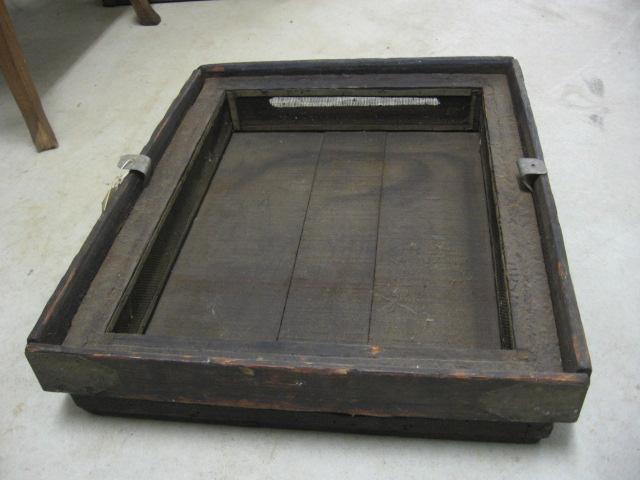
c. 1935 - 1965Rectangular timber box frame with metal mesh inserts nailed into edges.
Edges have an oval shaped longitudinal cut out which is covered by the mesh.
Timber is painted or stained black and is worn in places so timber is visible.
Corners of the frame have been reinforced with external tin brackets nailed over each corner.
The long edges have a flat galvanised steel hook nailed to the outside threaded under the timber and bent at right angles so they stick out past the edges.
Associated with the Cook family, who had established an apiary at Coondle in the Toodyay district by 1902. Used as a migratory cover on a brood hive to prevent bees from escaping while moving from place to place.
In his 1994 oral history (2006.43a,b), Sam Cook describes this lid as a 'Cook transport cover'.
Details
Details
Based on the manufacturing techniques, materials, and hardware visible, this screen likely dates from the mid-20th century, roughly between the 1930s and the 1960s. The solid, wide wooden planks used for the solid sections indicate older commercial milling standards. The simple butt-jointed outer rim secured with nails is consistent with utilitarian farm equipment from the early-to-mid 1900s. The simple butt-jointed outer rim secured with nails is consistent with utilitarian farm equipment from the early-to-mid 1900s. The fine, tightly woven mesh layout on the wire mesh screen seen here points to a post-1930s standard industrial wire weaving.