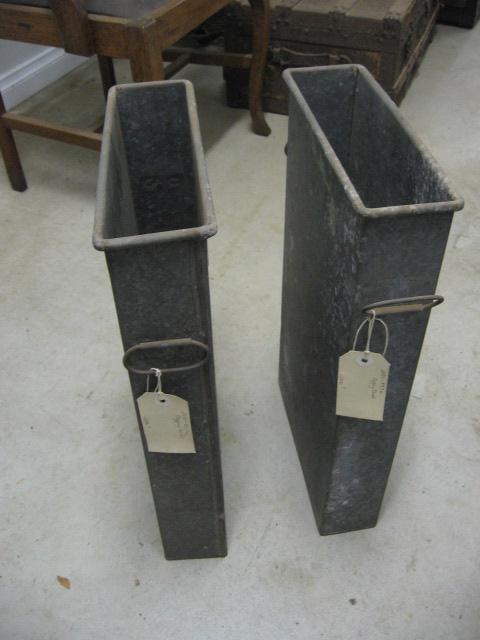
DIPPING TANKS FOR BEESWAX
c. 1965 - 1969Two galvanized steel rectangular tins. Each has a rolled welded lip on top and a welded seam down one corner only.
Small wire elliptical handles are welded on each end.
Each has a brand mark of a circle with a square cross down the middle but without a bottom length.
The circle has a fleur-de-lis cross on top, all in blue ink.
The material used to manufacture was produced between 1961 and the early 1970s based on the specific industrial ink markings. The text fragments decipher as manufacturing stamps from the iconic Australian steel manufacturer John Lysaght (Australia) Pty Ltd.
• 'SAGI' / AUSTRA...: This is part of the original "LYSAGHT / AUSTRALIA" corporate branding stamp.
• GALVABOND: This is the defining clue for dating. GALVABOND® is a proprietary trademark introduced by Lysaght Australia in 1961 to market their new commercial-grade galvanized steel sheets produced via a continuous-coil line.
• 125 OZ: Refers to the zinc coating mass specifications (traditionally measured in ounces per square foot under the old imperial system before Australia transitioned to the metric system in the 1970s)
• SOFT: Indicates the temper grade of the sheet steel, meaning it was a ductile grade meant for easy bending and forming without cracking.
• N2 7973W / 24F: These are internal mill production details, including the heat/batch number, coil tracking number, and sheet dimensions (e.g., a 24-inch width code).
Given the font type and layout of these mill stamps, they most likely date to the mid-to-late 1960s.
Details
Details
Both have lettering printed in blue ink. 'SAGI' / AUSTRA/ GALVABOND/ 125 OZ/SOFT / N2 7973W / 24F" [Assume that the AUSTRA should be Australia as inking was very inconsistent.]
To contain melted beeswax to make thin thin sheets of wax.