

First World War Black and White Photograph of The River Jordan
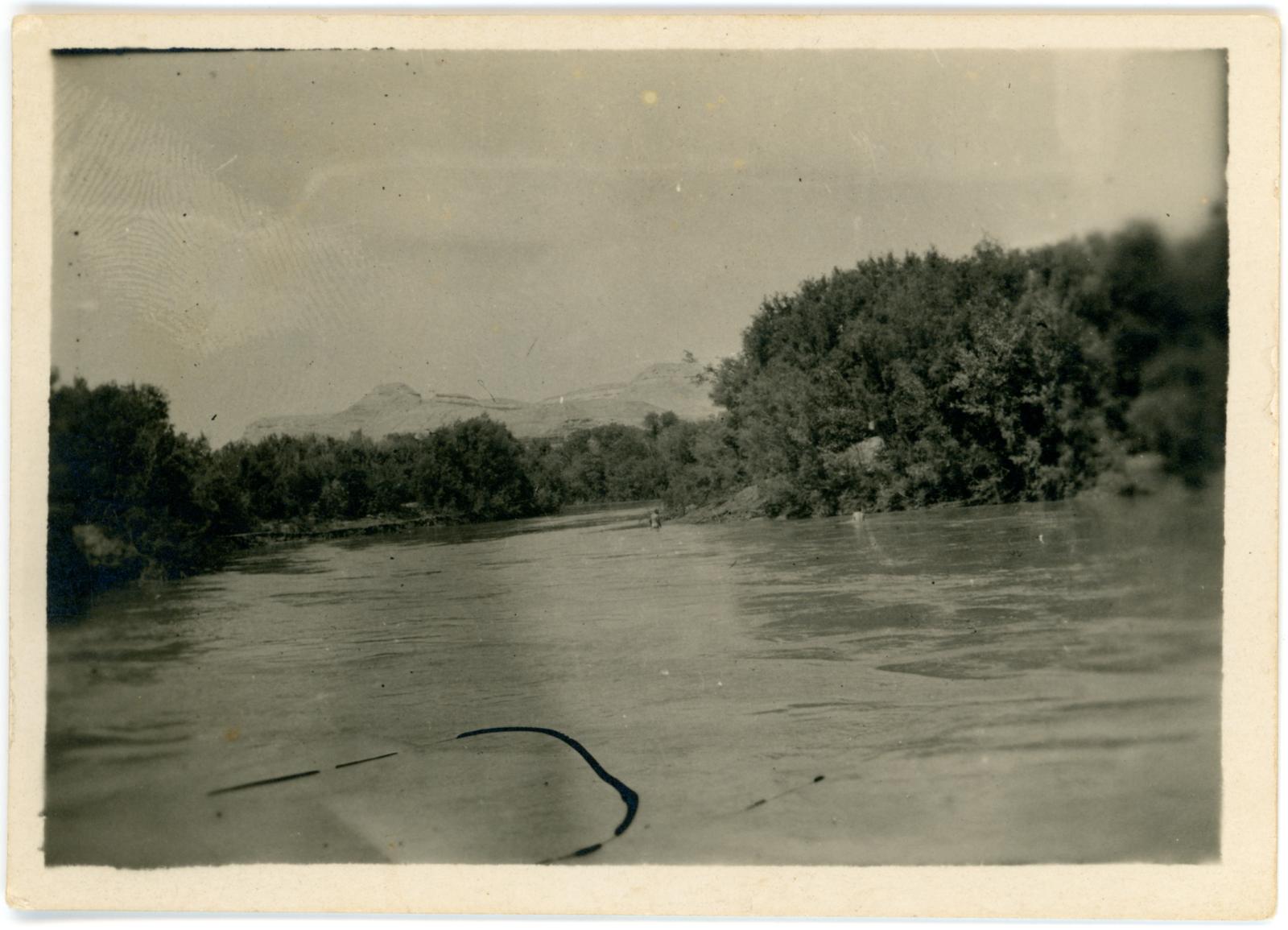
1918 - 1919A small black and white photograph showing a view of a large river with dense trees on either side of its banks and several high hills in the distance. In the water two men are swimming. The water must be reasonably shallow as one man is standing and the water only comes to his buttocks. On the left bank of the river a structure can be seen and is possibly a pontoon. A net and line can also be seen in the river at the front of the image. The image has a white border and is in good condition. The reverse of the image has the proforma printing of part of a postcard and an inscription in black ink.
General Edmund ALLENBY decided that after the capture of Jericho in February 1918 he should strengthen the front line of his Egyptian Expeditionary Force. Operations were mounted out of the Jordan valley in an attempt to capture Amman and another raid was launched towards Es Salt. The valley was also used as a garrison and rest area until September 1918 by the Australian Mounted Division, the ANZAC Mounted Division and the 20th Indian Brigade as part of Lieutenant General Harry Chauvel’s Desert Mounted Corps. Living conditions in the valley during the summer period were extremely unpleasant, with constant heat, high humidity and malaria being a major medical problem for the troops. The river Jordan became somewhere that troops could bathe and cool off.
Details
Details
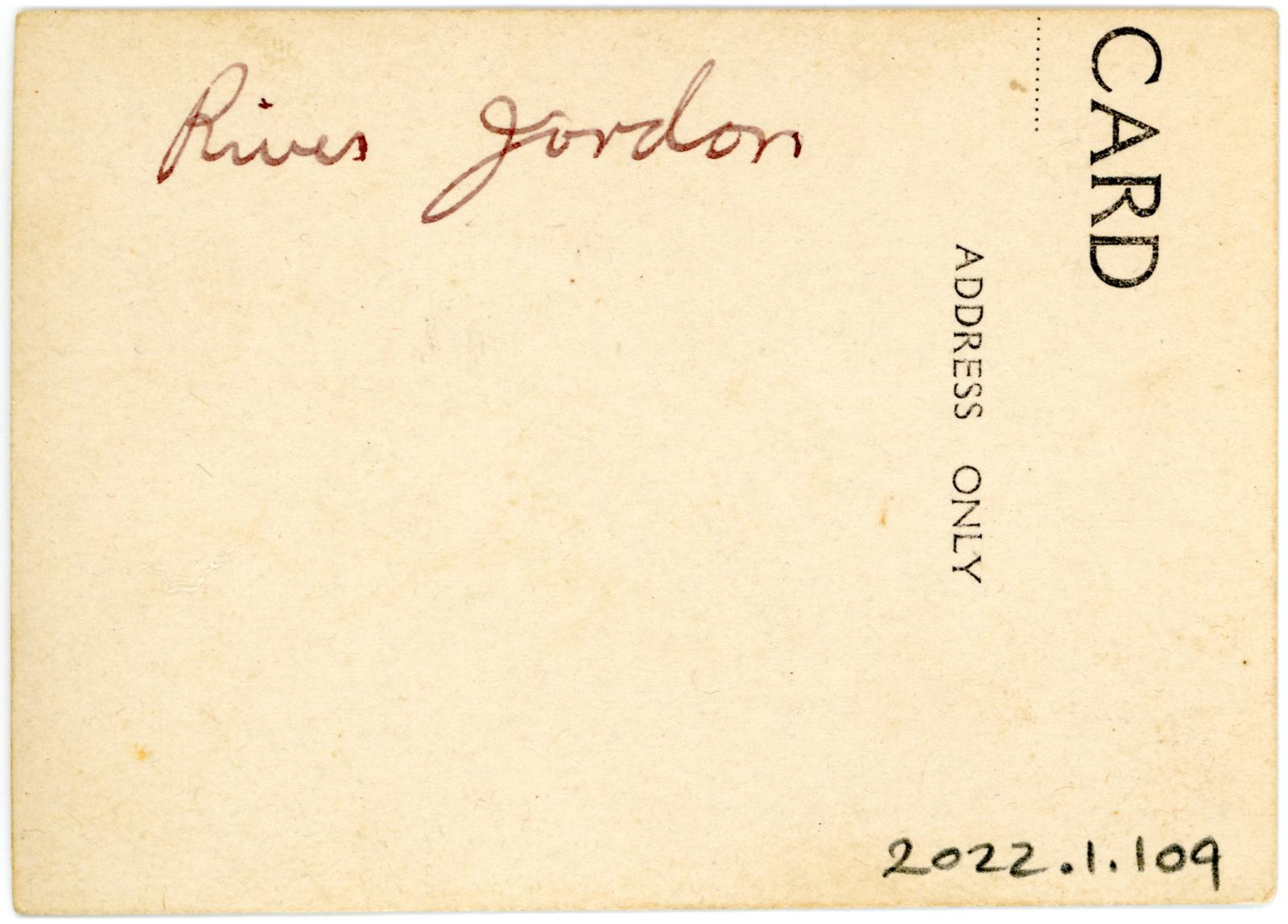
On the reverse in machine printing “CARD/ ADDRESS ONLY” with “River Jordan” written in black ink.
The southern parts of the Jordan Valley were much greener in 1918. Pools of standing water were a breeding ground for mosquitos, causing extensive malaria among the troops, while the atmosphere was damp, hot and oppressive. However, the river also proved a ready and plentiful source of fresh water, and it also supported a lot of wildlife. Major the Lord HAMPTON a squadron commander in the Queen’s Own Worcestershire Hussars (Yeomanry) recalled: “The Jordon afforded bathing, of a tepid and rather slimy sort it is true but still bathing. We also caught many fish of the cat-fish variety. Enthusiastic followers of the gentle art tempted them with bent pins, bully beef and indifferent success. Those who required them merely for the pot used a lobster trap constructed of wire netting and baited with a bully beef tin to which some of the original contents still adhered. This proved very popular with the catfish and as many as forty were taken in one haul. They were not exciting to eat, but were at any rate better than the glucose mess to which the heat of the Valley reduced our Bully ration…”Major the Lord HAMPTON’s memoirs, QOWH Museum.
It should be noted that Sgt F.E. BRUCE of the 3rd Machine Gun Squadron, 10th Light Horse, whose collection includes this photograph, contracted Malaria in August 1918.
Open in Google Maps
Nearest geotagged records:
- Invalid Cup (0km away)
- Peter LONEY Letter (0km away)
- Ellis SILAS Water Colour Painting (0km away)
- Engraved Japanese Water Bottle belonging to Robert George Staunton RENNIE WX7493 (0km away)
- Enlistment Poster (0km away)
- W. D. & H. O. Wills Lace Flag Cigarette Cards (0km away)
- First world War Picture Postcard (0km away)
- Photograph of the Japanese surrender to Australia on 13 September 1945. (0km away)
- Engraved Tin given to Major Arthur Robinson HOME WX11151 (0km away)
- Martini-Henry action (0km away)
Nearby places: View all geotagged records »
Princess Royal Fortress Military Museum
Princess Royal Fortress Military Museum
Other items from Princess Royal Fortress Military Museum
-
First World War Metal Fragment
-
First World War Black and White Photograph of Two Children at Bir el Esani
-
First World War Black and White Photographic Postcard of the Dome of the Rock
-
First World War Black and White Photographic Postcard of the interior of the Basilica of the Ecce Homo Jerusalem
-
First World War Black and White Photographic Postcard Chapel of the Holy Family Matarieh
-
First World War Black and White Photographic Postcard of The Shrine at the Church the Holy Sepulcher
-
First World War Black and White Photographic Postcard of The Golden Gate Jerusalem
-
First World War Black and White Photographic Postcard of Our Lady Roman Catholic Church of Heliopolis
-
First World War Black and White Photographic Postcard of Mohammed Ali Square, Alexandria
-
First World War Black and White Photographic Postcard of the 14th Australian General Hospital
-
First World War Black and White Postcard of Sun Set on the Nile Cairo
-
1967 ANZAC Commemorative Medallion and Certificate of Pte. William John BEER 1509
Scan this QR code to open this page on your phone ->
