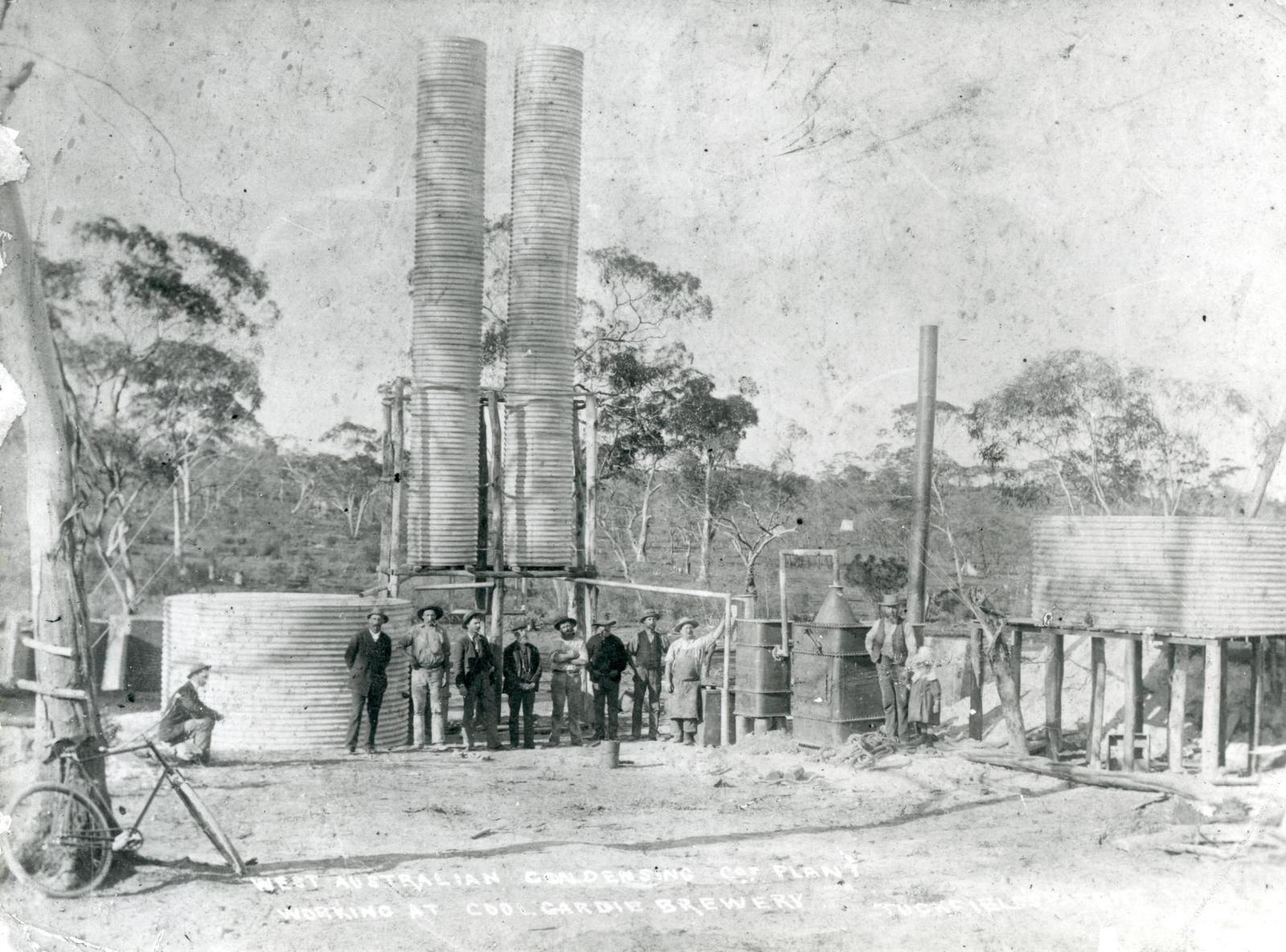
WESTERN AUSTRALIAN CONDENSING CO PLANT, COOLGARDIE BREWERY, C1894
c. 1894A black and white reproduction of a sepia print showing the Western Australian Condensing Co plant working at the Coolgardie Brewery, Coolgardie. Charles Tuckfield, the inventor, stands at the head of the line, with the plant's water supply tank, boiler, condenser, and collection tank in the background.
The Tuckfield patent condenser process is described in detail in the Albany Advertiser on July 8, 1895, and reproduced from The Advertiser (Adelaide) of November 22, 1894. The company offered their 1200-gallon-per-day condenser unit from £450, complete and delivered to Coolgardie.
The main offices of the condenser company were located on York Street, Albany, with agents Messrs Penberthy & Co. in Coolgardie and Mr A.G. Hassel at St. George's Chambers in Perth. The company's original directors were G. Leake, Esq., M.L.A.; A.Y. Hassel, Esq., M.L.A.; J. Moir, Esq., J.P., Mayor of Albany; and J. McKenzie, J.P.
Details
Details
Western Australian Condensing Coy. Plant
Working at Coolgardie Brewery. Tuckfield's Patent 1894-95
The Tuckfield patent story highlights the attempts made to improve existing water condenser processes in the WA goldfields. Tuckfield's process claimed to reduce the price of potable water from 8 pence to a quater-penny a gallon and consume vastly less wood in the process. Timber to fuel conventional condenser plant and traction engines was already running short in the goldfields which was the catalyst for Tuckfield's development of a more efficient process but ultimately, the WA Condenser Coy venture was a business and economic failure.
Harvesting of timber for water desalination condenser boilers and steam engines in the goldfields to provide water for mining operations consumed one of the world's largest and unique dry-land sclerophyll forests, thousands of square kilometres in extent around Kalgoorlie and Coolgardie, which has never returned and is gone forever.
It is a striking paradox that Western Australia's capital city, Perth, whose now-burgeoning population is almost completely reliant on modern desalination to survive, owes its very existence to a historical precursors like: the Tuckfield process, which first unlocked the region's mineral wealth.
Other items from Albany Historical Society Inc
-
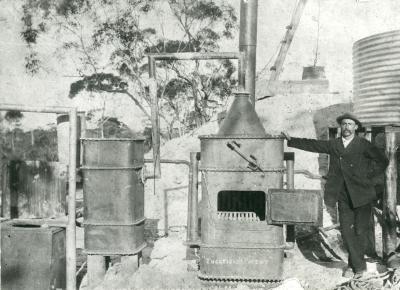
TUCKFIELDS PATENT CONDESNSER, COOLGARDIE, C1894
-
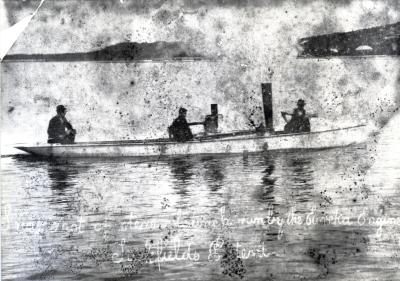
TUCKFIELD PATENT STEAM LAUNCH POWERED BY EUREKA ENGINE, ALBANY, C1899
-
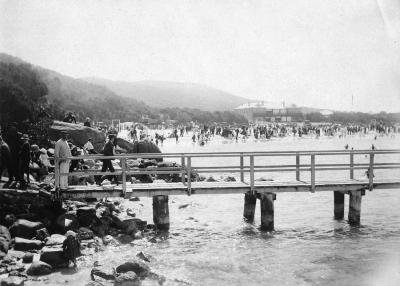
ELLEN COVE JETTY, ESPLANADE HOTEL,MIDDLETON BEACH, ALBANY 1911
-
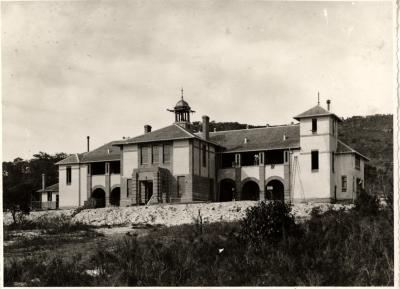
ALBANY SENIOR HIGH SCHOOL, UNDER CONSTRUCTION 1924
-
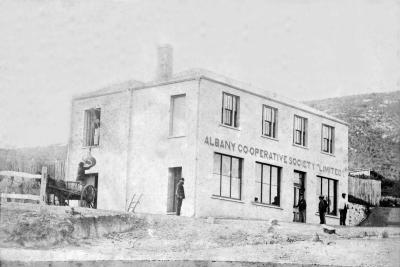
ALBANY CO-OPERATIVE SOCIETY LIMITED, c1870
-
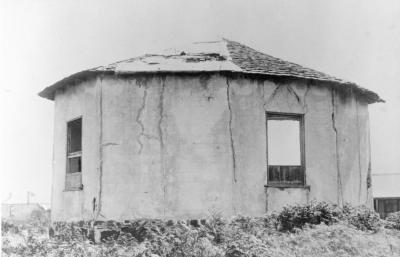
THE OCTAGONAL CHURCH, ALBANY 1893
-
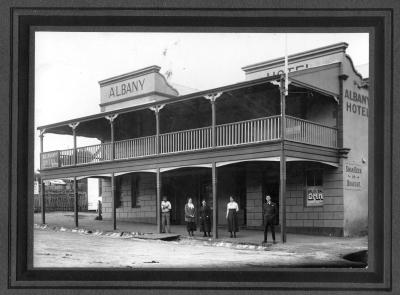
HISTORIC ALBANY HOTEL, 1922
-
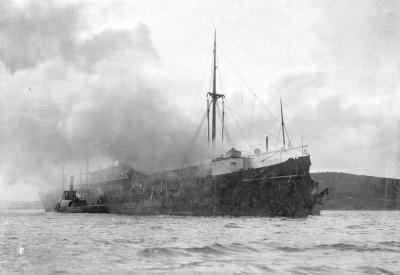
PRINCESS ROYAL HARBOUR, SS JANUS ON FIRE, 1914
-
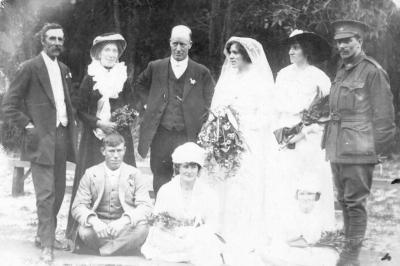
WEDDING PORTRAIT, JACK MOIR & C.L.NEALL
-
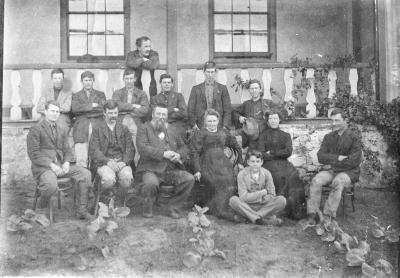
MOIR AND DUNN FAMILY 1912
-
GRIFFITHS, SELINA AND FAMILY GROUP, FLAG POLE
-
POLICE BARRACKS, GOVERNOR'S RESIDENCE, ALBANY