
Clock, Wall - Ansonia Clock Company New York
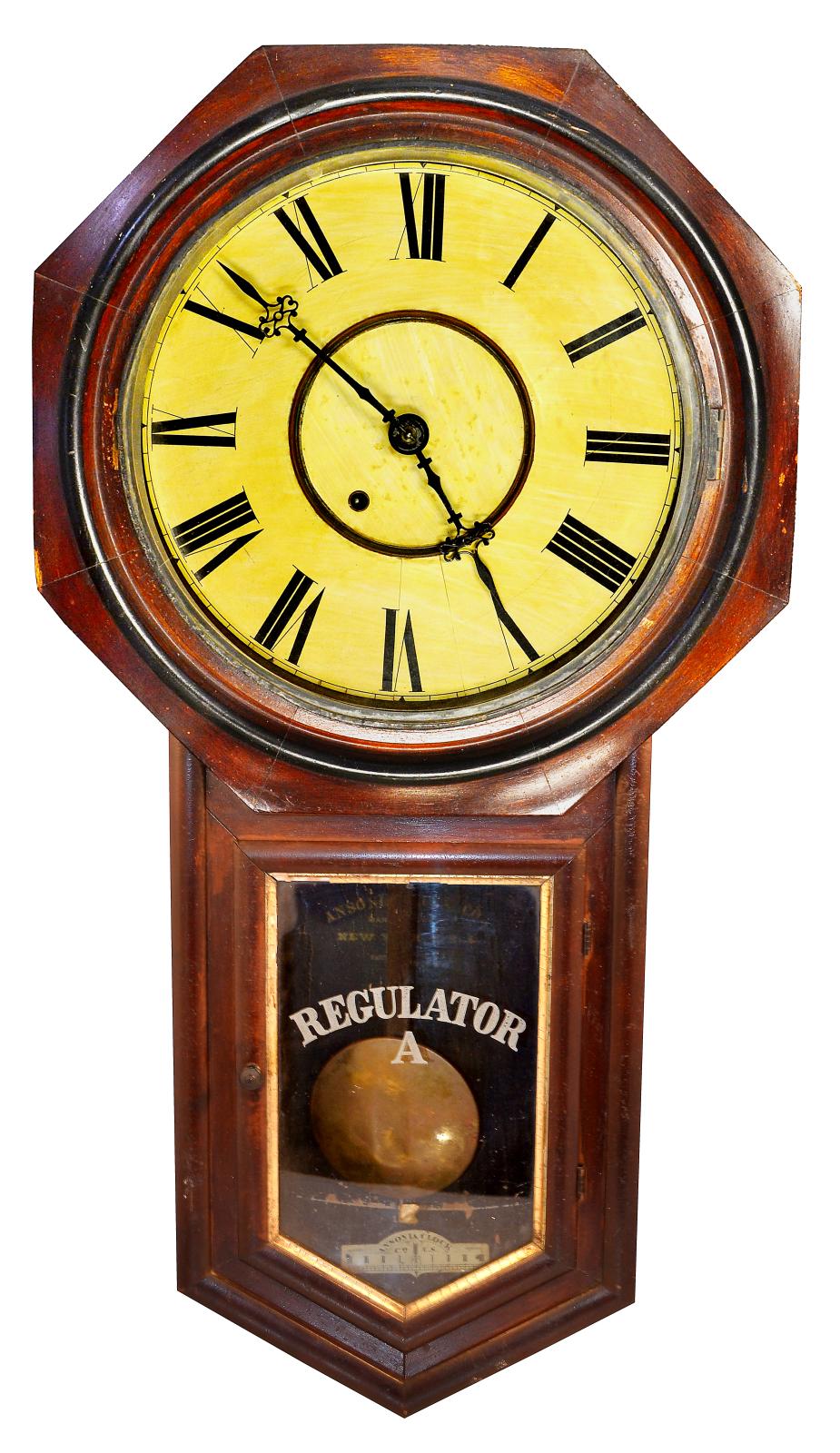
Main case is made from wood and is a basic rectangular shape with a triangular extension at the bottom which frames an aperture housing the pendulum. A hinged, glass door is fitted to the aperture. The white clock face with black Roman numerals and mechanism is above the door fitted into a large octagonal panel wider than the case and has a raised circular lip with a groove adjacent to the glass door to allow access to the winding mechanism.
There are three sets of text on this item:-
1 Glass door
2 Inside in the pendulum housing.
3 Small plaque at the base of triangle cream with black lettering and Roman numerals.
Restored by Barry Blacklow was on the data base but there is corroborating evidence.
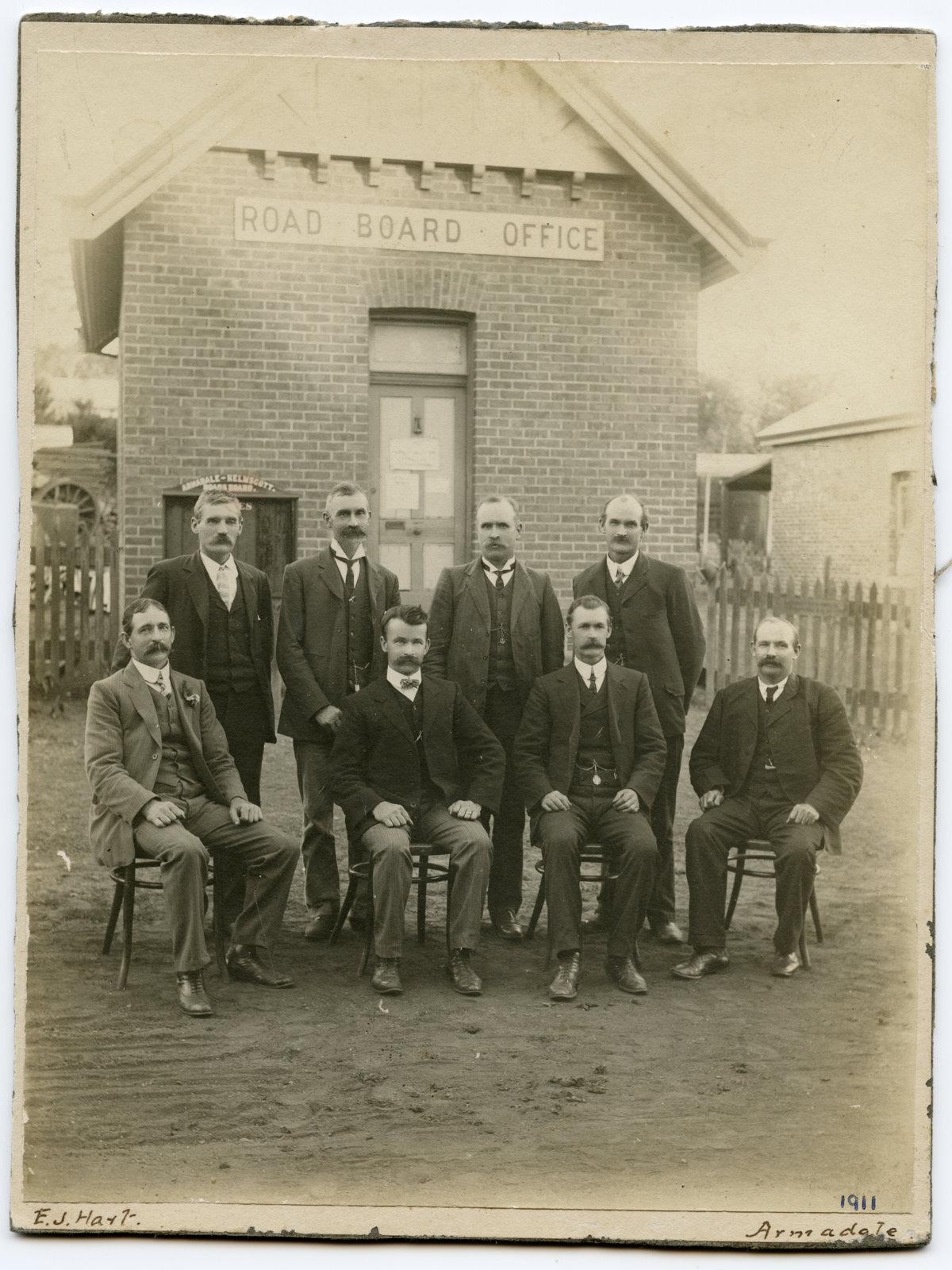
This clock was donated to History House Museum by the Shire of Armadale Kelmscott in 1978. It was used in the Roads Board Building from 1903.
The Armadale–Kelmscott Roads Board was established in 1894 as the Kelmscott Roads Board, formed from part of the Canning Roads Board during a period of regional growth fueled by the Western Australian Gold Boom and expanding railway infrastructure. In 1903, the board built a dedicated office in Armadale, reflecting the town’s rising prominence, and in 1910, it was renamed the Armadale–Kelmscott Roads Board to better represent the area it served. The board’s responsibilities extended beyond road maintenance to include managing community services like the Kelmscott District Cemetery after its board was dissolved in 1911. Following the Local Government Act of 1960, the board evolved into the Shire of Armadale–Kelmscott in 1961, later becoming the Town of Armadale in 1979 and achieving city status in 1985. The former Roads Board office remains a heritage-listed symbol of the region’s early local government and administrative history in Western Australia.
Built in 1903, the Armadale–Kelmscott Roads Board Office marked a shift in local governance from Kelmscott to Armadale as the administrative centre. Originally serving the Kelmscott Roads Board established in 1894, the building became home to the renamed Armadale–Kelmscott Roads Board in 1910. Designed in the Federation Free Classical style, the brick and rendered structure symbolized growing regional development and civic pride. The office remained the hub of local government until 1961, when the board transitioned into the Shire of Armadale–Kelmscott. Today, it stands as a heritage-listed site, preserving the early administrative history of the area.
The Ansonia Clock Company, founded in 1850 in Ansonia, Connecticut, began as a subsidiary of the Ansonia Brass Company, producing brass clock movements that revolutionized the industry. In 1877, it became an independent entity and relocated to Brooklyn, New York. By the late 19th century, Ansonia was producing millions of clocks annually in a wide range of styles, including mantel, wall, carriage, and novelty clocks. Renowned for ornate cases in cast iron, wood, marble, and celluloid, Ansonia clocks blended mechanical precision with artistic design. Sold worldwide, they remain highly collectible and are valued as icons of American industrial craftsmanship.
The Ansonia “Octagon Drop Regulator A” was produced between approximately 1890 and 1910 and features a distinctive octagonal upper bezel, typically crafted from oak or walnut, and a rectangular drop case housing the pendulum. The round dial, paper over metal, displays Roman numerals beneath a glass panel, while the lower glass is prominently stencilled in gold with “REGULATOR A.” These regulator wall clocks housed 8-day time-only or time-and-strike mechanical movements, either spring- or weight-driven, often marked “Ansonia Clock Co., New York, USA.” A polished brass pendulum bob, adjustable for accuracy, is visible through the lower glass. Known for their precision, these clocks were commonly used in schools, railway stations, and government offices. The octagonal design allowed for easier wall-mounting and added visual appeal. Highly collectible today, especially in original condition, they can range in value from $460 to $1380 AUD, with earlier weight-driven examples and uncommon wood finishes commanding higher prices.
The clock was restored by Barry Blacklow a HHM volunteer.
Details
Details
Text;
on Glass Door: [REGULATOR / A]
on Inside Pendulum Housing: [ANSONIA CLOCK CO,. / MANUFACTURES / NEW YORK, U.S.A. / FACTORIES / Brooklyn N.Y. / Ansonia Conn.]
on Small Plaque at Base: [ANSONIA CLOCK / Co U.S. / III II I an arrow pointing down I II III]
The Ansonia “Octagon Drop Regulator A” clock, produced between 1890 and 1910, is a significant artifact illustrating both American industrial craftsmanship and the local governance history of Armadale, Western Australia. Manufactured by the renowned Ansonia Clock Company, known for its innovative brass clock movements and diverse, ornate designs, this clock features a distinctive octagonal bezel and precise 8-day mechanical movement.
City of Armadale - History House
City of Armadale - History House
Other items from City of Armadale - History House
-
HOLDER, CANDLE - PRESSED TIN
-
TOBACCO BOX
-
WOODEN CHEST
-
CLOCK, MANTEL - WM. I. GILBERT CLOCK CO.
-
PRESENTATION WALLET
-
CLOCK, WALL - MADE IN WURTTEMBURG
-
HOLDER, CANDLE - WHITE ENAMEL
-
CARDBOARD FAN
-
HAT BAND - ARMDALE FOOTBALL CLUB 1923 PREMIERSHIP

-
HELMET, BRASS - FIREMAN'S
-
Trowel, ceremonial

-
WATCH, POCKET
Scan this QR code to open this page on your phone ->
