

CLOCK, MANTEL - WM. I. GILBERT CLOCK CO.
1896 - 1978Clock mechanism and pendulum housed in a rectangular box with a hinge glass front with a gilt pattern akin to drawn curtains on the lower half. The clock face is white with black Roman numerals and black hands and a pendulum with floral pattern weight.
Mechanism box is mounted on a pyramidal base and is surrounded side and top pieces of irregular shape. All surfaces are ornately carved with swirls and floral pattern.
Clock was donated to History House by Gwen Blackburn (nee Richards), who is the daughter of John Alfred Richards. The clock was brought to Western Australia by Mr Richards when he moved here from South Australia about 1890.
John Alfred Richards was born in Burra, South Australia, on 19/03/1869. He married Edith Mary Dix in Horsham, Victoria, in 1892. By 1898 they had moved to Western Australia and in 1901 he was working as a schoolteacher in Wagin. In 1910 he moved to Guildford where he was again working as a schoolteacher. From about 1917 John Alfred Richards was appointed the Headmaster of Armadale State School, a position he held until about 1930, when he retired from teaching and moved to Leederville. He died on the 16/09/1948, just four months after his wife. The clock was passed onto his daughter Gwendoline.
Gwendoline Edith Richards was born in 1902 in Wagin, Western Australia, the daughter of John Alfred and Edith Mary Richards. She married Robert Keith Blackburn in 1929 in Perth and they lived in Armadale virtually all their lives. The clock was kept in the family kitchen. She died in Armadale in 2001 at the age of 98.
The Wm. L. Gilbert Clock Company was a prominent American clock manufacturer based in Winsted, Connecticut, with origins dating back to 1828. Founded by William L. Gilbert, the company evolved from a series of early clockmaking partnerships into a major enterprise, officially becoming the Wm. L. Gilbert Clock Company in 1871. Gilbert specialized in producing affordable, reliable clocks for the mass market, making quality timepieces accessible to middle-class households across the United States and abroad.
The company’s extensive range included shelf and mantel clocks, wall regulators, schoolhouse clocks, alarm clocks, and decorative “gingerbread” clocks with pressed wood fronts. Many featured brass mechanical movements, paper or painted dials, and ornate wooden or marble cases. Gilbert clocks were known for blending functionality with attractive, often intricate designs, aligning with Victorian-era tastes and the growing demand for decorative household items.
At its peak in the late 19th and early 20th centuries, Gilbert was one of the largest clock manufacturers in the country, rivalling Seth Thomas, Ansonia, and New Haven. However, the company struggled during the Great Depression and went bankrupt in 1932. It was later reorganized and continued operations in various forms until the early 1960s.
Today, clocks made by Wm. L. Gilbert are valued for their craftsmanship, historical context, and representation of American industrial and decorative arts. They are held in both private collections and museums, offering insight into domestic life, technological progress, and design trends in the late 1800s and early 1900s.
This mantel clock, identified as Model No. 161, was manufactured by the Wm. L. Gilbert Clock Company of Winsted, Connecticut, shortly after April 28, 1896, the date noted on its patent label. A paper sticker affixed to the back of the case confirms the maker, model number, and patent date, along with Gilbert’s registered diamond-shaped "G" trademark. The Wm. L. Gilbert Clock Company, founded in the early 19th century and incorporated in 1871, was one of America's leading clock manufacturers, known for producing decorative and affordable clocks during the Victorian era. This clock is a fine example of a Parlor or kitchen clock from the late 19th century, with a pressed wood case intricately adorned with floral and scroll motifs. The date of manufacture of the clock is likely between 1896 and 1899. The clock face is white with black Roman numerals and hands, housed behind a hinged glass door. The lower glass panel features a gilt stencil in the shape of drawn curtains, a popular design feature of the time. Inside, a mechanical movement powers an ornate, floral-patterned brass pendulum. These features are characteristic of Gilbert's domestic clocks, designed to appeal to middle-class households seeking elegance and functionality. Model 161 exemplifies the era’s fusion of industrial production and artistic detail, typical of the post-Gold Rush boom in American consumer goods. Surviving examples like this are increasingly rare, particularly with original labels and decorative elements intact. This clock is not only a functional timepiece but also a decorative object reflecting both the craftsmanship and domestic values of its time.
The Gilbert Model No. 161 mantel clock is both rare and representative. It typifies the style, materials, and craftsmanship of American mass-produced clocks from the late 19th century, reflecting the design preferences and technological advances of the Victorian era. No other known examples of this specific model was found in an online searcgh of public collections in Australia or New Zealand, making it a rare surviving specimen. Its original patent label, decorative gilt glass panel, and ornate pressed wood case remain intact, enhancing its historical integrity. As such, it represents both a broader global manufacturing trend and a uniquely preserved artifact within an Australian context. A mantle clock by the same manufacturer but different models can be found in the collections of the Western Austrlaian Museum, The Australian Fund (NSW), Henry Kendall Cottage & Historical Museum (NSW), Port Chalmers Maritime Museum (NZ), Cromwell Museum (NZ), Western Bay Museum (NZ) and Te Hikio Museum (NZ).
Details
Details
This late 19th-century mantel clock, Model No. 161, manufactured by the Wm. L. Gilbert Clock Company of Winsted, Connecticut, holds historical, technological, aesthetic, and local significance. Produced shortly after its 1896 patent date, the clock exemplifies the decorative domestic timepieces popular with Victorian-era middle-class households. It features a pressed wood case with floral and scroll motifs, Roman numeral dial, gilt stencil-glass panel, and a brass pendulum—hallmarks of Gilbert’s affordable yet artistically refined designs.
City of Armadale - History House
City of Armadale - History House
Other items from City of Armadale - History House



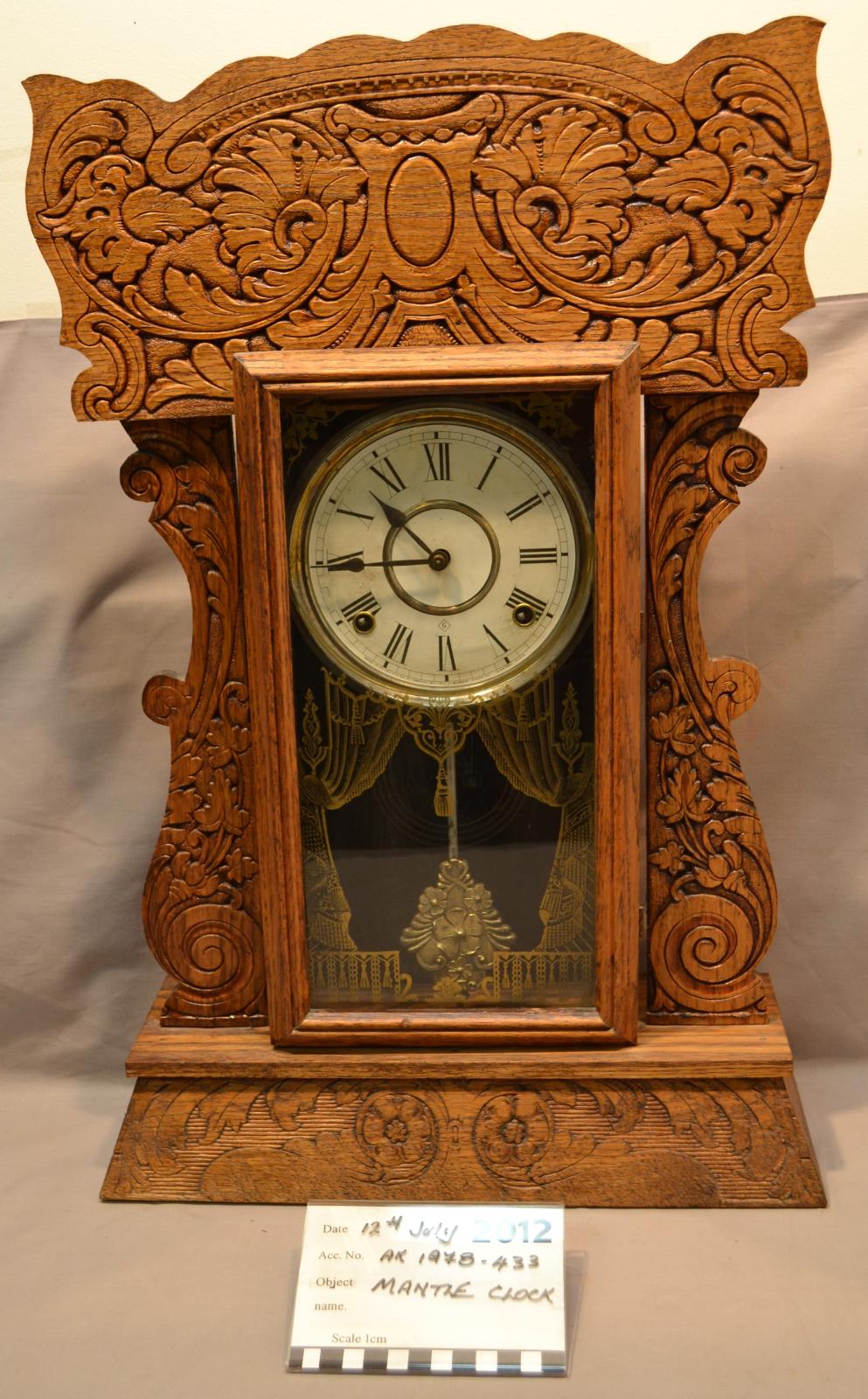
Mechanism box is mounted on a pyramidal base and is surrounded side and top pieces of irregular shape. All surfaces are ornately carved with swirls and floral pattern.
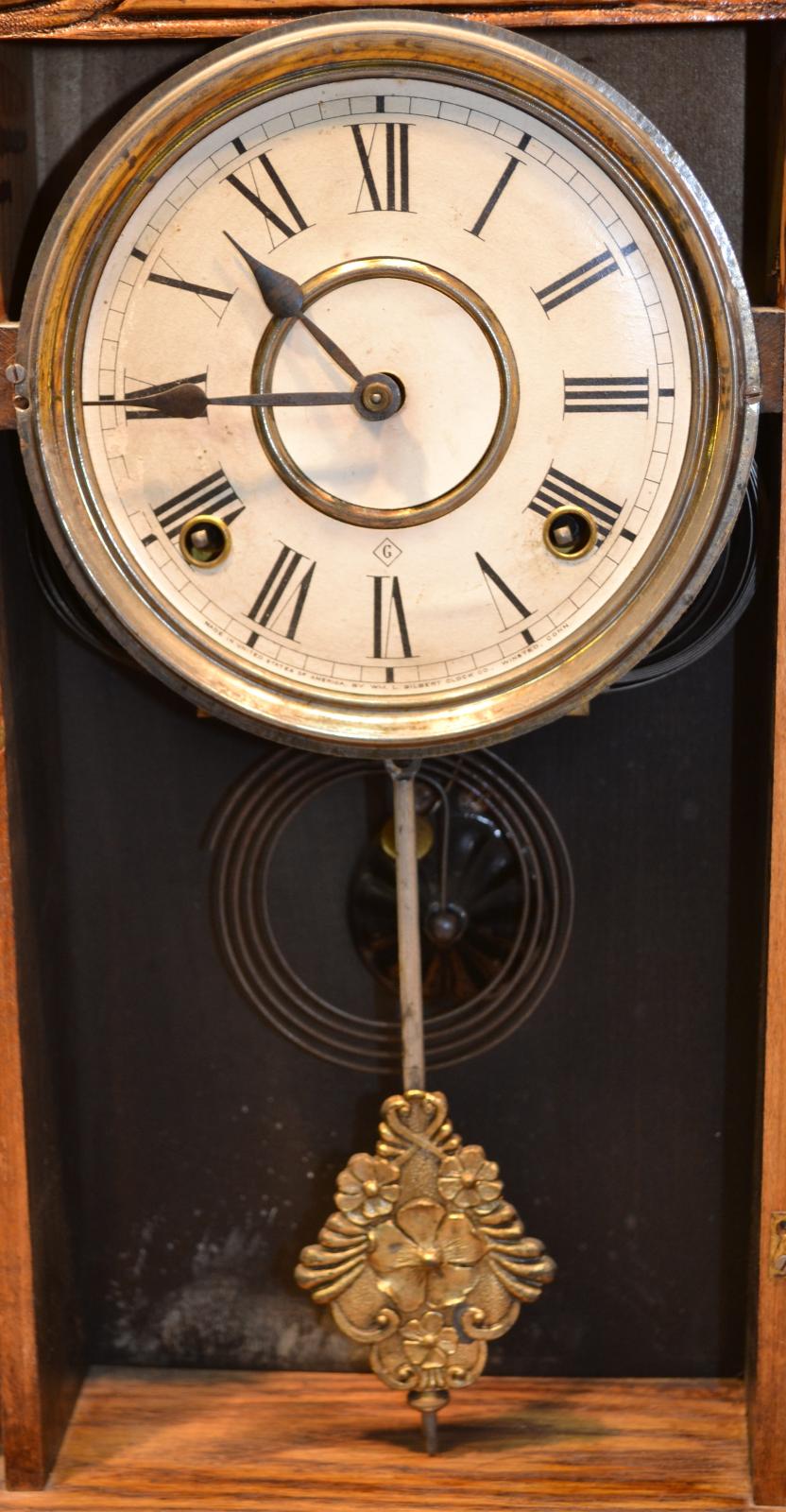
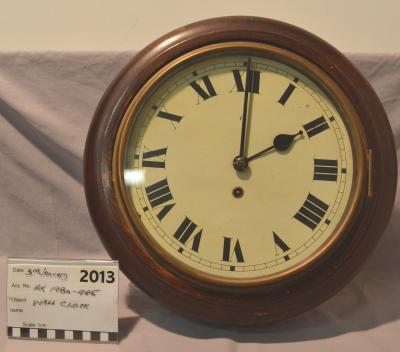
The clock face is white with black Roman numerals and black hands and a pendulum with floral pattern weight.
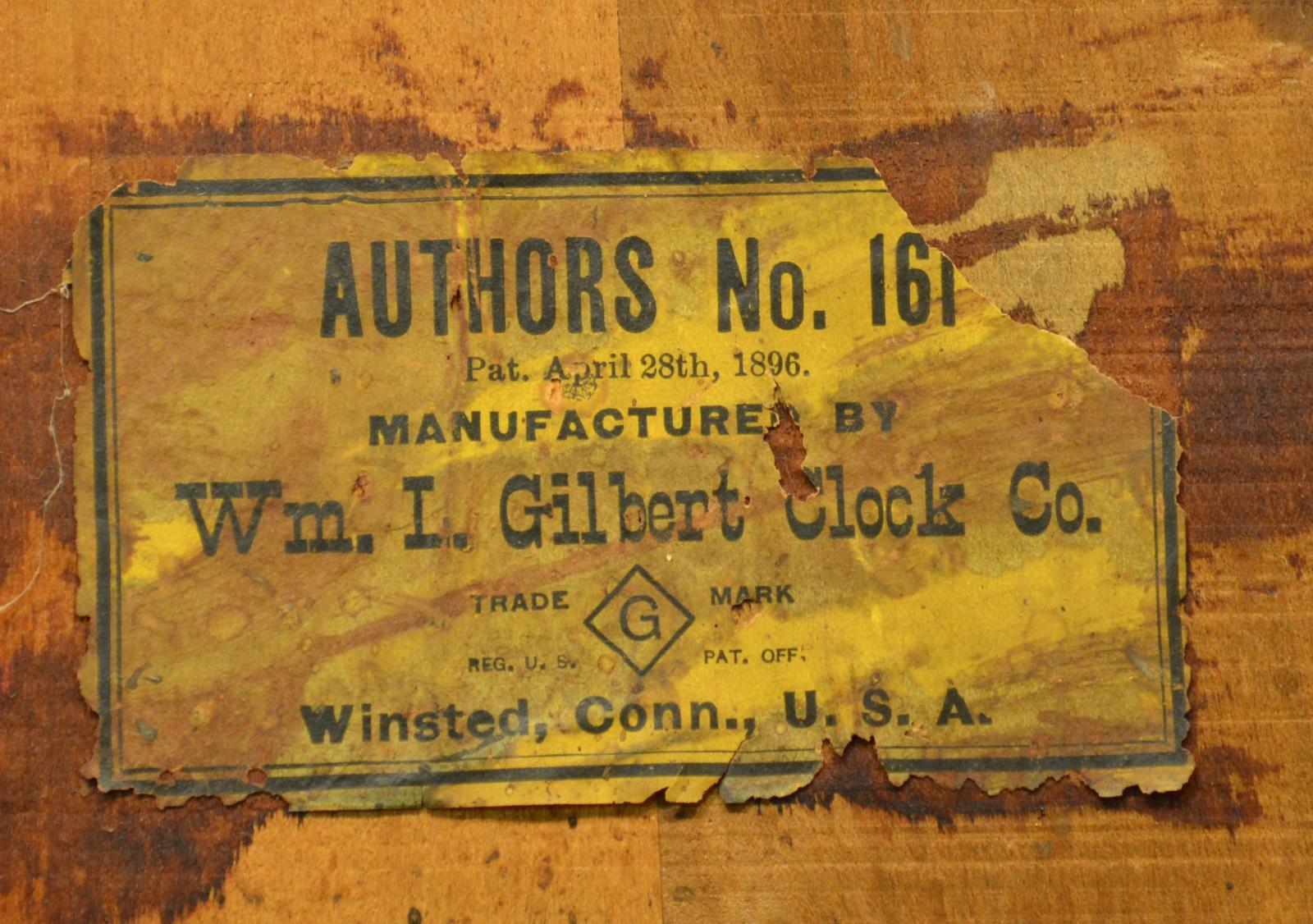
"AUTHORS No. 161 [corner of sticker torn off]" / "Pat. April 28th 1896" / "MANFUCATURED BY" / "Wm. I. Gilbert Clock Co." / "TRADE G MARK" / "REG. U.S. PAT. OFF." / "Winsted, Conn., U.S.A."
Scan this QR code to open this page on your phone ->
