

Clock, Wall - Ship's Bell
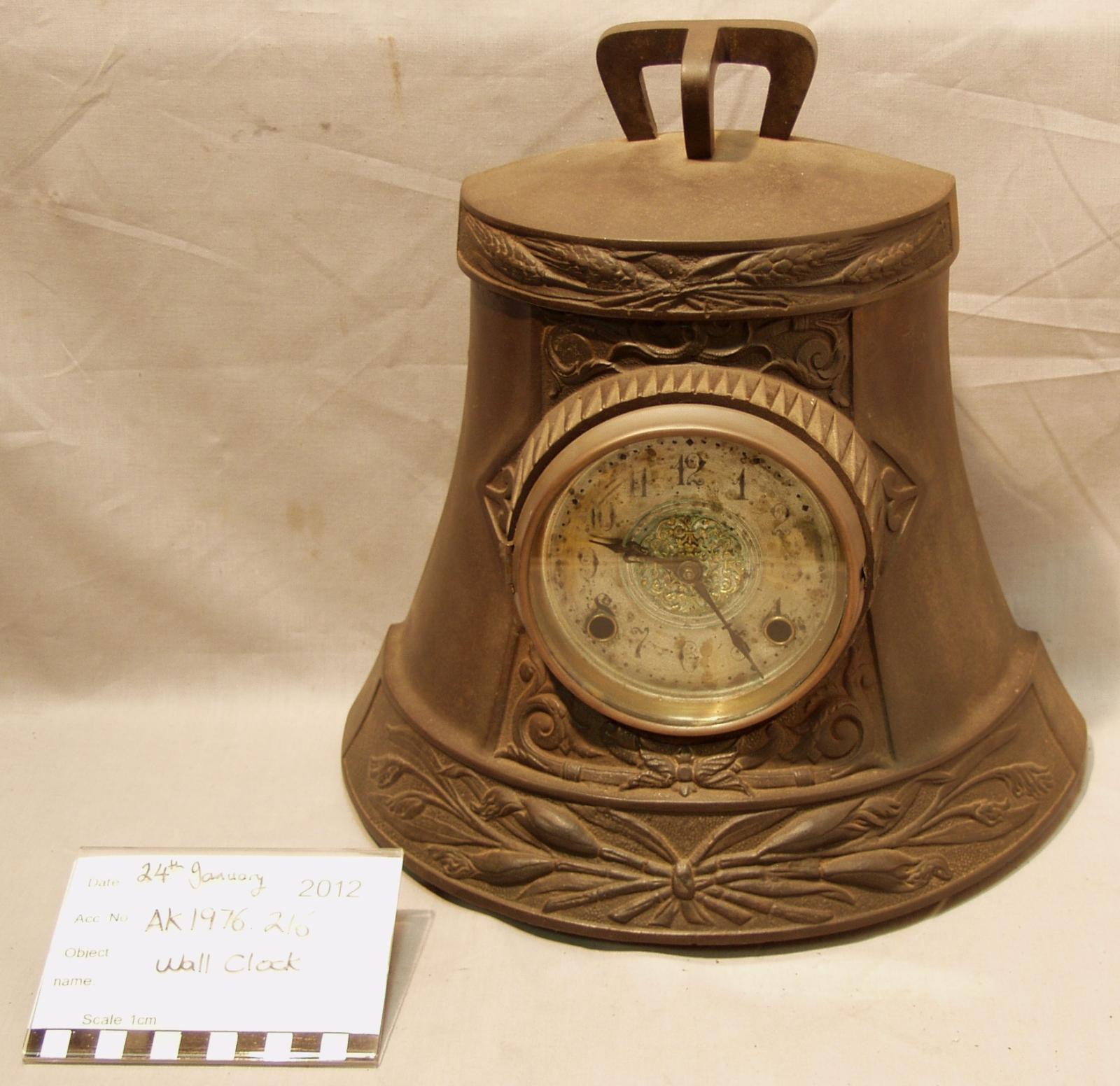
1900 - 1915Bisected ships bell ornately patterned around the mouth, a narrow band either side of the cylindrical protrusion added mid point to accommodate a clock mechanism. Ornate pattern is repeated around the crown. The dial was silvered with black Arabic numerals but is faded.
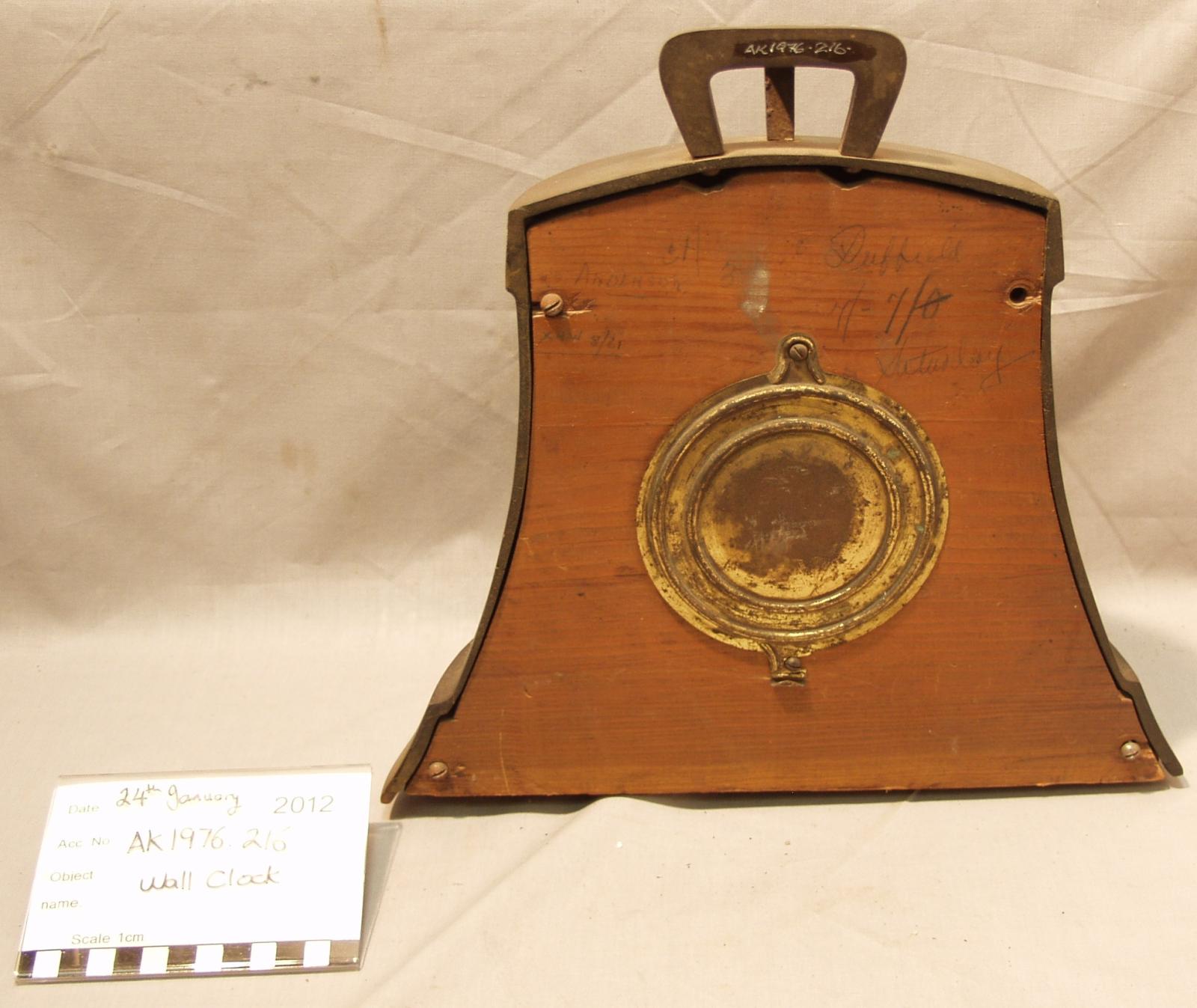
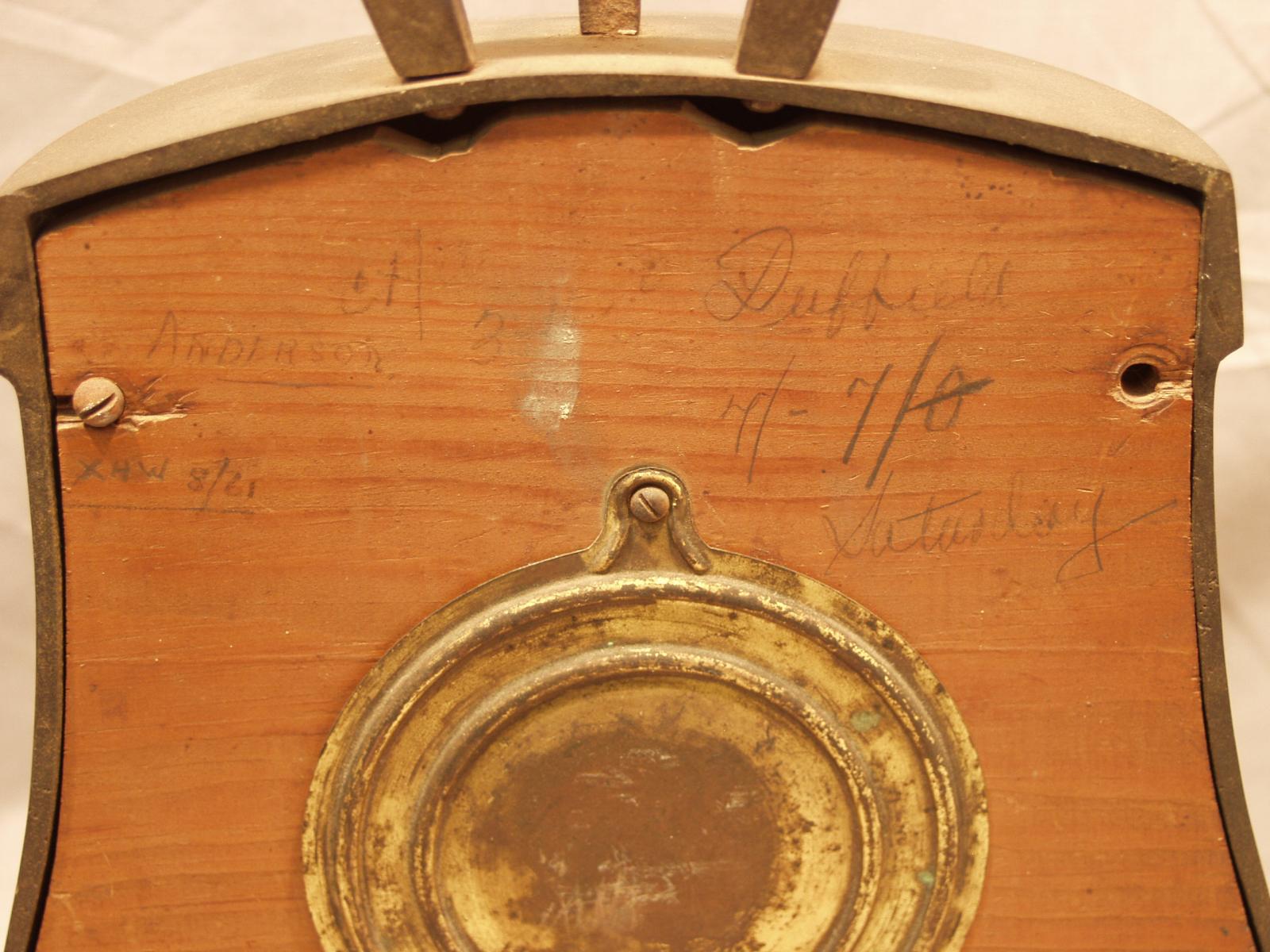
The back and bottom is enclosed by wood panels with some indecipherable lettering in pencil. A circular metal panel which allows access to the mechanism is hinged at the top and secured by a screw at the bottom
This item is a Mantel Clock made by the New Haven Clock Company of Connecticut, USA.
The New Haven Clock Company was established in 1853 and became one of the most prolific clock manufacturers in the United States. Originally supplying movements to the Jerome Manufacturing Company, New Haven took over the firm's operations after its collapse. By the late 19th and early 20th centuries, the company was producing a wide array of affordable timepieces and exporting them across Europe, South America, and Australia. Known for their blend of reliability, aesthetic appeal, and industrial efficiency, New Haven clocks became household staples globally. The company began producing electric clocks in the 1930s and ceased operations in 1956, with residual business continuing into the 1960s.
The trademark stamped on the clock consists of a double circle containing a six-pointed star (hexagram) with “New Haven” above, “Trade Mark” below, and “U.S.A.” outside the circle. This mark was typically used from c.1890 to 1935 and is associated with clocks intended for both domestic and export markets.
The item is a maritime-inspired mantel clock shaped like a vertically halved ship’s bell. The case is made of cast iron, a material frequently used by New Haven for durable, decorative novelty clocks. The bell form was typically mounted on a flat backplate, intended for display on a shelf or mantel. This clock style reflects early 20th-century tastes for themed and figural timepieces that blended function and ornamental design.
A visible patent mark reading “Pat’d Nov 28, 1876” is found on the bezel or dial surround. While this date refers to a specific component, not the clock as a whole, it suggests the use of long-standing designs and moulds common in mass production. New Haven frequently reused parts marked with 1876 patents into the early 20th century.
While this record pertains to a general model type, individual clocks with similar markings were widely distributed internationally, including in Australia — a known export destination for New Haven. Given the makers mark and clock design, it is estimated that the clock would have been produced between 1900-1915.
The clock was the property of Lydia Mary Duffield, who was born in Fremantle WA in 1847. Lydia was the daughter of Samuel Bidgood Duffield and Eliza Backshall. Her father Samuel was born in England and arrived in the Swan River Colony with his family in about 1830, making him one of the very earliest settlers in the colony. He was a lighthouse-keeper at Rottnest Island for many years.
Lydia Duffield never married and passed away in 1927 at North Fremantle, having lived her entire life in Western Australia. For 16 years she was Superintendent of the Perth Girls’ Orphanage until resigning in 1887. She was then a schoolteacher in various parts of the State until her retirement.
This clock was passed to her sister, Mrs E. Brown, on her death. It has been kept in their family until it was donated by Robert Brown of Como WA.
Details
Details
"1/3" / "Anderson" / "XAW 8/61"
"Duffield", "7/- 7/0" / "Saturday"
This maritime-themed mantel clock, made by the New Haven Clock Company of Connecticut, USA, is of considerable historical and interpretive value due to its rarity, provenance, and broader cultural associations. Shaped like a ship’s bell and made of cast iron, it reflects the early 20th-century international popularity of novelty and figural clocks that blended function with decorative appeal. Bearing the New Haven maker’s mark and a patent date of 1876, the clock exemplifies the company's mass-production methods and global reach, including exports to Australia.
City of Armadale - History House
City of Armadale - History House
Other items from City of Armadale - History House

Scan this QR code to open this page on your phone ->
