

LAMP, CARBIDE
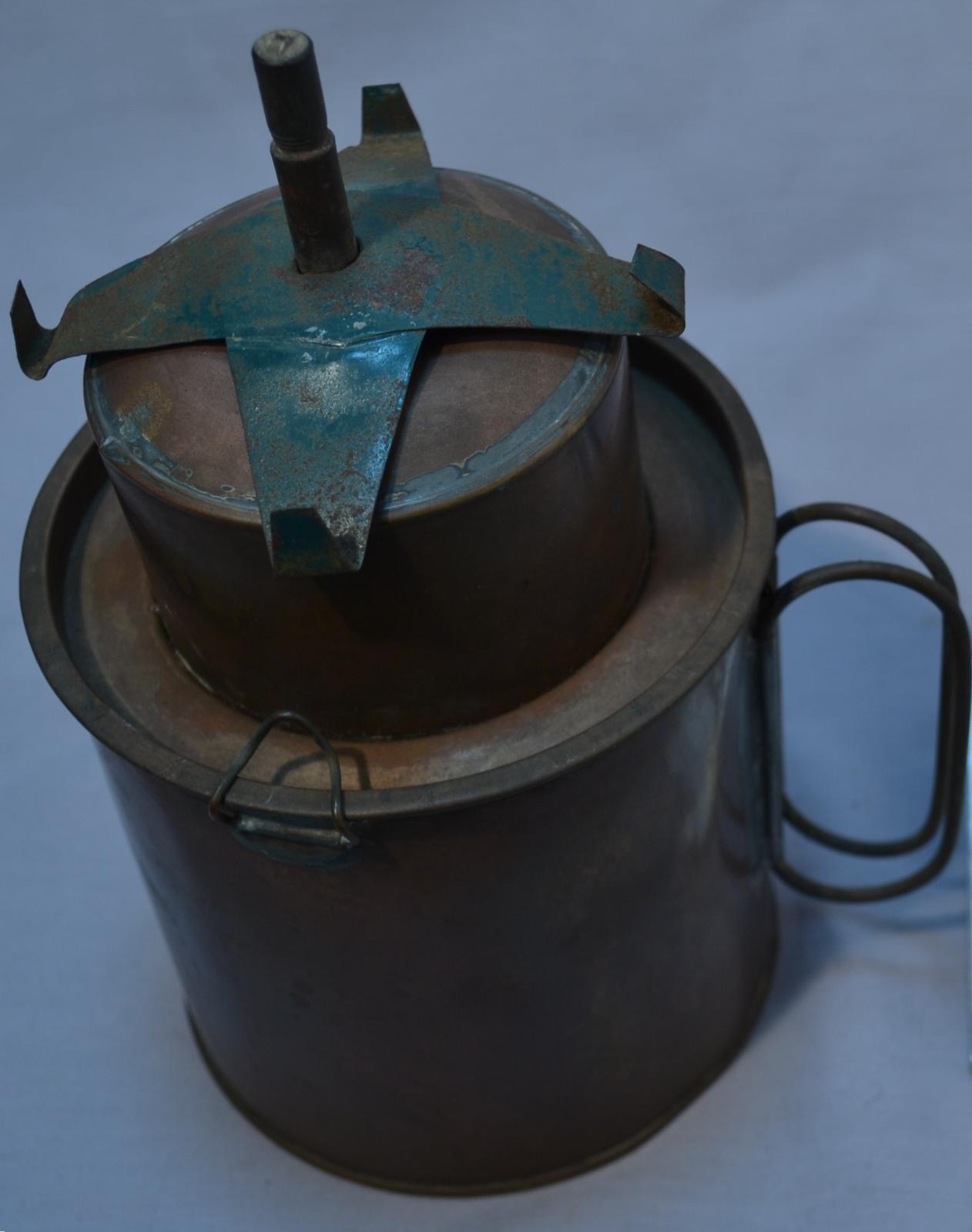
3 piece set. A copper outer, central sheath, fitting to hold lamp glass, clips, double handles, green base.
Victor Claude Evans (some records have his name as Victor Charles Evans), born 30th April 1893, in Molong, NSW, was the son of Charles Henry and Marcia Alice Finch. In 1916, he worked as a farmhand in Doodlakine, WA, while his parents lived in Cottesloe Beach, WA. He enlisted in the AIF during WW1 and served with the 51st Battalion. After being wounded twice (in 1917), he returned to Australia in 1918 and was discharged in February 1919. In 1923, Victor married Kuhio Therese Violet (Betty) Paget in Perth, WA. By 1941, he was a labourer in Harvey, WA, and enlisted with the 2nd AIF during WW2, serving until 1944. Between 1949 and 1958, they lived in Armadale, WA, and from 1968 to 1977, in Roleystone, WA. Victor passed away in 1982 at 90 and was buried in Fremantle Cemetery, WA.
Carbide lamps are powered by the reaction of calcium carbide (CaC2) with water (H2O). This reaction produces acetylene gas (C2H2) which burns a clean, white flame. Carbide lamps were widely used for lighting in mining, bicycles, and other applications before widespread electric lighting became available. Today, they are still used by a dedicated subculture of spelunkers (cave explorers) due to their high light-for-weight ratio.
Details
Details
This carbide lamp represents a key technological transition from candlelight to more advanced lighting solutions in the early 20th century. Powered by the reaction of calcium carbide with water to produce acetylene gas, carbide lamps were widely used in mining, as well as for cycling and cave exploration before the widespread adoption of electric lighting. This lamp is a reminder of an era when such innovations provided bright, reliable illumination in places where electric lighting was unavailable.
City of Armadale - History House
City of Armadale - History House
Other items from City of Armadale - History House
Scan this QR code to open this page on your phone ->
