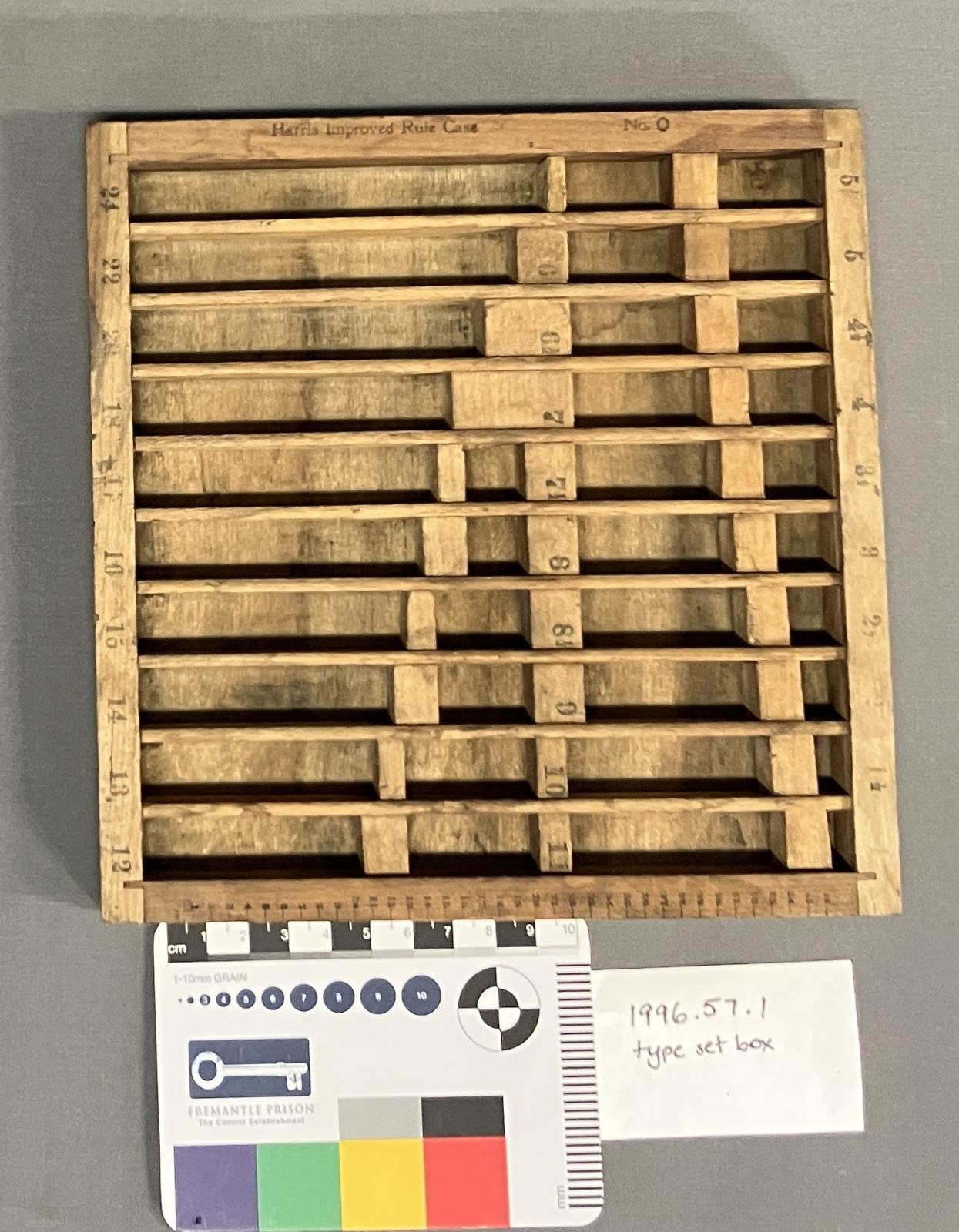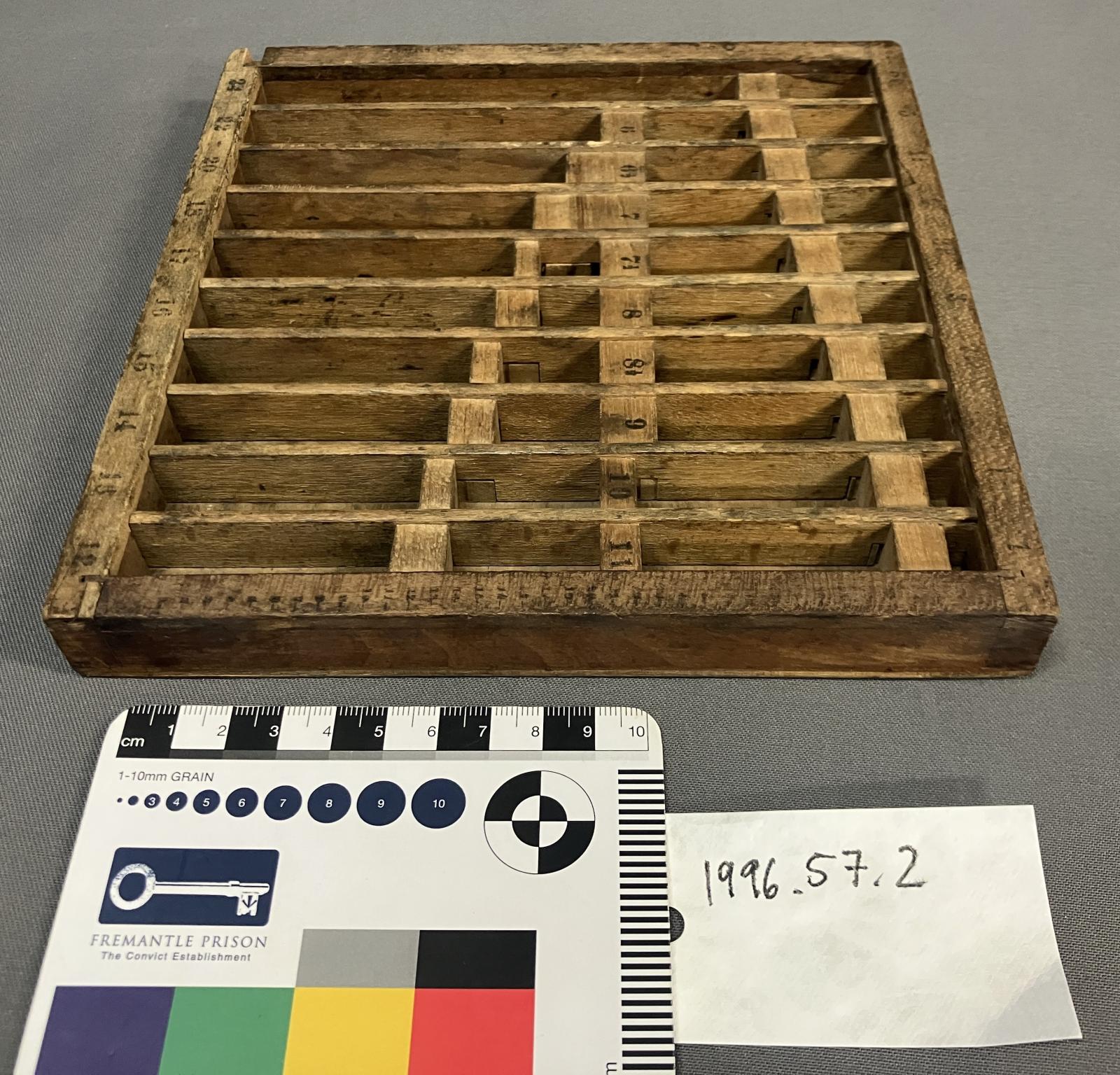
wooden trays for printing type
1891 - 1904The objects are two wooden trays for holding metal printing type. The trays both measure 193 mm wide by 488 mm high by 23 mm deep and feature the same construction details, namely a wooden frame and plywood base, held together using 14 nails. Compartments are divided by slats of plywood into 10 rows, which are further divided by small slats into 36 compartments of differing sizes. The top, bottom and one of the side edges of the tray, as well as the blocks in the middle row, have numbers hand printed in black marking pen on them. The remaining edge has the name of the item printed in black; ‘Harris Improved Rule Case No.0’. The base of the item has the makers marks embossed; ‘HAMILTON/ TWO/ RIVERS WIS.’.
The trays are very similar and are both in fair condition, showing wear indicative of use, but no damage.
The trays were left onsite at the prison when it closed in 1991 and were exhibited as part of the Fremantle Prison Museum in the 1990s before being moved to collection storage in 1996. The trays themselves were produced by the Hamilton Manufacturing Company, a manufacturer of furniture and materials for printers, based in Two Rivers, Wisconsin (U.S.A). This company was founded by J. Edward Hamilton in 1880, and was at one time, the largest manufacturer of wooden type in the United States. The company still exists today as Hamilton Scientific and manufactures laboratory furniture and fume hoods. A catalogue from the makers, Hamilton Manufacturing Company, indicates these trays were produced between 1879-1904, and the type of stamp used on the trays were used after 1891 providing a date range for manufacture between 1891 and 1904.
Details
Details
‘Harris Improved Rule Case No.0’, ‘HAMILTON/ TWO/ RIVERS WIS.’.
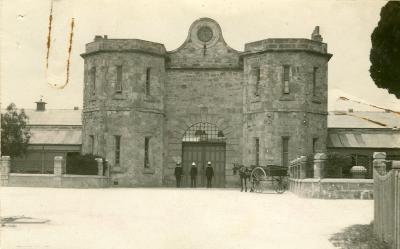
Printing using wooden blocks and stamps has been in use for thousands of years, with the use of mass produced woodtype for the commercial printing industry expanding in the early 19th century. Traditionally, wooden trays were used for holding collections of each typeface, to keep fonts and letters neatly ordered, for efficient typesetting. Printing was one of the first industries undertaken in Fremantle Prison, with a Print Shop part of the Convict Establishment's original infrastructure. Convicts were instructed in the use of two available printing presses from 1857. The Print Shop building was built as an outcome of the 1898-99 Royal Commission, which recommended that more workshops be established at Fremantle Prison, which allowed prisoners to learn new skills while serving their sentence. The Fremantle Prison Print Shop functioned as the official Government Printer from 1858 until 1870, and then again for an unspecified period from 1950 onwards. Many internal documents and forms used in prison operation were printed in the Prison's print shop. including the successive newsletters published during the twentieth century for prisoners, such as The Newsletter, The Jarrah Post, and Ad Rem. Due to its discovery onsite and date of manufacture, between 1891 and 1904, it is likely that the trays were used in the Fremantle Prison print shop. It is unlikely they were in use as part of the official Government Printer, as this operated outside of the dates of manufacture.
The trays relate to the progression of approaches to incarceration from punishment to reform. In the prison print shop, inmates had the opportunity to learn skills, which marked a progression towards the idea of the prison as a place of reform and rehabilitation. Learning a skill, in many instances, offered prisoners a sense of accomplishment, and an avenue to employment post sentence.
The trays are of historic significance as evidence of the type of equipment used in Printing workshop, a pertinent early industry in the colonial period of the prison. Additionally, there is a rarity value as there are relatively few objects in the Prison’s collection from the colonial period.