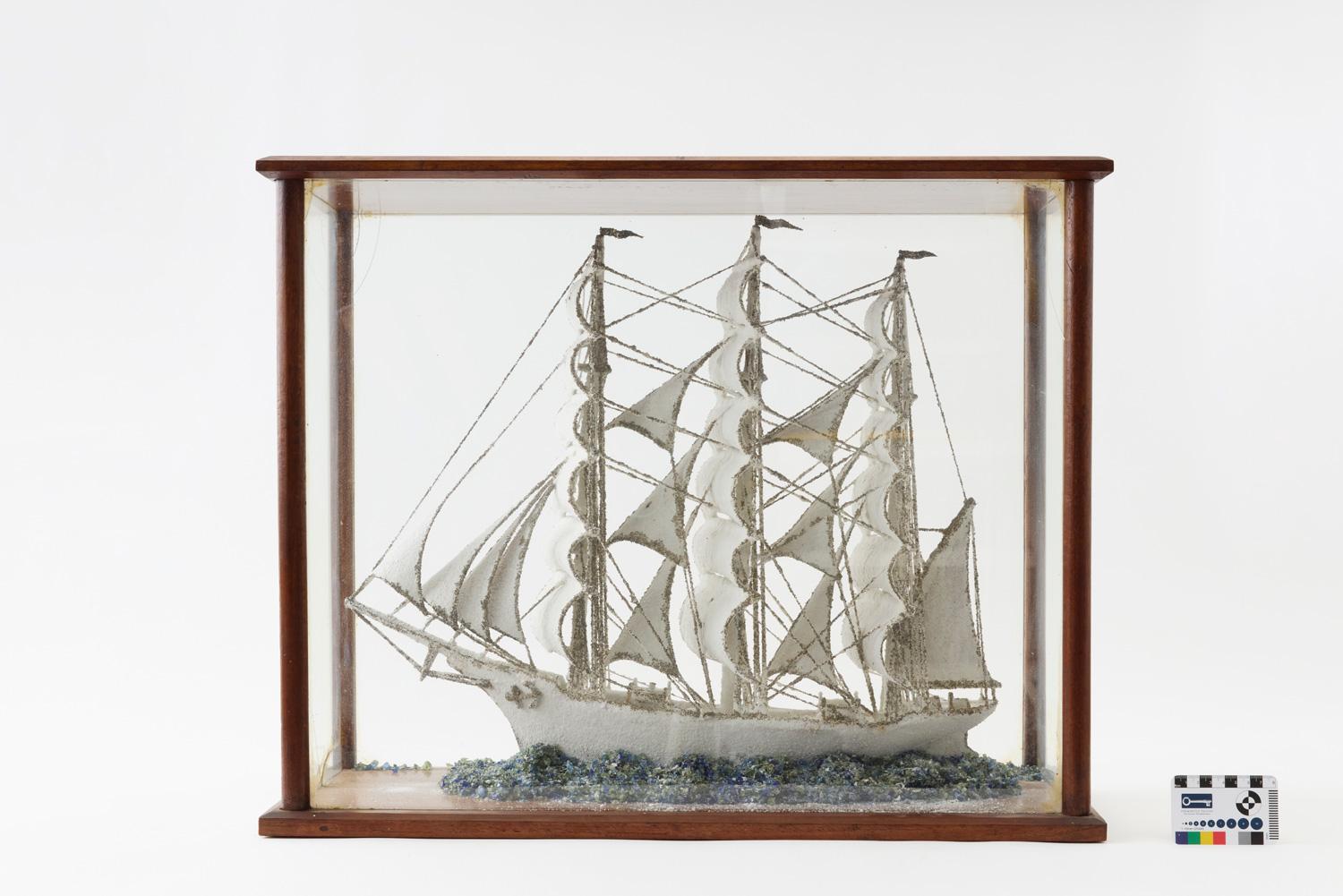
Model of Sailing Ship by Shiner Ryan
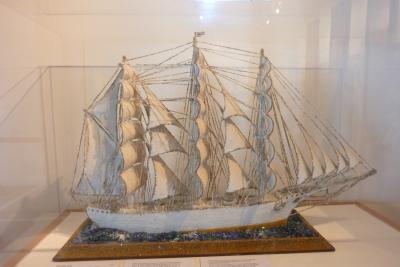
c. 1938 - 1940A sculpture of a three masted sailing vessel with a flag atop middle mast bearing the name, 'KATHLEEN ANNE'. The ship appears to be made from found materials such as white textured material including scraps of cardboard, tobacco tins, white frosting, tinsel, crushed glass and string. It sits atop a gravel base in a glass and wood display case. The two parts consist of:
(a) Large, white, textured, model sailing ship. Model of three masted sailing vessel in full sail with pennant atop middle mast which has vessel name printed on it, 'KATHLEEN ANNE'. The model ship appears to be made from a white, textured material with silver reflective edges along the sails and rigging. The model ship is sitting on top of a large textured base, possibly made of gravel and/or broken glass.
(b) Large, glass and dark wood, display case for model ship. Solid wooden base, with thick wooden edges holding in place four glass panels around the sides, and a glass lid on top. There are some small cracks present in the bottom corners of the front panel of glass.
The model ship was donated in 1988. Ryan is known to have crafted the boat in the period between 1938 and 1940. The ship is thought to have been named after Kathleen Anne Carter (nee Mullaley), the donor's mother-in-law. Information contained in an accompanying letter (1988.13.2), written by the wife of the donor alludes to a friendship struck up outside the Prison, with Shiner Ryan meeting Kathleen Anne’s husband John Mullaley through the ‘Ugly Men’s Club’ charity. In 2020 a granddaughter of Katheleen Anne informed the Prison’s curatorial team that her grandmother was a volunteer who played piano at Fremantle Prison in the late 1930s and early 1940s. It is assumed Kathleen and Shiner struck up a friendship during this time, with Shiner making the model ship and giving it to Kathleen as a gift. Kathleen kept the ship and wanted it to be donated back to Fremantle Prison when she passed away. In 2025 the donor’s daughter provided a photograph of Kathleen Anne taken in 1987 at her home in Boyup Brook with the model ship in the background.
Details
Details
'KATHLEEN ANNE'
This model ship and display case were made by noted prisoner, local personality, forger and artist Ernest ‘Shiner’ Ryan while incarcerated in Fremantle Prison in the period 1938 to 1940. He was a talented artist, and produced a number of works from found materials during his time in the prison including a number of model boats. Born in 1886 in Adelaide, Ryan had an extensive criminal record, and was in and out of jail for most of his adult life. In 1902 he was changed with larceny. In 1914 he was an accomplice to an armed robbery as the driver of the getaway car. Whilst he was a career criminal, he was also a gifted artist and in between lengthy stints in prison, worked as a watchmaker, painter, well sinker and locksmith. He was known for making fake coins and skeleton keys while at the prison and looked after the gatehouse clock. Following release from prison in 1940, he donated a painting entitled, ‘The Reclamation’ of which 400 copies were made and sold to raise funds for the Fremantle Citizens' Reception Council.
He became somewhat of an infamous local Fremantle identity, known for his good nature despite his crimes and lengthy periods of imprisonment in 1905, from 1932 to 1936 and again in 1938. Ryan married notorious Sydney gangster Kate Leigh in 1950, however they separated 6 months later. Ryan died in 1954 at the age of 71, with the Mayor of Fremantle a pallbearer at his funeral.
There are eight items in the museum collection relating to Ryan , three of which are artistic works attributed to him. Works include another mixed media sailing ship made of found materials (1982.2.1), similar to this one, and a print entitled, ‘The Reclamation’ from his time in prison in 1934.(2002.318). The model ship is of historical and social significance due to its association with well known crime figure, artist and Fremantle identity Ernest ‘Shiner’ Ryan and the clear provenance linking it to people and events in Fremantle Prison’s history. The model ship is of aesthetic value due to the use of found materials taken from the prison environment and the skill inherent in crafting them into a realistic model. The model fills an underrepresented theme un the collection as it speaks to the personal life and experience of a prisoner expressed through their art.