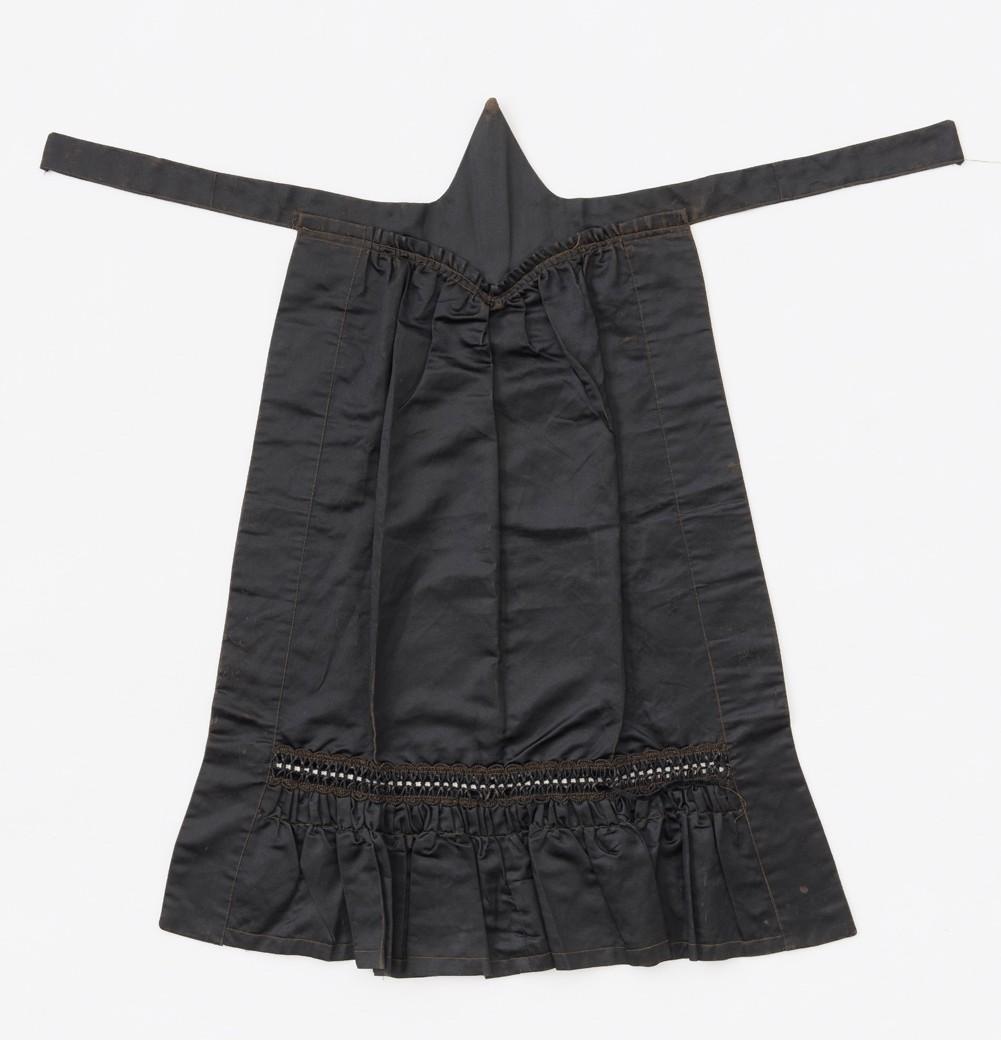
Mourning Apron
1886Black silk mourning apron, with pleated skirt and boning at the waist, rising to a peak at the centre of the midriff. It features decorative stitching, black piping and a ruched hem, with a strap at either side of the waist, designed to be passed around the waist and tied at the wearer's back.
This object was donated to the Fremantle Prison Collection, some time prior to 2006 before being accessioned into the collection in 2013. The item was displayed in the 'Escape! Fremantle to Freedom' exhibition in 2006 and reidentified during a collections storage move in 2012. The donor noted that the apron was associated with Harriet Doonan, wife of Joseph Doonan, the Assistant Superintendent of Fremantle Prison, and the Acting Superintendent of the Convict Establishment at the time of the Fenian escape in 1876.Joseph died in 1886 and it is assumed that the apron was used by Harriet during the mourning period. However, there is no way to fully substantiate the original ownership of the apron.
Details
Details
Harriet Doonan arrived in Western Australia in April 1854 onboard the ship the Sea Park. She subsequently married Mr Joseph Doonan. Joseph Doonan was the Acting Superintendent of the Convict Establishment at the time of the Fenian escape in 1876. As an Irishman, he was subject to internal investigations as to whether he was a part of the conspiracy. He attempted suicide, but survived, and went on to establish a general store in Adelaide House on Adelaide St, Perth. Together Joseph and Harriet had three sons and two daughters. Joseph died in 1886 and it is assumed that the apron was used by Harriet during the mourning period. During the Victorian era, clothing was used, particularly by women, to signify stages of mourning following the death of a loved one. Harriet died in Fremantle 1908. Further research may provide further context to the item’s use and relationship to Fremantle Prison and Harriet Doonan.
The mourning apron in the Fremantle Prison Collection is of significance as an object associated with religious and social customs of women during the Colonial period. The object provides a tangible link to the lives of women, underrepresented in the historical record of this time and at Fremantle Prison. The fine quality of the fabric and the care and detail taken in its design, embody its aesthetic significance. The apron is of historical significance due to its provenance associated with a key figure in Fremantle Prison’s history during the colonial period.