Eiserne Jungfrau ("Iron Maiden") - miniature reproduction
c. 1801 - 1900This is a miniature model, and known in German as the Eiserne Jungfrau which translates to 'Iron Maiden' in English.
It often refers to a historical torture device used for executions, depicted as a woman bound in iron and used in various historical accounts as a symbol of human cruelty and fear. The Iron Maiden was a horrible medieval torture device, a casket with spikes on the inside which could be closed slowly, impaling the living person inside.
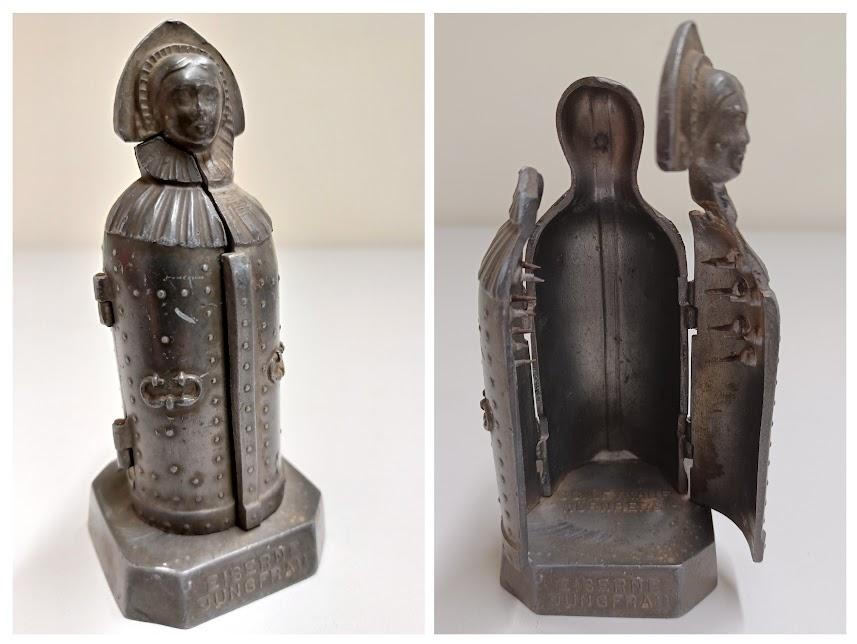
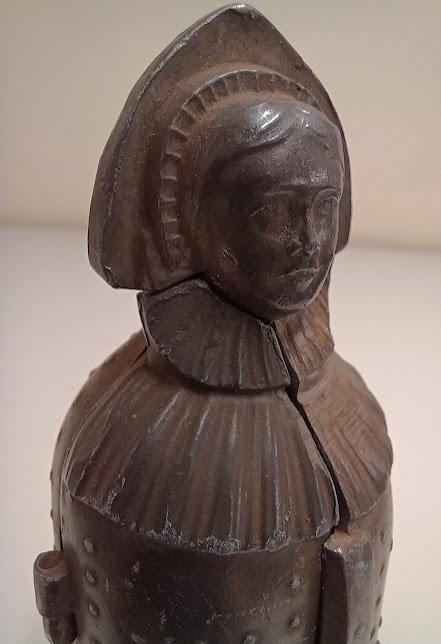
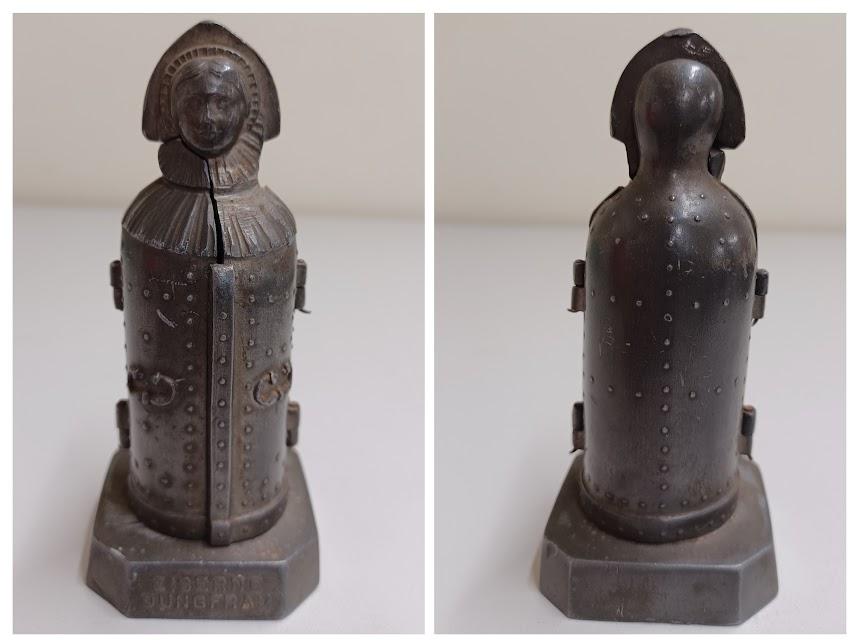
The model is designed in iron and looks very similar to a mummy sarcophagus with a head, body casket that opens up to reveal seven spikes in the body, and two spikes in the head. The model is attached to a base.
The iron maiden is a torture device, believed to have been first created in the 19th century. It consists of a solid iron cabinet with a hinged front and spike-covered interior, sufficiently tall to enclose a human being. While often popularly thought to have been used in the medieval period, there is no known mention of the iron maiden from before the 19th century.
For the curious, a copy of the Iron Maiden of Nuremberg is on display at Rothenburg ob der Tauber, a town located in the district of Ansbach in the Franconia region of Bavaria, Germany.
The most famous iron maiden that popularized the design was that of Nuremberg, first displayed possibly as far back as 1802. The original was lost in the Allied bombing of Nuremberg in 1945. A copy "from the Royal Castle of Nuremberg", crafted for public display, was sold through J. Ichenhauser of London to the Earl of Shrewsbury in 1890 along with other torture devices, and, after being displayed at the World's Columbian Exposition, Chicago, Illinois, 1893, was taken on an American tour. This copy was auctioned in the early 1960s and is now on display at the Medieval Crime Museum,
Rare and fascinating, this piece is a miniature lead model dating from the late 19th century, representing the legendary Iron Maiden of Nuremberg ("Eiserne Jungfrau"). It is a miniature reproduction of the mythical torture device once displayed in the Nuremberg museum and destroyed during the bombings of World War II in 1945.
Meticulously sculpted, the figurine takes the characteristic shape of a female double-doored sarcophagus, adorned with a grimacing face and riveted details across its surface. When opened, the interior reveals genuine metal spikes fixed to both doors — a chilling evocation of the torment this object symbolizes.
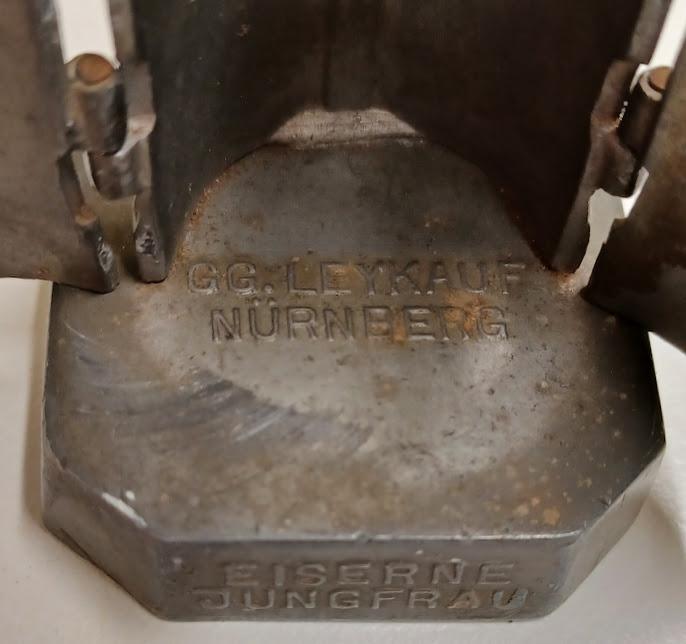
The embossed inscription "Eiserne Jungfrau Nürnberg" (Iron Maiden of Nuremberg) is clearly visible at the base, attesting to its thematic origin and its link with the famous German city. Whether as a curiosity, collector's item, or decorative piece, this historical miniature reflects the 19th-century fascination with medieval torture instruments.
Reference: https://relics.es/en/products/miniature-iron-maiden-or-nuremberg-maiden
Details
Details
Inside the casket on the base is the name of the manufacturer, 'GG. Leykauf Nurnberg' who was a steel metalware producer and trader in Nuremberg, Bavaria.
Front of casket at base, the German words "Eiserne Jungfrau" which translates to "Iron Maiden" in English.
Georg Leykauf was a steel metalware producer and trader in Nuremberg, Bavaria.
An iron maiden is a torture device, consisting of an iron cabinet, with a hinged front, sufficiently tall to enclose a human being. It usually has a small closable opening so that the torturer can interrogate the victim and torture or kill a person by piercing the body with sharp objects (such as knives, spikes or nails), while he or she is forced to remain standing.
Inspiration for the "Iron Maiden“ may come from the Carthaginian execution of Marcus Atilius Regulus, as it was recorded in a passage in Augustine of Hippo’s The City of God in which "the Carthaginians packed him into a tight wooden box, spiked with sharp nails on all sides, so that he could not lean in any direction without being pierced“. It is possible that some Iron Maidens were originally designed as a kind of coffin torture with the spikes added later.
Several 19th century Iron Maidens are on display in museums around the world.
Reference: https://www.prague-underground-tours.com/museum/medieval-torture-and-ex…
Other items from Busselton Historical Society
-
Door Ring Pull - St Mary's Anglican Church, Busselton
-
Postcard - "Post A Plank"

-
Boy Scouts - Uniform

-
Brownies - Ephemera
-
Camera - Poloroid Automatic 230 Land Camera
-
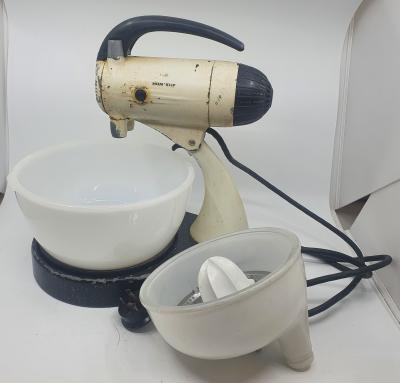
Sunbeam Mixmaster
-
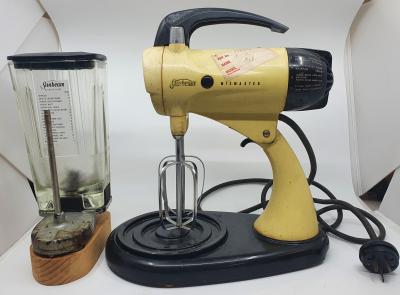
Sunbeam Mixmaster and blender
-
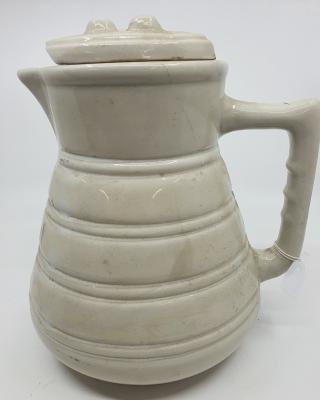
Electric Jug - Wembley Ware
-
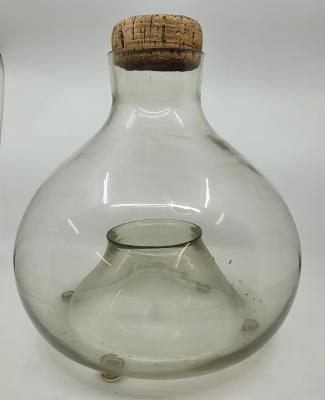
Glass Fly trap
-
Glass Fly Trap
-
WW1 Trenching Tool
-
WW2 Multi-meter