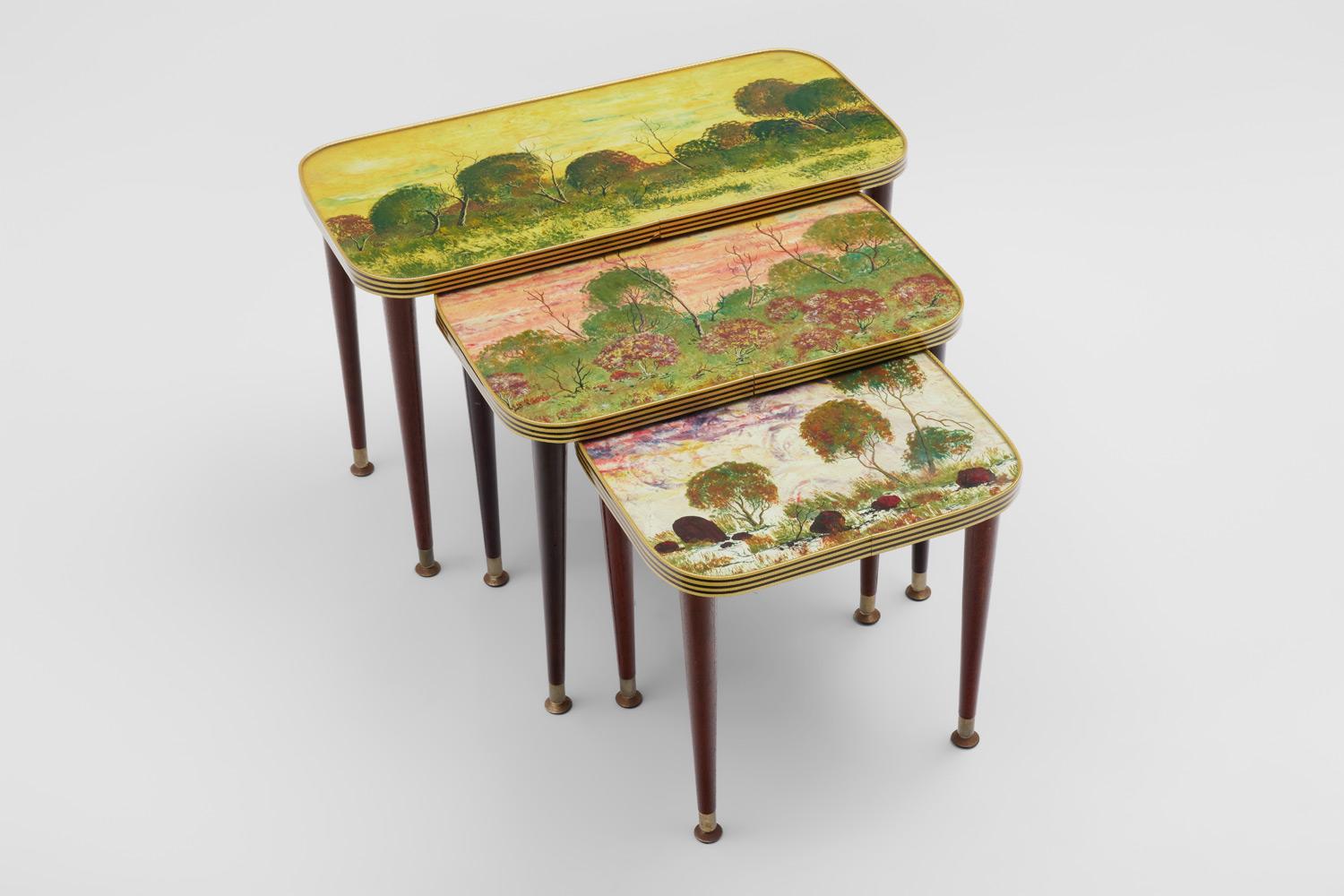
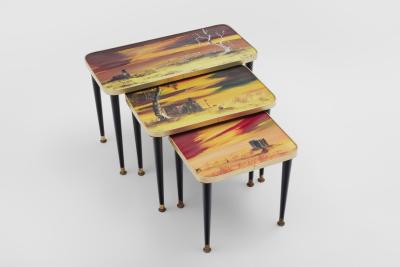
Nest of three occasional tables
1970 - 1991This object consists of a trio of metal and wood painted tables. The trio of nesting tables depict three different landscape scenes on the painted tabletops. The largest table shows trees both with and without leaves, a green and yellow ground, and a green, orange and yellow sky. The middle table shows trees with and without leaves in green and red, the ground in green and a red and yellow sky. The smallest table shows trees with leaves, large boulders on a green, red, black and white ground, and a white, red, yellow and purple sky. They are all signed, ‘G WOODS’ in black in the lower right corner. The painted surface of the table tops are covered in glass and have striped gold and black edging. The tables stand on four legs painted in black and attached to the wood via screws. The table is slightly wobbly but otherwise in good, used condition.
This trio of tables were made at Fremantle Prison in the 1970s, and are signed G. Woods. The tables were identified and bought from the Fremantle Op Shop, ’Old Values’, in 2019 by Prison staff. Other examples of nested tables in the Fremantle Prison are of the same design and style; prisoners were known to add their own designs and artwork to the table tops. The tables featured in an exhibition; Exhibition: '30 Years: Unlocked. Fremantle Prison After Closure'.
Details
Details
‘G WOODS’
The changing nature of work within the prison is a manifestation of penal reform, marking a shift from punishment to rehabilitation, a transition which began at the end of the 19th century. Colin Campbell, who became Comptroller General of Prisons in 1966 was a leading proponent of prison reform including the expansion of education programs and prisoners learning skills through expanded industries. By 1969/70 the prison’s annual report stated that 6 prison workshops were in operation, employing around 192 men across metalwork, carpentry, footwear, clothing, printing and concrete products.
The Carpenters Workshop was an integral part of the prison’s range of industries and one of the longest running; with convicts trained to work with wood essential to the Establishment’s construction. With the passage of time the type of objects the Carpentry Workshop produced changed with those in the late 20th century of a more personal nature. By the time of the prison’s closure in 1991 the carpentry shop was still a highly utilised prison industry.
As an object built within the prison workshops and sold in the community, the table is of historical significance as it demonstrates the change from punishment to reform in the prison system through the establishment of prison workshops and industries. The object speaks to the value of prison industries as a form of connection between prisoners and the wider community, and a way of learning a new skill while giving back to the community.
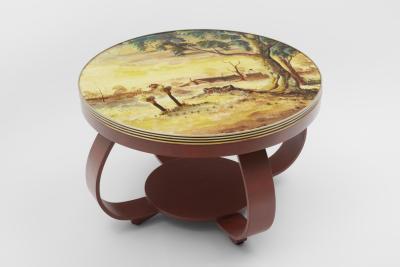
Art was also an important component of the expansion of the Prison’s educational programming. The early 1980s saw the inclusion of art lessons which became immensely popular with more than 2,000 prisoners enrolled within the first five years. Artwork produced during this period provides an insight into the personal experience of prisoners and the lived experience of incarceration. Further research may i provide detail regarding the identity of the artist; a mural on the ground floor of 4th division is signed Woods. The Fremantle Prison collection contains numerous items made by prisoners during their time here, (prison industries). There are at least 7 examples of painted table tops.
Other items by Fremantle Prison
Other items from Fremantle Prison
-
SHIV
-
cradle
-
Clay Pipe
-
Matchstick Model of Steam Engine
-
framed landscape painting
-
Landscape Painting
-
Tower of London Shotgun
-
Bill of Sale - 13/02/1877
-
Alternative Logbook for the Catalpa
-
Photograph at the grave of Captain George Anthony
-
Photograph of Captain George Anthony
-
Business Card for J. T. Richardson