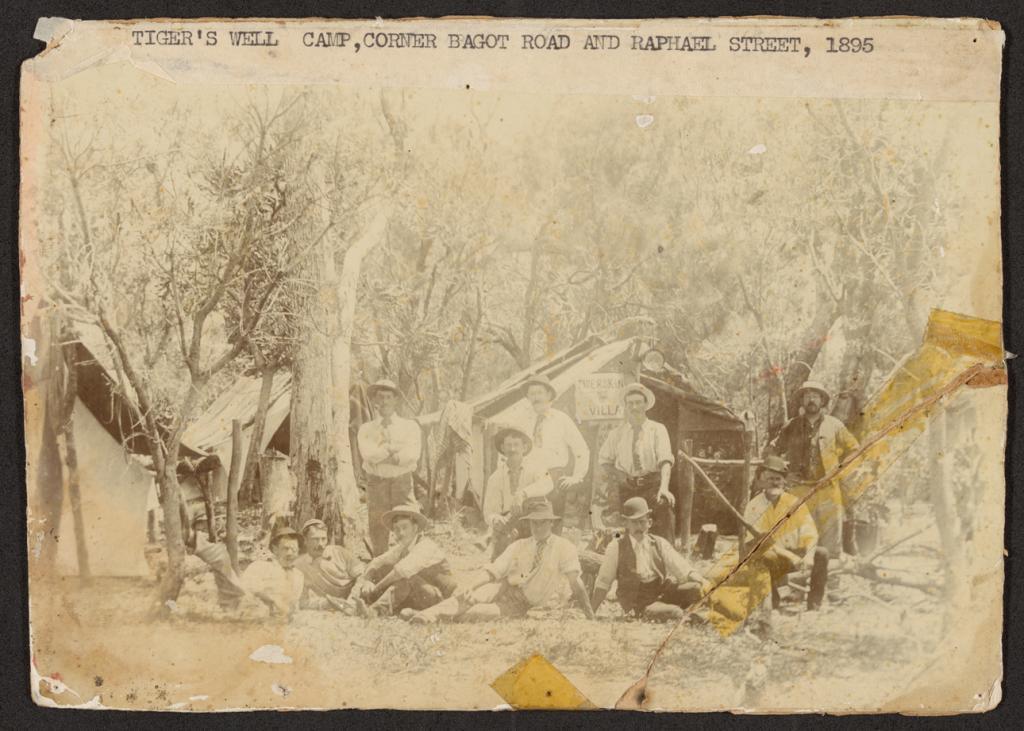
PHOTOGRAPH: TIGER'S WELL CAMP, CORNER BAGOT ROAD AND RAPHAEL STREET, SUBIACO
1895Image: The sepia image features a group of tents amongst the trees and several men standing or sitting on the ground in front of them. The men all wear working clothes and hats and some have pipes in their mouths. The tent in the centre of the image is distinguished by a sign reading 'Tigerskin Villa'. Some of the tents were made from 'Tiger' flour sacks. This camp was set up to alleviate the shortage of housing in the area. A well was sunk in the area. Migrants arriving at Fremantle were able to use the camping ground whilst looking for work and housing.
Battye Library negative, number 67474P. Investigate donation and scan each….? Three?
On the extreme left of the photograph (foot on sapling) is Mr Frank Smithson. Reclining to his right is Mr Mick Abrahams (father of c1947 Subiaco councillor Joe Abrahams).
In 1947 Mr Smithson recalled in the Subiaco Weekly Gazette: ...in the year 1895 housing accommodation in Perth was even worse than now. So seven of us, all young chaps batching in rooms decided on the open spaces, bought a block of land (-£ acre) at the corner of Bagot Road and Raphael street, Subiaco for £20, and sank a well 112 feet deep for water. There were two other wells in Subiaco then, one opposite the station and another behind where a timber yard is now. This was at the time when every ship from the east was crowded with men, women and children and as there was little hope of accommodation in Perth they were advised to camp at Subiaco, and like all humans, got as near to water as possible. So our camp became a place of importance and the information and social centre of the surrounding tents and humpies...The camp was called the Tigers because our tents were covered with sacks, and sacks were called Tiger Skin rugs by the old swaggies when used as blankets. The names of the original ones were: — Jack Hearty, George and Ned Donald son, Mick Abrahams, Harry Martin, my brother Harry and myself. But with the exception of myself, all have passed on. As regards the price of water, I think it was 1/- per week per family and pull up as much as they wanted. The charge was made because some of the men would let their women folk come for water just as we got home from our work. And of course we could not stand by and see women trying to haul up 6 , gallon drums of water, so ' we thought it fair to make the charge. Some of the surrounding campers thought so too, for while we were away they would demand payment from anyone who called. We reckoned they got more out of it than we did...
Details
Details
Local history
Open in Google Maps
Nearest geotagged records:
- PHOTOGRAPH (DIGITAL): 93 DENIS STREET, SUBIACO, LIZ ANDERSON COLLECTION, 1998 (0.07km away)
- PHOTOGRAPH (DIGITAL): 93 DENIS STREET, SUBIACO, LIZ ANDERSON COLLECTION, 1998 (0.07km away)
- PHOTOGRAPH (DIGITAL): 13-15 RAPHAEL STREET, SUBIACO, LIZ ANDERSON COLLECTION, 1998 (0.07km away)
- PHOTOGRAPH (DIGITAL): 19-21 RAPHAEL STREET, SUBIACO, LIZ ANDERSON COLLECTION, 1998 (0.08km away)
- PHOTOGRAPH (DIGITAL): STREETSCAPE, RAPHAEL STREET, SUBIACO, LIZ ANDERSON COLLECTION, 1998 (0.08km away)
- PHOTOGRAPH: 'DENIS STREET PRE-POWER UNDERGROUNDING' 1986 (0.08km away)
- PHOTOGRAPH: 'POWER UNDERGROUNDING ROWLAND/DENIS STREET' 1987 (0.09km away)
- PHOTOGRAPH: 'POWER UNDERGROUNDING ROWLAND/DENIS STREET' 1987 (0.09km away)
- PHOTOGRAPH: 'POWER UNDERGROUNDING ROWLAND/DENIS STREET' 1987 (0.09km away)
- PHOTOGRAPH: 'ROWLAND/DENIS STREET POST-POWER UNDERGROUNDING' 1987 (0.1km away)
Nearby places: View all geotagged records »
Other items from Subiaco Museum
-
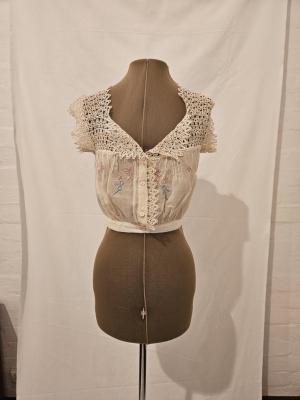
CAMISOLE: EMBROIDERED VOILE
-
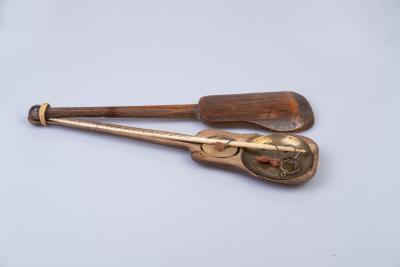
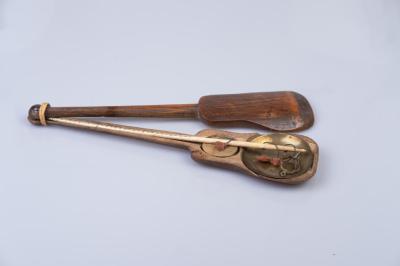
OPIUM SCALES: BAMBOO, METAL AND IVORY
-
OPIUM SCALES: BAMBOO, METAL AND IVORY
-
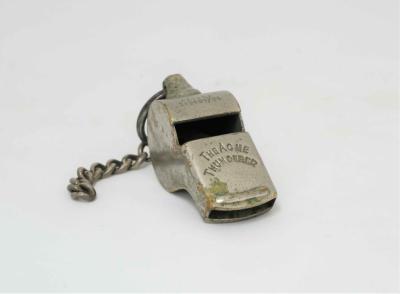
WHISTLE: 'THE ACME THUNDERER'
-
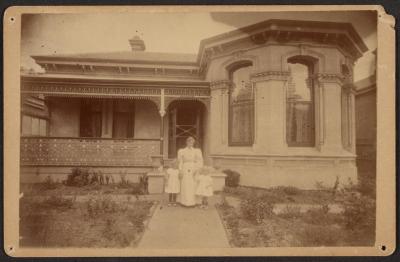
PHOTOGRAPH: WOMAN WITH HER CHILDREN
-
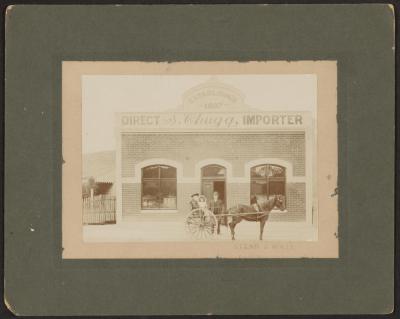
PHOTOGRAPH: SIMON CHUGG, IMPORTER, AND DAUGHTERS OUTSIDE CHUGG'S BUILDING
-
PHOTOGRAPH: SIMON CHUGG, IMPORTER, AND DAUGHTERS OUTSIDE CHUGG'S BUILDING
-
PHOTOGRAPH: OPENING CEREMONY OF SUBIACO SEWERAGE SCHEME
-
PHOTOGRAPH (COPY): OPENING CEREMONY OF SUBIACO SEWERAGE SCHEME
-
PHOTOGRAPH (COPY): OPENING CEREMONY OF SUBIACO SEWERAGE SCHEME
-
MUSICAL INTRUMENT: TIN WHISTLE
-
COLLAR: SATIN PIPING WITH CREAM CROCHET AND SATIN TIES