

Researched by Jia Xin Yeo
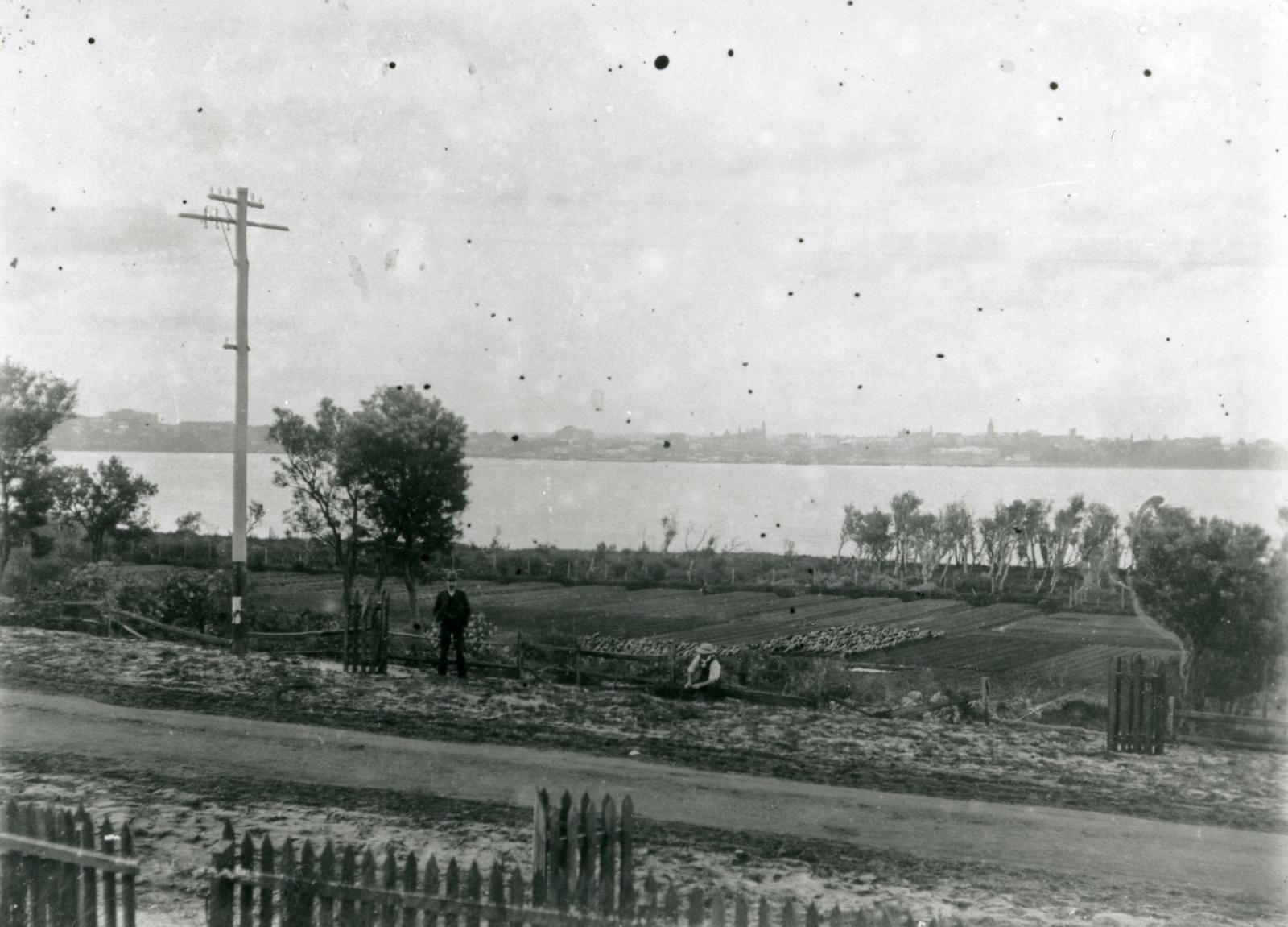
The view from 181 Suburban Road (now known as Mill Point Road) across the river to Perth city, shows James Goss with an unknown man. Both on a track on the side of the road for horse carts, and a crushed shell footpath, circa 1900. (COSP_PH_2003)
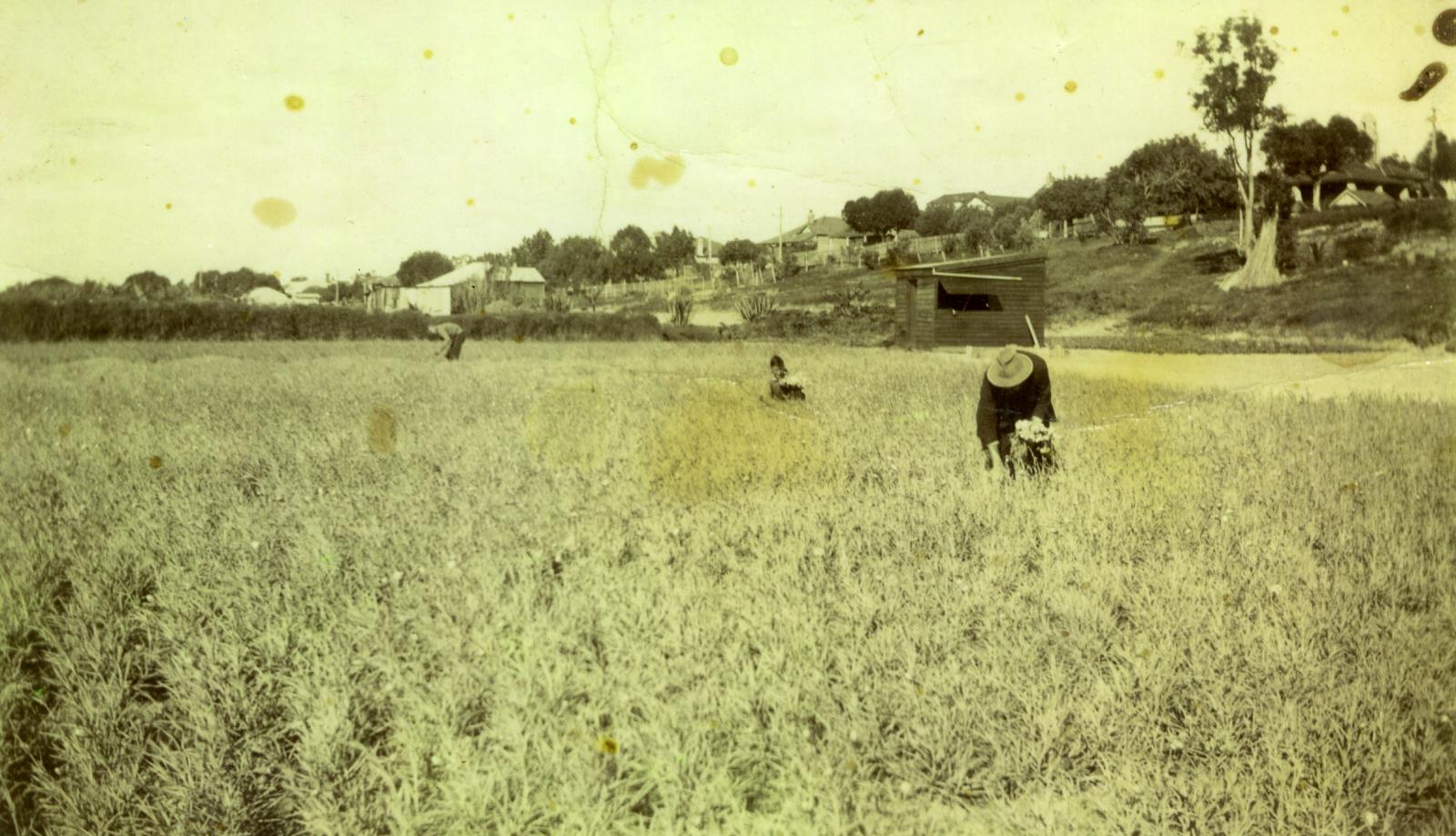
Picking Chrysanthemums in field, circa 1930. (COSP_PH_2180)
The gardens began when small numbers of Chinese immigrants arrived in Perth in the early 1880s, improving and cultivating the marsh lands along the foreshore of South Perth. They covered 11 acres of land owned by Mr Mends. His former house became most of the market gardeners’ place to stay. Sections of the South Perth foreshore was rented to these market gardeners, including Justice Edward Stone and Messrs Sutton and Olsen.
In 1888 there was a published letter on the Daily News paper, owned by Horace Stirling, over an alleged Chinese leper living in South Perth, selling contaminated vegetables to the public. This accusation was part of a broader pattern of anti-Chinese sentiment during this period, when Chinese market gardeners faced regular hostility and discrimination despite providing most of Perth's fresh produce. The allegation threatened to destroy the livelihoods of all the South Perth gardeners, whose businesses depended on public confidence in the safety of their vegetables. South Perth market gardeners sued Stirling for defamation. To defend himself and prove his newspaper's claims were accurate, Stirling assigned journalist Arthur Lovekin to track down the alleged leper. After an investigation, Lovekin eventually located a Chinese man at Spencer's Brook who was subsequently deported to Hong Kong. Although there was no evidence that this individual had ever worked in South Perth or had any connection to the South Perth gardens, Stirling won the case by presenting this discovery as proof that the story was fundamentally true.
After the controversy, the Chinese people sought for an investigation by health authorities to restore their damaged reputation. After examining the garden, health inspector Adam Jameson certified that everything is up to standard, pronouncing it as one of the finest and best-kept gardens in the neighbourhood of Perth.
The discovery of gold in Kalgoorlie in 1893 led to a population boom, and the market gardeners grew enough to help supply the expanding community. The gold rush also brought in more Chinese immigrants to Western Australia. For racial reasons, they couldn’t obtain Miner’s Rights in the goldfields. The Chinese then turned to what they did better: trading and gardening. South Perth had a small number of Chinese gardeners residing in Mr Mend’s house on the foreshore.
Most of the farmers were from Guangdong, a province in south China, where the cultivation of rice, fruits, and vegetables was common. Drawing on this background, they applied intensive, small-scale farming methods ideal for marsh production. The wells were dug in traditional Chinese style: 10 feet by 10 feet square, 4–5 feet deep, suited for the wetlands.
Unfortunately, due to the Restricted Immigration Act 1901, people of Chinese origin were subjected to strict immigration policies including restrictions on owning land. They were not permitted to bring their wives and children to Australia. With no successors or new waves of immigrants to replace them, the Chinese gardeners would eventually age without replacement.
The market gardens were subjected to regular health inspections. The market gardeners lived in basic shacks that health officials deemed inadequate, demanding upgrades to ventilation, sanitation, and living space. Demands for spraying against fruit flies and pests were imposed and strictly enforced. Even though the Chinese market gardens were less profitable, they remained a major supplier to Perth and beyond by the 1930s and 1940s, and the area remained mostly untouched.
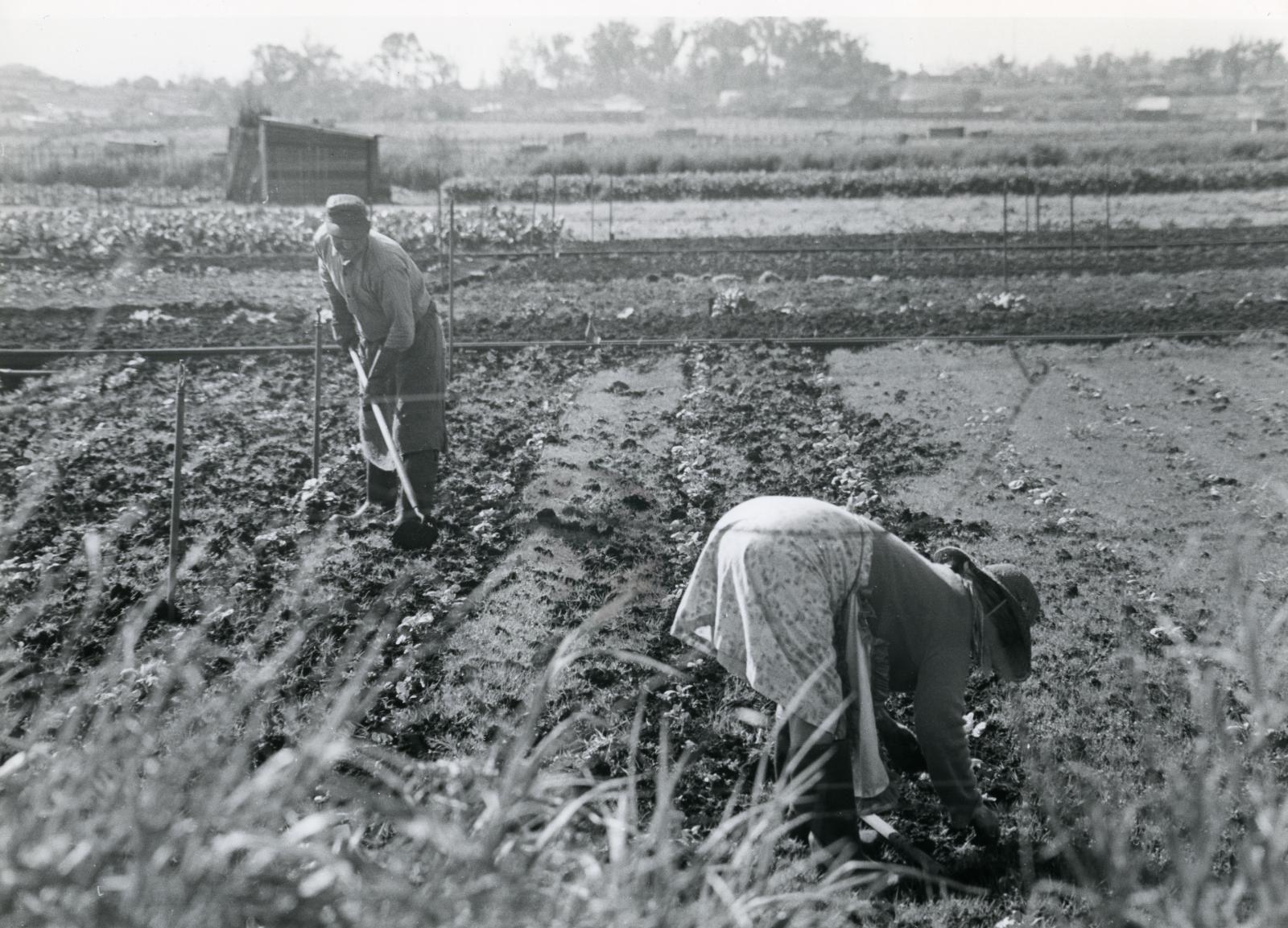
Chinese Gardens – Mill Point Road, South Perth. (COSP_PH_435)
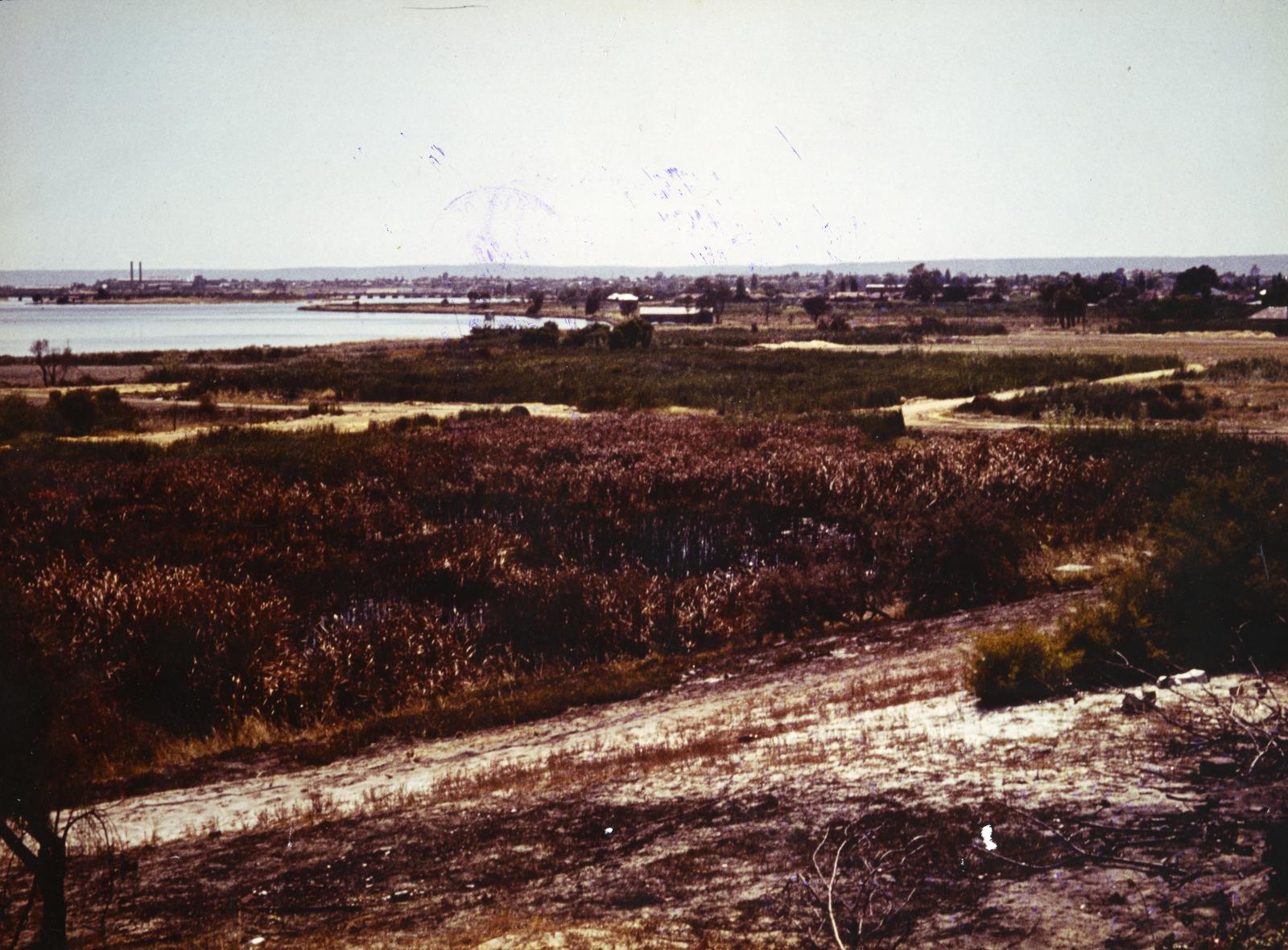
From the future location of Sir James Mitchell Park, looking towards the Causeway. (COSP_PH_107)
In 1920s, Southern European family migrants (Italians, Croatians, and others) entered the industry, starting their own market gardens in Spearwood and Wanneroo. These newer migrants could earn additional wages from employment outside their gardens and access to new technologies like artificial fertilizers, long arm sprinkler systems, and electrical pumps. This gave access to higher fertile land that had gardening potential but no access to water. This increased competition further challenged the aging Chinese gardeners who had no one to replace them.
By the late 1940s, few Chinese gardeners remained working on the South Perth foreshore, and all were elderly men. Around 1950, the Road Board entered negotiations with some sporting clubs with a view to redeveloping the area, and by 1952 the Chinese market gardeners had been served eviction notices. The promised redevelopment did not materialize as expected. Only the Hurlingham Polo Ground moved in, and much of the land reverted to swampland. It would take another 20 years before Sir James Mitchell Park and other developments were finally implemented.
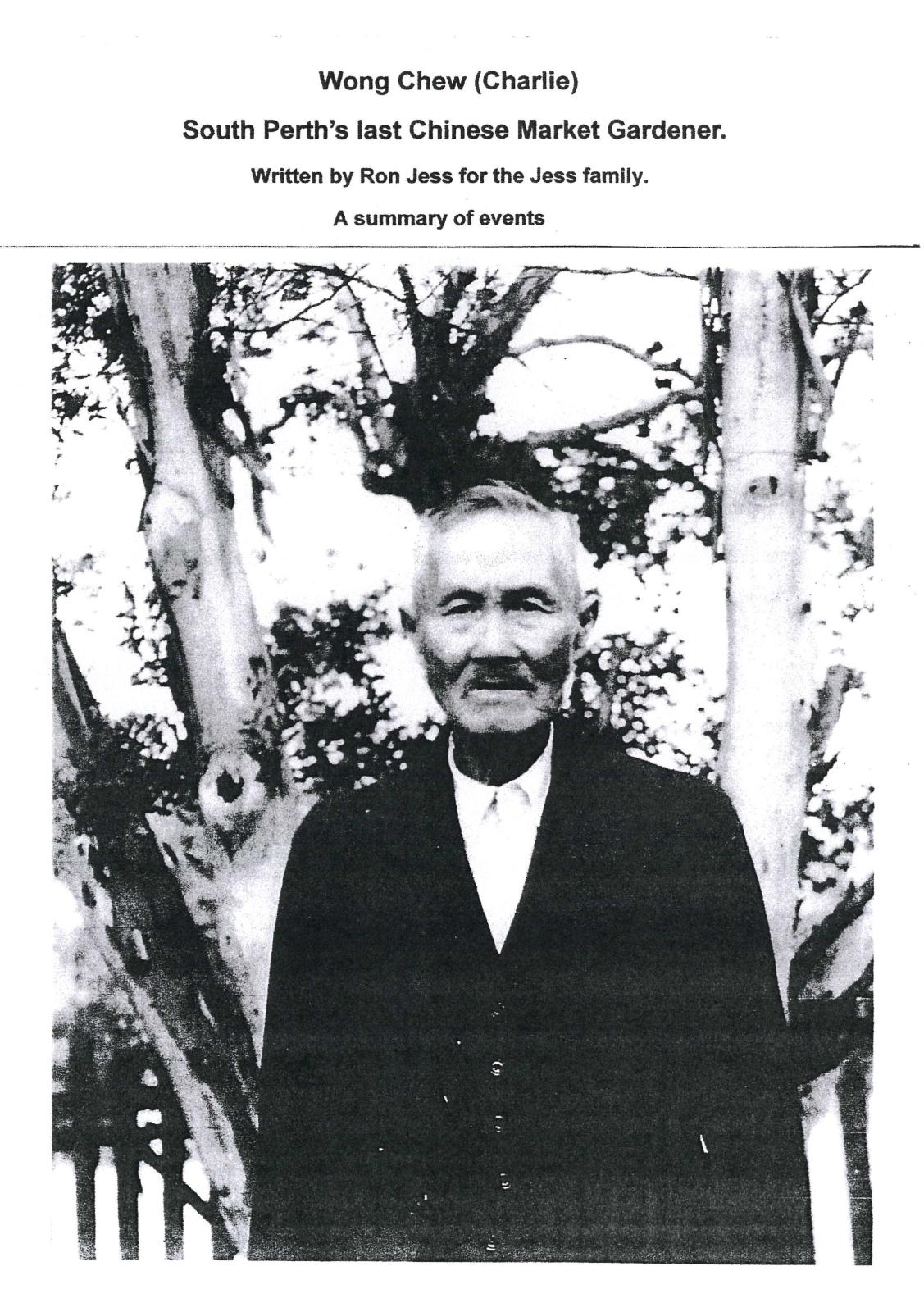
A summary of the life of Wong Chew, written by Ron Jess for the Jess family. Includes black and white images, copies of Certificates of Registration, letters, greeting cards, address books, and news articles. Copies are held in the South Perth Local History Collection archives.
Wong "Charlie" Chew (AKA Chin, Chu, Chou due to misspellings) was the last market gardener to work in South Perth. He was a familiar sight in the area, travelling with his horse-drawn cart.
Wong Chew worked alongside his brother, Wong Bue, who operated Wong Bue's Market Garden from 1916 until 1934 on the Manning Estate (now Heppingstone Street). In 1925, Wong Bue expanded to a second location on the Courthope Estate, near present-day Hurlingham Road. Both properties were compulsorily acquired in 1934 for the Hurlingham Polo grounds.
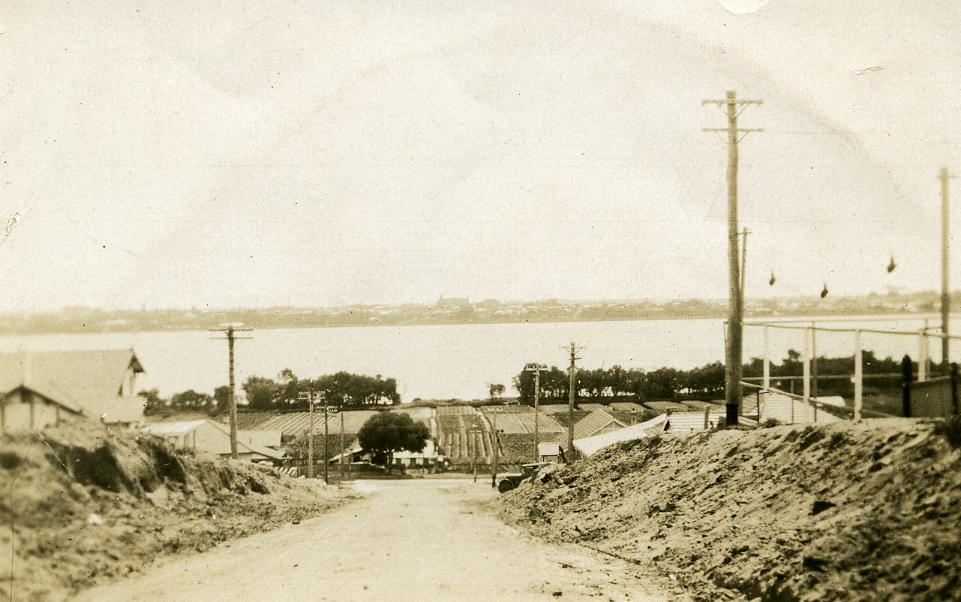
Chinese Gardens were located on the South Perth foreshore. Taken from Forrest Street. The area of Wong Bue's Market Garden was in the centre of this 1929 photograph.(COSP_PH_2056/2)
Following their eviction, the brothers relocated to Suburban Road (now Mill Point Road). They worked this land until 1951, when they were evicted again to clear the foreshore for "sporting bodies."
Wong Chew eventually returned and became the last Chinese market gardener on the South Perth foreshore, continuing to work until he left for Hong Kong in 1968. Other gardeners either returned to China, moved to more remote areas, or ended up at the Sunset Rest Home and Hospital in Dalkeith.
References:
Florey, C. (1995). Peninsular city.
State Library of Western Australia. Market gardens. https://webarchive.slwa.wa.gov.au/wepon/land/html/marketgardens.html
UWA Collected. Chinese market gardens in South Perth. https://collected.uwa.edu.au/nodes/view/60111
UWA Collected. Wong Bue's Market Garden, South Perth - Victoria Park. https://collected.uwa.edu.au/nodes/view/48301
Western Australian Museum. Chinese gardeners. https://museum.wa.gov.au/explore/wetlands/city-development/chinese-gardeners