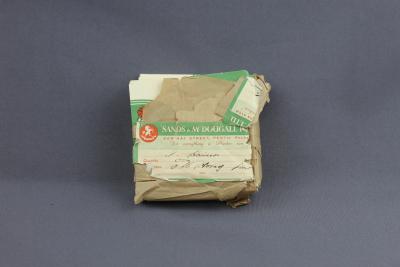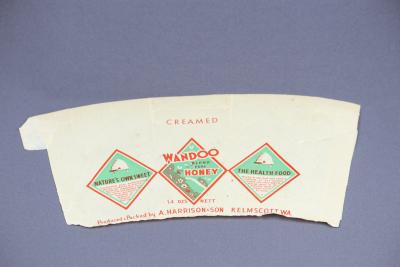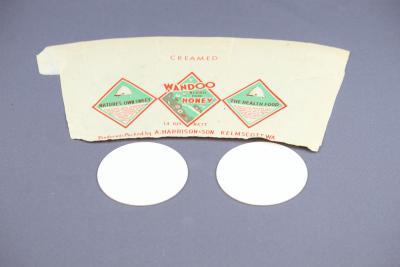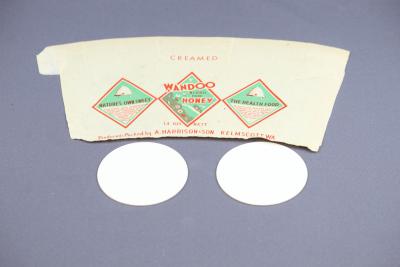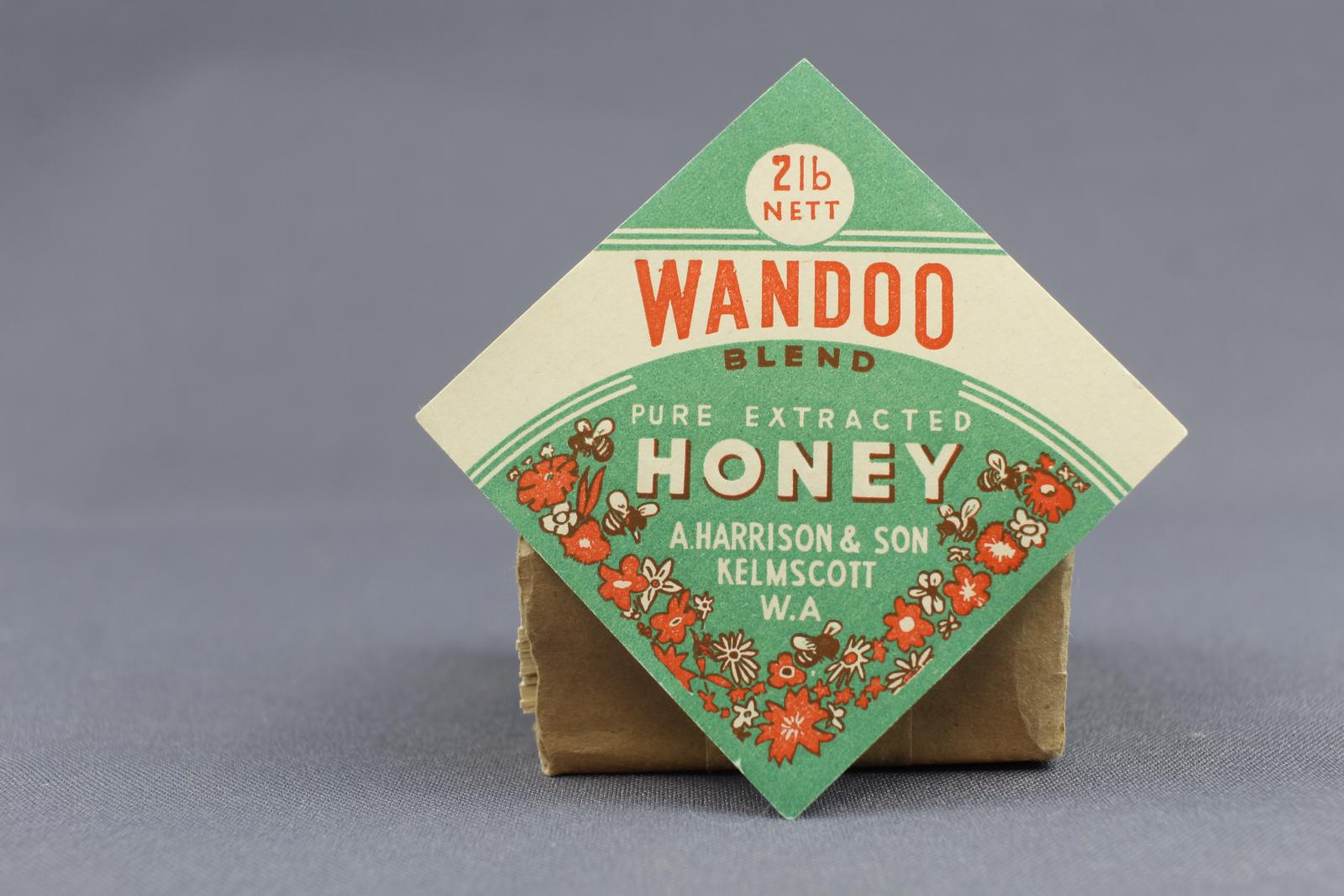
LABELS, WANDOO BLEND PURE EXTRACT HONEY - A HARRISON & SON KELMSCOTT
c. 1960Diamond shaped paper labels wrapped in brown paper. Labels green with a cream arch shaped band across middle. Illustration of red flowers and bees down bottom edges. White circle in top point with red text [2lb / NETS]. Red text on and just under cream band [WANDOO / BLEND]. White text bottom half of label [PURE EXTRACTED / HONEY / A.HARRISON & SON / KELMSCOTT / W.A.]
Albert Harrison, along with his son Lincoln, were in the business of collecting and selling honey from the 1910s to the 1970s. They ran their business from Kelmscott and collected honey from the surrounding suburbs of Armadale and Roleystone. Their produce was sold as Wandoo honey, named after the tree from which their honey came.
Albert Harrison died on 12 March 1944 following and accident when cutting timber with a circular saw. The piece of wood he was holding was thrown backward striking Albert in the head. He was taken to St. John of God Hospital but died the following morning. He was 57 years old and left behind his wife and two sons.
Albert was a well respected and industrious member of the community. He was remembered as being a strong financial supporter of numberous community organisations though he was not one to necessarily be actively involved with them. He and his family were also known for their hospitality at their Third Avenue home especially for those in the service. Albert was burried in the Methodist section of Karrakatta cemetery
Albert Lincoln Harrison became engaged to Eleanor Joanna (Noreen) Canaletich in 1946. He died age 83 in Gosnells in the year 2000. Eleanor died in 2003 age 87
Their honey processing plant was located next to the railway line in Kelmscott on Third Avenue
Details
Details
This object is part of a collection that represents the commercial history of the City of Armadale. It represents the many different businesses that have operated in the local area and how those businesses have evolved over time. Businesses play an important role within a community, they provide wanted and needed goods and services, employment, income and opportunities to the local community. They can also operate as important social connectors, places where people gathered and engaged with other members of the community.