

Letter by Fred Hussey
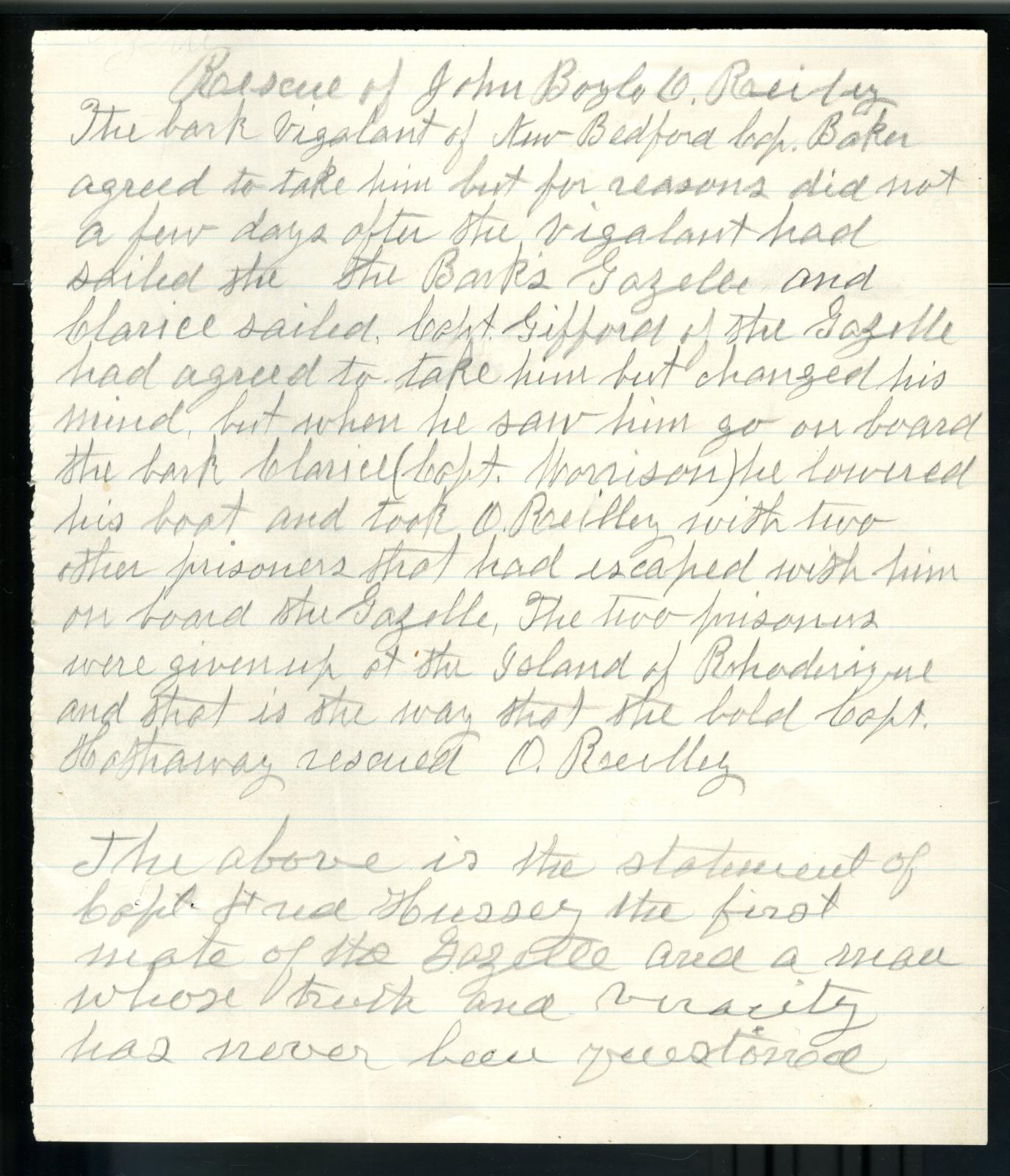
Digital only scan of a single page, one-sided, handwritten letter in pencil by Fred Hussey of the Gazelle, explaining the rescue of Fenian John Boyle O'Reilly. Single page of white paper, with light blue printed lines. Handwritten text in lead pencil on one side. The reverse is blank. The paper is in fair condition with no tears, and only slight yellowing across the surface.
This is a scan of an original handwritten letter by Fred Hussey, first mate of the ship Gazelle, who assisted in rescuing Fenian John Boyle O'Reilly from Western Australia in 1869. This set the scene for the later rescue of six Irish political convicts from Fremantle in 1876 aboard the Catalpa. It was donated by James Ryan, the great-grandson of George Anthony, who was Captain of the Catalpa during the Fenian rescue of six Irish political convicts from Fremantle in 1876. James Ryan visited Fremantle in April 2026 to partake in the 150th anniversary celebrations of the Catalpa rescue, held in Fremantle, Rockingham and Bunbury. For this visit he bought with him a selection of his family archives, including documents related to the Catalpa and Captain Anthony. During this visit James met with Fremantle Prison staff and kindly allowed us to scan these documents and accession these scans into the Prison’s collection. The physical documents remain in America with James Ryan.
Details
Details
'Rescue of John Boyle O'Reilly/ The bark Vigilant of New Bedford Capt. Baker/ agreed to take him but for reasons did not/ a few days after the vigilant had/ sailed the barks Gazelle and/ Clarice sailed Capt. Gifford of the Gazelle/ has agreed to take him but changed his/ mind but when he saw him go on board/ the bark Clarice (Capt. Morrison) he lowered/ his boat and took O'Reilly with two/ other prisoners that had escaped with him/ onboard the Gazelle. The two prisoners/ were given up at the island of Rodrique/ and that is the way the bold Capt./ Hathaway rescued O'Reilly./ The above is the statement of/ Capt. Fred Hussey the first/ mate of the Gazelle and a man/ whose truth and veracity/ has never been questioned'
Fred Hussey was first mate on the Gazelle, the ship which John Boyle O'Reilly escaped Western Australia in 1869. This set the scene for the later rescue of six Irish political convicts from Fremantle in 1876 onboard the Catalpa.
The Fenian movement or Irish Republican Brotherhood was a secret political society resisting British rule in Ireland in the 1860s. Several Fenians who had infiltrated the British military services were discovered, arrested and sentenced to transportation to Australia. In 1868 the convict ship Hougoumont arrived at Fremantle carrying 280 convicts, including 62 Fenians. Of this number 17 had been serving in the British Army and were classified as ‘military’, one of them was John Boyle O’Reilly. This was the last convict transport ship to arrive in Australia.
O’Reilly was born in Dowth, County Meath, in 1844. At the age of 15 he was working for The Manchester Guardian newspaper in England before enlisting with the British Army in Dublin in 1863, where he was covertly recruited to join the Fenians. When a plan to stage an uprising was discovered the military Fenians were tried and convicted. O’Reilly was initially sentenced to death for treason, but his young age (21 on sentencing) was taken into account, and this was commuted to transportation for life. Transported aboard the Hougoumont in 1868, O’Reilly was only held at Fremantle Prison for one month before it was decided to transfer him to roadbuilding works in a camp at what is now Gelorup, south of Bunbury. He was granted the position of party constable in the work party, a position of privilege and great trust helping to muster the convicts and to carry communications between the work party Warder and the Convict depot.
The Catholic priest responsible for the Bunbury district was Irish-born Father Patrick McCabe, who often inspected the convict work parties. O’Reilly and McCabe became friends, with Father McCabe worrying about O’Reilly’s mental state. McCabe enlisted another Irishman, local farmer and Justice of the Peace James Maguire, and together they planned O’Reilly’s escape, organising passage for him on the American whaling ship the Vigilant. On the appointed day in February 1869, O’Reilly absconded from his work party, met up with Maguire and other locals, and rowed out into Geographe Bay. However, the Vigilant failed to sight them and sailed away. The party then rowed back to shore at Buffalo Beach, north of Bunbury.
By this time the police and Aboriginal trackers were chasing O’Reilly. He was forced to hide in the sand dunes in the summer sun with little fresh water for weeks while McCabe and Maguire organised another rescue. Eventually McCabe secured passage aboard another whaler, the Gazelle, paying £10 to carry O’Reilly to safety. On 2 March 1869, O'Reilly again rowed out into the waters of Geographe Bay, and was picked up by the Gazelle and sailed away to eventual freedom.
O’Reilly finally reached America and settled in Boston. He became the editor and co-owner of the Catholic newspaper The Pilot, and one of the most influential Irish Americans of his day.
Scan this QR code to open this page on your phone ->
