

A Short History of Baseball in the Goldfields
Paul Tye, Baseball WA Museum & Archives
“Just after 9.00 o’clock a lone cyclist appeared off the street with a hessian sugar bag over his shoulder. That lone cyclist was Jim Puckett and in the sugar bag were at least 9 old baseball gloves, a set of old catching gear and a few bats and balls.” – Colin Smith, 14-year-old teenager (1951).
NOTATION
All due care, attention and responsibility has been taken in preparing this history of baseball in the Goldfields.
However, it is likely that some facts may be incorrect, out of chronological order, names misspelt or significant baseball history omitted.
You can help us to rectify the situation by contacting the Baseball WA Museum through the Baseball WA Headquarters.
CHAPTER 1:
1909 – A diamond unearthed in the Goldfields
The discovery of gold in 1893 by Paddy Hannan, Thomas Flanagan and Dan Shea at Mt Charlotte near Kalgoorlie, initiated not only a gold rush, but also the development of a baseball diamond in 1909.
A contingent of 40 American schoolboys aged between 13 and 16 years, visited New Zealand and Australia for 6 months as part of a Young Australia League (YAL) initiative. The YAL had been established in Perth in 1905 by Jack Simmons and Lionel Boas as a means of developing Australian nationalism and patriotic values through organising activities.
The American boys were under the guidance of Major Sidney S. Peixotto and were from the Columbia Park Boys’ Club in San Francisco. Part of their visit included a trip to Western Australia to (actually) play football. They had been taught the Australian Football game by Messrs Pat O’Dea, an old Melbourne and Essendon footballer, and Chas Lynham. They certainly came with an attitude: “We are prepared to play your game, and play it hard; and if we can’t beat your teams, we’ll make them play hard.”
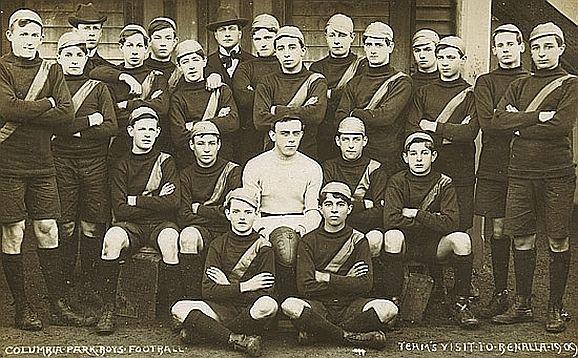
1909 American schoolboys at Benalla, Victoria.
However, it would appear that the boys could also play baseball. Jamie Caveney, an expert baseball player and accompanying the group, travelled to Kalgoorlie and Boulder to act as a baseball coach for three months. During this time, he also coached boys of the Christian Brothers’ School in Perth.
To accommodate the interest in baseball, the Kalgoorlie Municipal Council agreed to allow the boys to use the Kalgoorlie Recreation Ground for practice purposes. Schools were closed and studies postponed at this time due to an outbreak of scarlet fever which, therefore, afforded the opportunity for Caveney to organise two coaching sessions each day.
Living in the Goldfields at the same time was a young American geologist and engineer named Herbert Hoover, who later went on to become the 31st President of the United States (1929–1933). He was a mining expert and was employed to select gold mines that showed promise and to ‘strike out’ the dud ones. He had a Quaker background and by 1901 was estimated to be the “highest salaried man in the world of his age”.
It is interesting to speculate whether he had some influence in encouraging Jamie Caveney to the Goldfields to promote and encourage the sporting activity of baseball.
It has been difficult to obtain information on the development of baseball from this time to the 1930s but it is likely that the foundation and knowledge of the sport had been laid prior to the arrival of Joe Thorn as the General Manger of the Fimiston Lake View mining company in 1928.
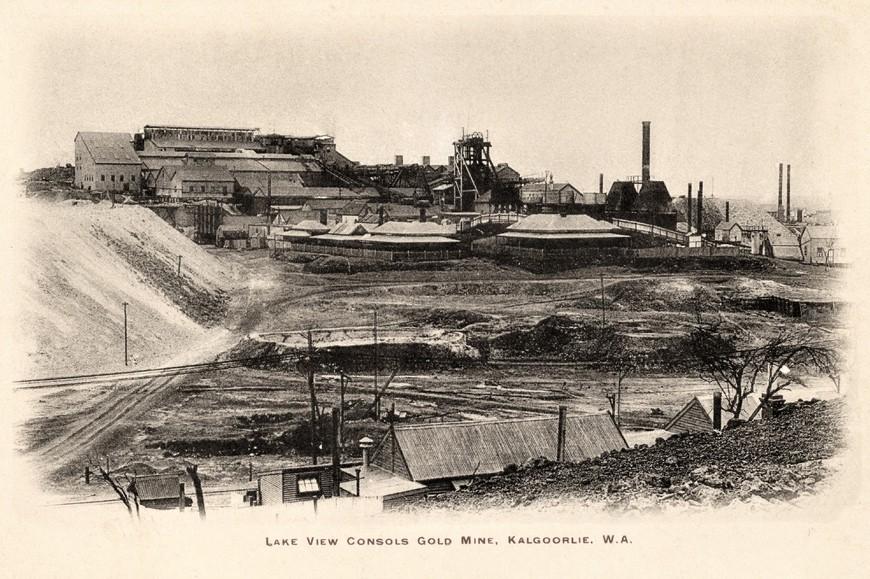
View of the Lake View Consols Gold Mine, c. 1900.
CHAPTER 2:
1930s – A rough diamond emerges
While mining was very productive in the 1930s there was also this little gem of a baseball diamond in town waiting to be finally unearthed.
As baseball officially developed in Perth through the establishment of the West Australian Baseball League (WABL) in 1936, so an American stepped up to the home plate in Kalgoorlie. Joe Thorn had arrived on the Goldfields in 1928. In 1931 he helped form teams from within the Fimiston Lake View Company. The teams were known as:
- The Sand Train Team
- The Fitting Shop Team
- The Sawmill Team
- The Power Corporation Team was added later.
All these teams played on top of an old slime dump known as the Ivanhoe Dump.
Joe Thorn was attached to the Fimiston Lake View and Star Gold Mine as General Manager and encouraged young men to try the winter game of baseball. Joe had played baseball for the California Pacific Coast League in 1902, and it was through his uniting efforts with Charlie Thielicke (Assistant General Manager and an amateur ball player), that in 1935/36 the Goldfields League was founded. Games, up to this time, were organised and played under the auspices of the Lake View and Star Baseball League.
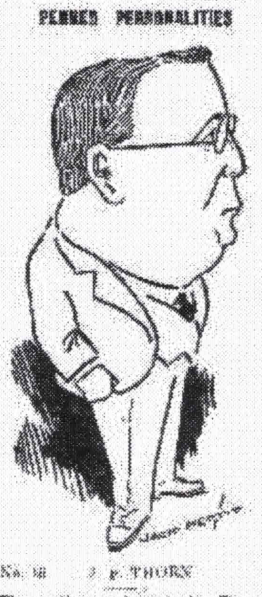
The swell guy above is Joe Thorn.
In the United States he was born;
But he travelled afar
To where gold diggings are,
And now is the boss of the Lake
View and Star,
Where he's caused a new era to
dawn.
Courtesy of the 'Kalgoorlie Miner', 9 May 1936.
As baseball equipment was imported and the game grew, the original teams were disbanded as four new teams entered the competition – Great Boulder, Chaffers, Lake View and Westers – all named after mining companies. These teams continued to play and exist in the Goldfields League until 1939.
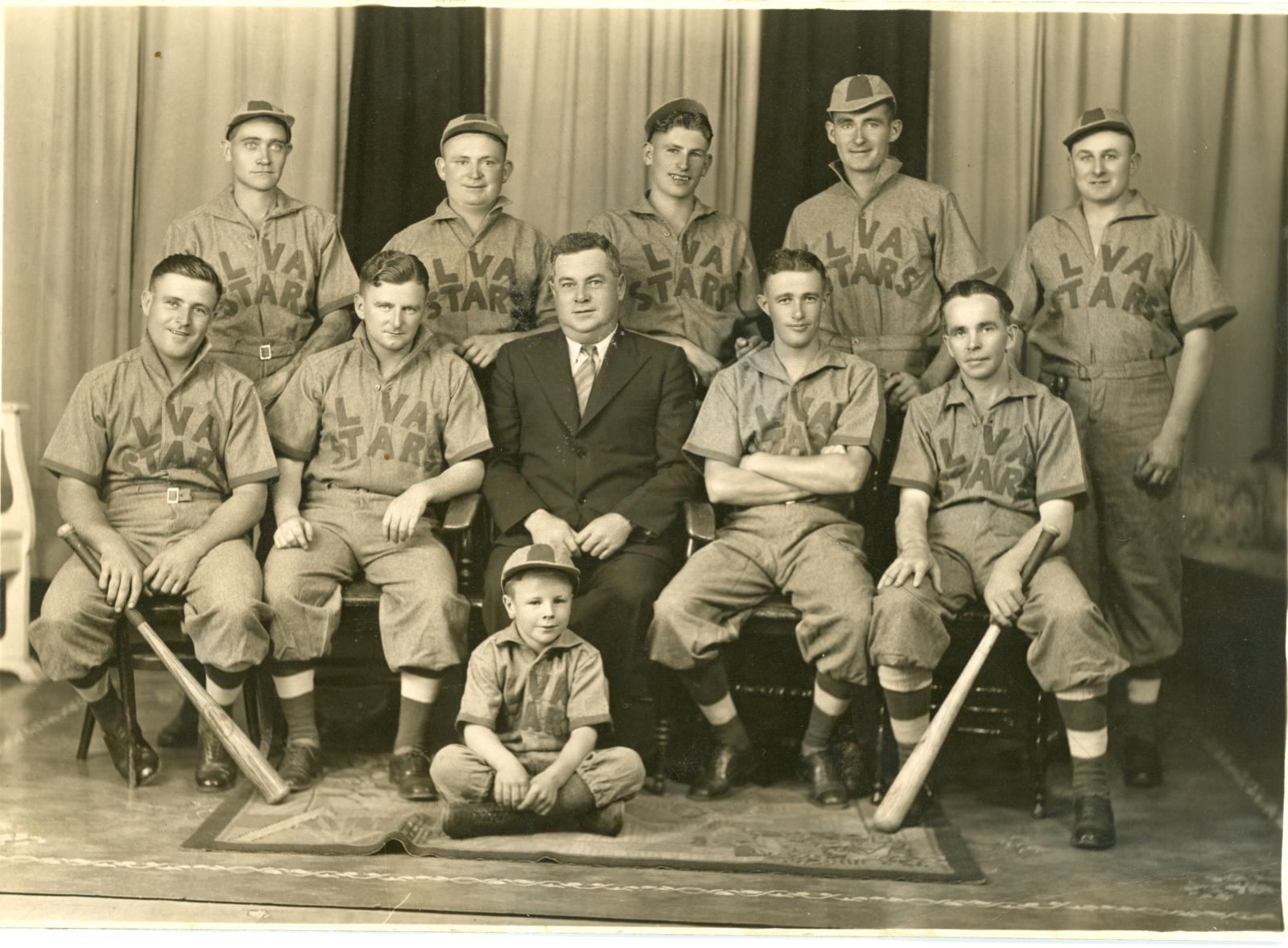
Although difficult to date, the above photo is of the Lake View and Star Team around 1936 or 1937.
The person in the middle wearing a suit could be Joe Thorn, General Manager of the Lake View Gold Mine and instrumental in establishing baseball in the Goldfields.
Photo courtesy of Eastern Goldfields Historical Society donated by Barbara Wray.
Although still in its infancy, remarkable progress was being made to stimulate its growth and to speed up the attainment of a good baseball standard. Therefore, baseball in the Goldfields looked to expand the playing opportunities by inviting Perth and interstate teams to visit Kalgoorlie. A Perth team, known as ‘Wests’, had visited Kalgoorlie in 1936 under the leadership of Micky Carr, a well-known Perth sporting personality. The games were umpired by G. Pascoe and played behind the Lake View dump and attracted impressive crowds in Boulder. The games were split with the first game going to Perth 24–15 and the second to the Goldfields 10–2 over 5 innings. Goldfields catcher J. Peart and Randall (outfield) from Perth were awarded trophies as the best players in the first game. Partington (Goldfields) and Lynch (Perth) picked up the trophies for the second game.
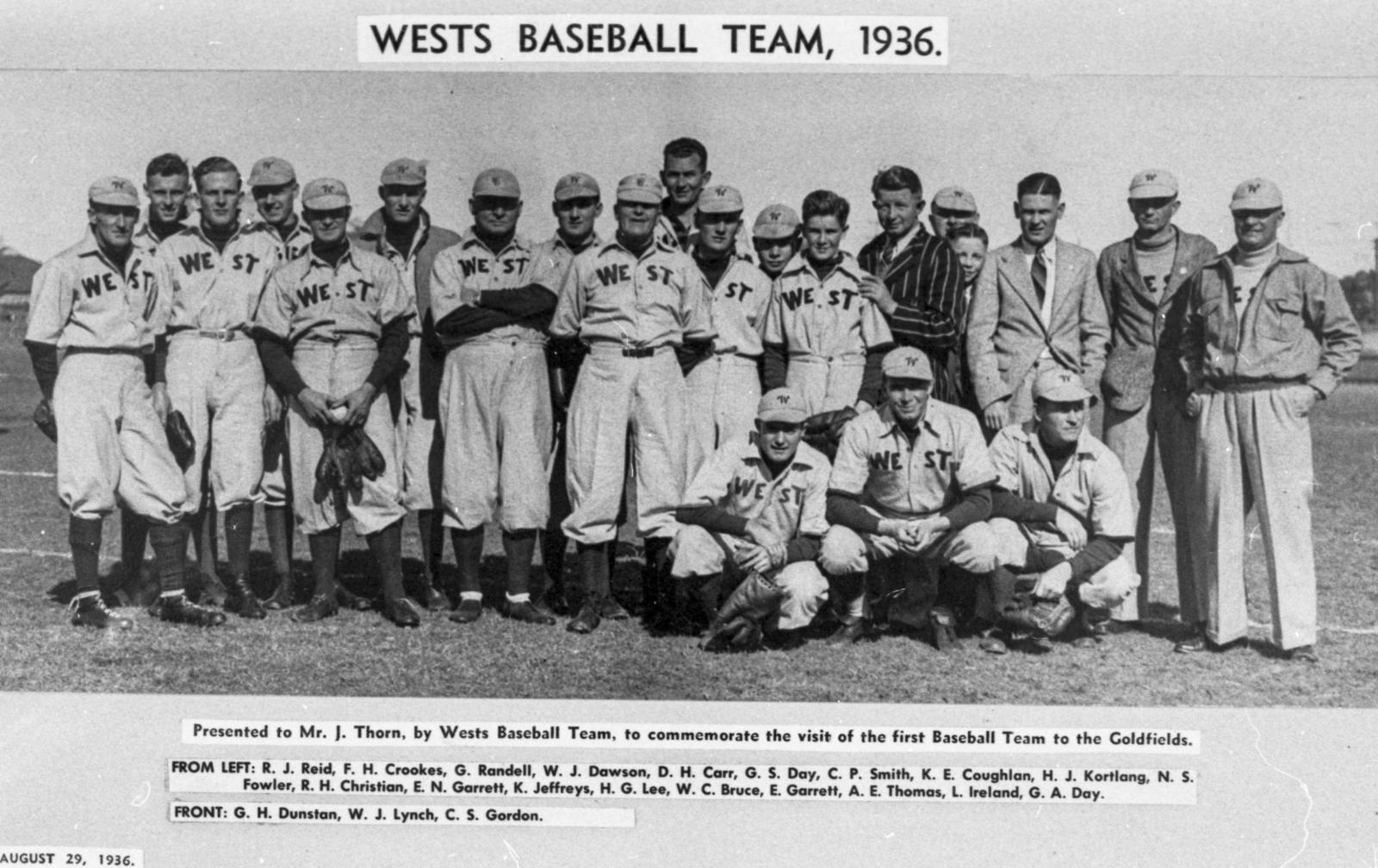
Wests baseball team, 1936.
Photo courtesy of Eastern Goldfields Historical Society.
In 1937 a vibrant league had been established with the four teams competing under the auspices of the Lake View and Star Baseball Association. On April 12, 1937, however, it was decided to change the name to the Goldfields Baseball League with Messrs J. Thorn, J. Hyton and C. Thielicke, appointed as Patrons of the League, Mr A. Ford as President; Mr W. Lowry as Secretary and Mr E. Hutcheson as Treasurer. They wrote to the WA Baseball League asking for a copy of its constitution so as to frame a similar constitution for the Goldfields League.
Later in April 1937, the Lake View team approached the Kalgoorlie Council to use the Kalgoorlie Oval on Saturday afternoons for baseball at an agreed price of one guinea (21 schillings or £1 and one schilling). A similar deputation had approached the Boulder Municipal Council to make its oval available for games too. Thus, the four teams of Lake View, Chaffers, Dodgers and Westers played each other in either Kalgoorlie or Boulder.
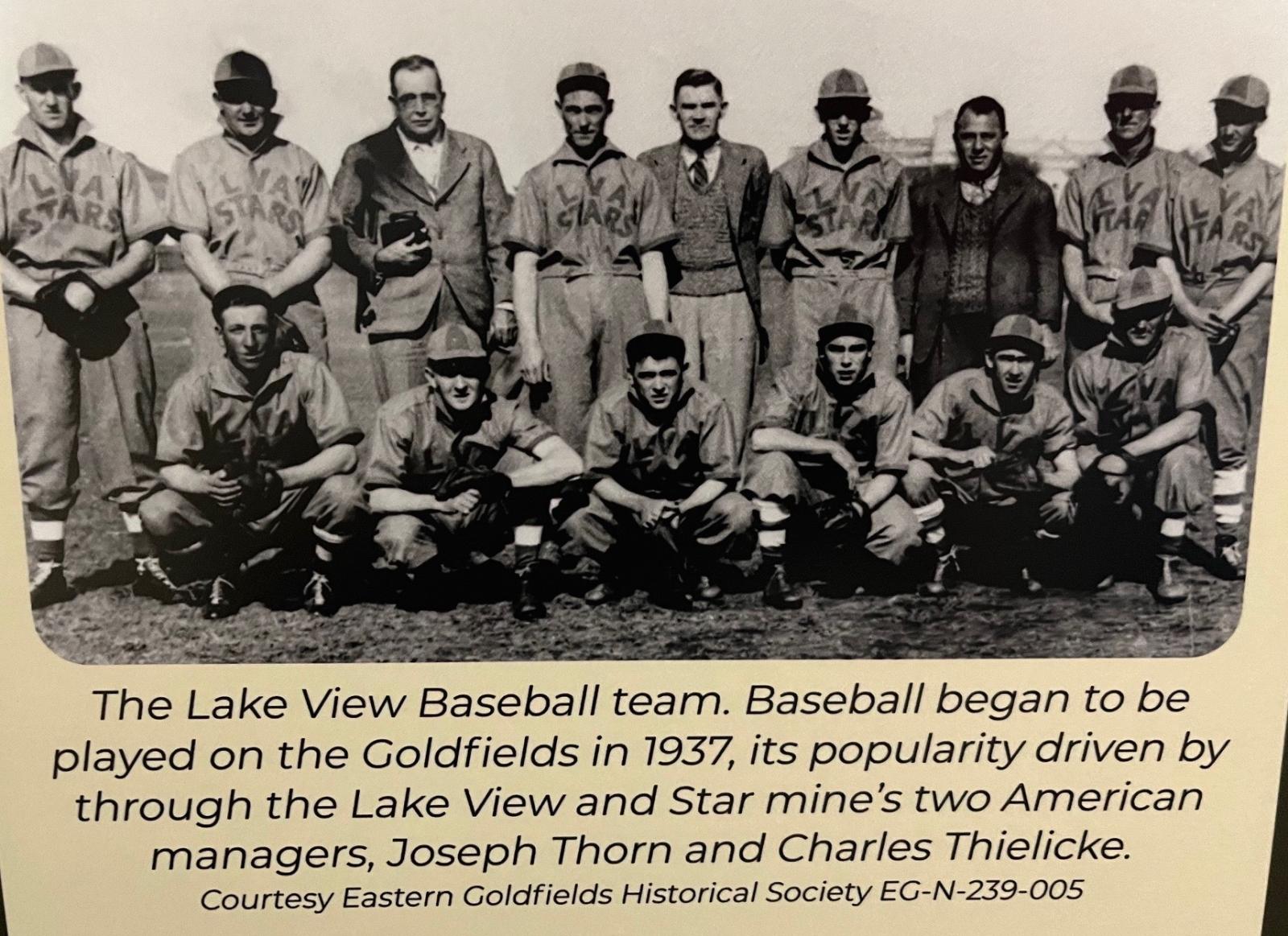
The Lake View baseball team.
It had been anticipated that with baseball being played in winter, the game would attract and be taken up by local cricket teams and clubs as preparation for their summer encounters—a development that was evolving in Perth. Unfortunately, this did not eventuate.
League games were played every Saturday, some at the Ivanhoe slime dump which was rolled and marked for the afternoon game. The game of baseball had taken Perth by storm and it was hoped there would be a similar reaction in the Goldfields. During this era and up to 1939, the standout players, umpires and coaches who provided inspiration to the younger men of the game included:
Westers: T. Sala, W. Lowry, J. Osmetti, Barney Osmetti, A. Dressa and G. Spence.
Lake View: W. Burbridge, D. Georgeson, T. Maloney, G. Noble, Power, Spence, Seymour and H. Carrington.
Great Boulder: C. Baldock, S. Maynard and W. Schwan.
Chaffers: J. Peart, P. Hodge and W. Langdon.
The inaugural premiers of the 1937 Goldfields League were Lake View.
On Saturday July 10, 1937, two baseball games between a team representative of the Goldfields Baseball League and the Railway Baseball Club from Perth were played on the Boulder Oval. The Railway Baseball Club played in the B Grade competition in Perth and contained five ex-Goldfields players but were no match for a much stronger Goldfields team, who ran out winners 29–9 and 22–13. The starting nine for the Goldfields team were: Maloney (pitcher), Spence (catcher), Seymour (1B), Jones (RF), Harris (emergency) and Power (CF) from the Lake View team; Osmetti (SS), Dressa (2B) and Wylie (3B) from the Westers team; and Peart (LF) from Chaffers. The umpires were Thielicke, Slatyer and Clarke.
Despite their infancy, local baseball was making great strides to stimulate public interest in the game. The appearance of the WA Claxton Shield team in 1937 on its return journey by train from Adelaide, after their initiation into the Australian Carnival Series, provided much needed quality and entertainment. WA had performed well in their first Claxton Shield series (August 1937) losing 2–5 to Victoria, 0–3 to South Australia and 0–4 to New South Wales. The Kalgoorlie line-up was Dressa (2B), Spence (catcher), Maloney (pitcher), Seymour (1B), Osmetti (SS), Peart (3B), Skahill (OF), Dawson (OF), Jones (OF) with Power, Partington and Shields as reserves.
The WA team contained some formidable players of the calibre of Dickinson, Crooks, Evans, Downing, Black, Nightingale, Lynch, Gilmour and Carr.
In 1937 a trip was made to Perth by a Goldfields team captained by D. Dressa. Kalgoorlie defeated a crack team of that period known as Tigers and were narrowly beaten by the State side. The next year Kalgoorlie defeated Hawks, a Midland Junction team, in a shut-out game at Sawyer's Valley, and they were in front when rain marred the second game against a combined Perth side. They suffered a set-back in their third game and were defeated by Wests, who were led by the indomitable M. Carr, but were not disgraced as the game ended with the score at 3–2. Kalgoorlie was captained on this visit by E. Seymour — one of the greatest first baggers in Australia.
Western Australia hosted the Claxton Shield Series in Perth for the first time in July 1938 and 18 players from Kalgoorlie travelled to Perth to witness the interstate games and to play against local teams. The team was mainly comprised of young players and two of these youths were later to turn out stars of Goldfields baseball — W. Waddell, later captain of Chaffers, and R. ('Tiddler') Hearn, a crack second baseman.
Later in that season, Hawks Baseball Club from Perth visited Kalgoorlie. The team was captained by Trevor Nesbit, then State vice-captain, and also included Charlie Puckett in their party, one of the greatest WA State pitchers. Puckett continued to pitch for WA until 1952 and was later inducted into the Baseball Australia and Baseball Western Australia Halls of Fame. He was also one of the best all-rounders of the 1938 Australian baseball carnival held in Perth.
The Hawks were defeated by Kalgoorlie in both games, with the Goldfields team putting up creditable performances.
As the game graduated and transitioned to grass ovals, it attracted other baseballers to the Goldfields. In 1939 the services of J. Reece — at that time a State pitcher for Victoria — were secured for Westers. Lake View obtained M. Booth, the South Australian interstate outfielder and Chaffers, not to be outdone, applied for and received J. Considine and C. Young from Perth. It also proved a great year for Kalgoorlie baseball when a team visited Perth and defeated M. Carr's team (Wests) and the Western Australian interstate team. Their victorious run was ended when narrowly defeated by Press, led by Charlie Puckett.
Games in the Goldfields at this time were played on a Saturday and football on a Sunday. “There wasn’t much to do apart from playing sport” – said Frank White, a second baseman with Chaffers.
By 1939 baseball had been built up to a greater height than ever before in Kalgoorlie, and seven teams were competing for the premiership. They were Lake View, Kalgoorlie, Chaffers, Colts, Diorites, Dodgers and Cardinals. The Goldfields exponents had, in several years, steadily carried the game forward and provided a standard of play well worth seeing and appreciating.
However, as with baseball in Perth, World War II from 1939–45 impacted on the development of the game and both Leagues went into recess.
CHAPTER 3:
1940s – An uncut diamond
Early in 1940, local baseball as an organised sport went into recess due to the loss of players. Following the war, however, baseball emerged again in 1946 with four teams — Chaffers, Lake View, Cornwall Dandies and Kalgoorlie. Lake View and Dandies played off in the grand final with a local supporter donating the premiership cup, known as the ‘Sportsman’s Cup’ and a replica of the cup to each winning team member.
South Australia's interstate team also paid a visit and were defeated by a combined Goldfields team.
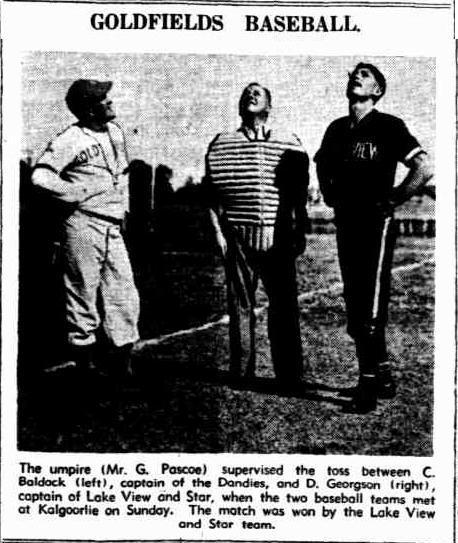
September 24, 1946.
Article courtesy of 'The West Australian'.
At the start of the 1947 season, baseball reached a new height with the League expanding to seven teams competing for the premiership – Lake View, Kalgoorlie, Chaffers, Colts, Diorites, Dodgers and Cardinals. It was indicative of the enthusiasm of the League to steadily improve and carry forward the game and provide a standard of play that “was well worth seeing and appreciating”.
In 1947, one particular player attracted to the Goldfields was Jim Puckett, of the famous South Australian Puckett family, who had represented South Australia in 1946 and also won the Capps Medal for the fairest and best player in the South Australian League. As a right-handed pitcher he influenced the local game with his skill level. Jim was later selected to play for the WA State team in the Claxton Shield series in 1948 and so became the first WA country player to achieve that distinction. He became a stalwart of Chaffers and by 1948 was captain-coach, involved in umpiring and a mentor and influencer for aspiring juniors.
In October 1947, a selected Perth team again played against the Goldfields, with both teams having a predominance of younger players. F. Day and F. Shaw had represented WA in the Claxton Shield series in Adelaide and provided experience for the visitors. N. Pratt (1B) from the Goldfields team was selected and later played for Australia in an exhibition game of baseball at the 1956 Olympics after many years of baseball playing for Nedlands BC and Western Australia. The teams for that game were:
|
PERTH G. Day (Captain) |
GOLDFIELDS T. Maloney |
As players improved their skills, so did the umpires. Charles ('Concrete') Baldock was the first local umpire to be appointed to the panel for a 1947 Country Carnival.
During this decade, George Dickinson, who was considered to be one of the finest Australian pitchers ever produced, began work in the Goldfields, which attracted significant crowds to watch his feats. George was a stalwart of the WA Baseball League and WA Claxton Shield Team for many years (1937–1952) and later achieved All-Australian team recognition and Western Australian and Australian Baseball Halls of Fame status.
Barry Dickinson, son of George Dickinson, recalls listening to his father recall his baseball encounters and experiences in the Goldfields especially about “playing on the flat tops of the tailing dumps”; a prospect he could never appreciate until seeing “that surface of packed clay and small rocks, hard as a bitumen road and unforgiving on fabric and flesh when one decided to slide”.
Meanwhile, League and Juniors began to thrive, with the 1948 teams comprising Chaffers, Colts, Kalgoorlie, Lake View, Dodgers and Cardinals.
In 1949, a strong but young Goldfields side visited Perth and were untroubled in defeating a Metropolitan team 10–5 on Langley Park. The Goldfields team were always in control, playing steady and sound baseball. Ron Dellar, a 20-year-old pitcher, who later played Claxton Shield for WA in 1950 and 1951, “was composed on the mound with splendid control and is fast by the best standards”, wrote the 'Kalgoorlie Miner'.
CHAPTER 4:
1950s and 1960s – A well-cut diamond
The 1950s and 1960s marked a golden age for baseball, with the region boasting the strongest competition outside of the Perth metropolitan area. Brian Harvey recalls “that games were played on the Kalgoorlie and Boulder ovals. The training sessions by the clubs were held on gravel sports grounds around the town, with only the selected Goldfields squads training on grass ovals on a Sunday morning with an 8:00 am start. Baseball was a winter sport at this time and often the ice had to be broken!”
The local competition comprised the Goldfields League, ‘B’ Grade and Junior games through the following clubs:
Dodgers: Club colours - Fawn/Red
Kalgoorlie: Club colours - White/Blue
Cardinals: Club colours - Maroon/Gold
Chaffers: Club colours - White/Red
Colts: Club colours - ????
The Cardinals eventually folded and were replaced by the Piccadilly Saints, whose Club colours were Black/Red/White.
|
Chaffers J. Puckett |
Cardinals C. Read |
Dodgers J. Warburton |
Kalgoorlie B. Henniker |
Colts L. Perham |
Umpires officiating in local and interstate competitions during this period were: J. Peart, T. Sala, L. Wylie and C. Baldock.
Junior baseball was re-introduced to the Goldfields Baseball League around 1956–7 when they canvassed junior high schools in Kalgoorlie.
As the game continued to gain prominence in the community, Americans Frank Moser and Ben Teale influenced the development of the Dodgers Baseball Club, which went on to dominate the local competition for the next 15 years. Eventually, the Kalgoorlie Baseball Club rectified the uneven balance. Seven teams comprised the Goldfields Baseball League in those years – Chaffers, Dodgers, Colts, Cardinals, Kalgoorlie, Diorites and Lake View.
On July 29, 1950 a strong Perth metropolitan team visited the Goldfields to play two games against the home team. In front of large crowds, each team was successful with a 2–1 win in favour of Perth in the first game and a 3–1 win to the Goldfields in the second game. The Perth team comprised some strong players with Claxton Shield experience, including T. Nisbett, C. Puckett, F. Day, K. Denham, D. Friend, F. Goodwin, S. Jones, E. Melloncelli, J. Pestell and N. Pratt. The Goldfields team comprised J. Warburton, A. D’Alton, R. Verran, W. Nunn, C. Gard, J. Puckett, T. Hearn, C. McCreed, L. Fuller and R. Thurley.
In the 1950 season, Dodgers had been the most dominant team in the local competition, winning every game until they met Chaffers in the grand final; eventually going down 6–2. The game was played on Boulder Oval. From the first pitch by Jim Puckett (Chaffers), Verran (Dodgers) hit a safe hit to left field and from that moment the game was truly on.
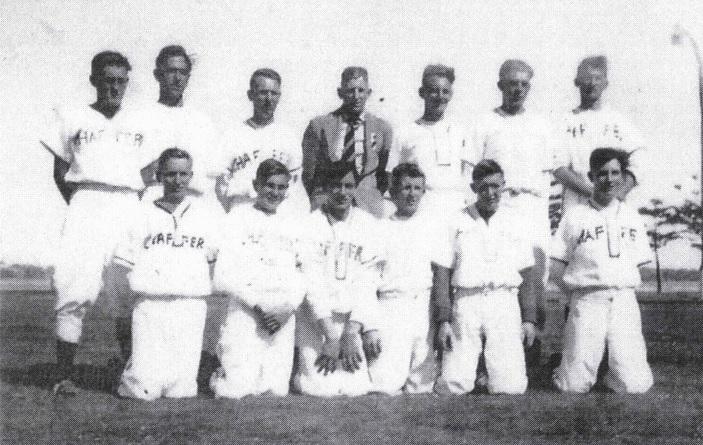
A photo of Chaffers Baseball Club in the 1950s taken on the Perth Esplanade during a regular visit to Perth
to play the Nedlands Baseball Club.
Back row (left to right): Ern Treby, Alan Middleton, Ian Thorburn, Jack Peart, Robert Craig, Leo Tesser, Ian Mitchell??
Front row (left to right): Jack Priest, Des Thompson, Steve Mosconi, Jim Sullivan, John Medlen, Ron Thornton.
Photo courtesy of the 'Kalgoorlie Miner'.
During the mid-1950s, the League consisted of five baseball teams, namely Dodgers, Kalgoorlie, Railways, Chaffers and Cardinals. Teams were selected from the following players and games were noted for producing first-class exhibitions of baseball. Clubs reported increasing numbers of registered players and good crowds attended the games.
|
Chaffers Roy Graffin |
Railways C. McCreed |
Dodgers J. Warburton |
Kalgoorlie Rogers |
Cardinals C. Read |
In the 1957 season Chaffers played the Dodgers in the grand final of the Goldfields Baseball League when Chaffers beat Kalgoorlie in the preliminary final 7–0.
During this time, Goldfields hosted two games against a Colts side from Perth. In the first game, Kalgoorlie ran out easy winners 6–0 due to batting strength and numerous errors from the Colts. However, in the second game next day, Kaye Greenham (a Claxton Shield player) showed his class for the Colts by pitching four immaculate innings and then starring at third base. The games demonstrated that baseball in the Goldfields was very, very strong with some classy players and that they could compete against visiting Perth teams with distinction.
The line-up for the Goldfields was Jesson, Smith, Hughes, Thornburn, McCreed, Weir, Chester, Pettit and Throssell. As the Colts team had State selector Merv Muggleton as captain coach, there was an opportunity and incentive for Grenville Kelly, Dale Hughes and Don Pettit to catch the selector’s eye.
Although the level of competition in Kalgoorlie was strong, players had to migrate towards the WA Baseball League in Perth in order to improve their skills and reach a higher level. However, the depth of talent in Kalgoorlie was enormous as the following players were selected to represent Western Australia in the Claxton Shield, with some receiving All-Australian team recognition.
Jack Warburton – catcher (1952, 1955)
Ron Dellar – pitcher (1950, 1951)
Ian Thorburn – pitcher (1954, 1955)
Colin Trezona – pitcher (1964, 1965, 1966) All-Australian Team 1965, 1966
Grenville Kelly – pitcher (1964, 1966)
Dale Hughes – catcher (1961,1962, 1963, 1964, 1965, 1966, 1967, 1969, 1970, 1971) All-Australian 1963, 1965 and Australian Team, Manilla 1969
Ray Cook – infield (1966, 1967, 1969, 1970) Australian Team, Manilla 1969
Neville Pratt – infield (1949, 1955, 1956, 1957, 1961, 1962, 1968) Olympic representative 1956
Ron Thornton – catcher (1955, 1956, 1957, 1959, 1960, 1961, 1962, 1963, 1964, 1965)
Kevin Peart (1966)
To continue the growth of quality baseball in the Goldfields, several teams were invited to Perth with a reciprocal arrangement for Perth teams to visit Kalgoorlie.
The Kalgoorlie Railways Baseball Team travelled to Perth in the early 1950s to play Swan Districts. The matches were played at the Midland Oval on a Sunday and Monday. In the 1951 State Claxton Shield team to play in Adelaide, Ron Dellar (pitcher) from the Goldfields team was selected to play after also being selected in the 1950 State team, where he had limited opportunities to demonstrate his ability.
Colin Smith, a local and typical 14-year-old teenager in 1951, records his story of involvement in baseball which sheds light on the opportunities that existed at that time:
“In 1950 I had finished primary school at North Kalgoorlie and started at Boulder Central School. Now I didn’t know a soul out there but I soon met up with the Graffin twins, Ron and Roy, and we became quite firm friends. The deputy headmaster was one Bill Liddicoat and Bill was a very sports-orientated person.
"Fairly early in the year, the Graffins knew a baseball player playing in the Goldfields League. I can’t remember his name now. So, they introduced a form of baseball to the schoolyard. I cannot remember what we used for bats but we used a tennis ball and no gloves and we started to play our form of baseball in the schoolyard at every break.
"After several weeks of this, I was stopped by Bill Liddicoat on my way back to class and he said could I get everyone who wanted to play real baseball to be at the Boulder Oval on the following Saturday morning at 9.00 am. There were literally dozens at the Oval on Saturday morning and we all waited with Bill.
"Just after 9.00 o’clock a lone cyclist appeared off the street with a hessian sugar bag over his shoulder. That lone cyclist was Jim Puckett and in the sugar bag were at least 9 old baseball gloves, a set of old catching gear and a few bats and balls. Jim Puckett (Chaffers) and Bill Liddicoat (Cardinals) both played senior baseball in the Goldfields Baseball League.
"On the Saturday mornings a couple of teams were picked and we would have a game. What was happening was that other people were doing the same thing at the High School with the same age level and after several weeks we began a competition between Boulder Central and the High School. I personally don’t remember any of the High School players except one and that was Neil Mitchell and he, along with the Graffin twins and myself, became very firm friends in the years to come.
"We played this competition for the rest of the 1950 winter – the baseball season. It recommenced in 1951 but there was no junior competition in the Goldfields League, but I recall a visiting junior team from Perth accompanying a senior team coming to Kalgoorlie and playing a game against a local Goldfields team. I cannot remember all the players from the Goldfields team but from the Boulder Central and High School teams, Neil Mitchell and myself were included in that junior team.
"1951 was the year that we all turned 14 and the students of Boulder Central, including myself, generally left school when we turned 14.
"Jim Puckett and Bill Liddicoat knew this and, there still being no junior competition in the Goldfields League, realised that we could be lost to baseball after leaving school.
"So Jim, who was a member of the Chaffers Baseball Club, together with a few other senior players, broke away from the Chaffers team and together with us juniors, who were leaving school, formed a second Chaffers baseball team to play in the senior ranks.
"Jim was Captain/Coach of that team and certainly taught us all a lot about baseball. He was also the number one pitcher. We played in the grand final in our first season, beating the senior Chaffers team to get there. We then played Dodgers in the grand final. I cannot remember if we won the grand final in our first year or if it wasn’t, then the next, but we certainly won it within the first two years.
"Baseball was played during the winter and the games were played on Saturday at the Kalgoorlie and Boulder Ovals, sometimes with two games being played at either end of the oval. Practice was on Sunday mornings on a gravel open space behind Kingsbury Park and near the tennis courts behind the Lord Forrest Swimming Pool.”
Reference: Oral history of Colin Smith, Baseball WA Museum & Archives 2023
The status and strength of baseball in the Goldfields was constantly receiving justified recognition. In early May 1952, members of the strong South Perth Baseball Club, not involved in a State trial game, visited Kalgoorlie for a series of games over the weekend. A Metropolitan representative team played a combined Goldfields team on June 22, 1952 to give State selectors an opportunity to try out several young players on the verge of State selection for the forthcoming Claxton Shield series. Thus, the Metropolitan team omitted players of the calibre of Charlie Puckett, George Dickinson, Jim Dore, Neville Pratt, Eric Goodwin, Brian Cruchett and Alan Hickinbotham, all of whom were State representatives. However, the Goldfields Team was seen as being particularly strong with Jack Warburton and Jim Puckett captaining the side and the Metropolitan team included some very experienced and proven performers.
| Goldfields Team R. Craig A. D’Alton L. Delamotte C. Gard I. Hamilton C. McCreed W. Nunn W. Polmear J. Puckett (Capt.) J. Sullivan R. Thornton R. Verran J. Warburton |
Metropolitan Team A. Bell R. Booth D. Callanan N. Corker K. Denham G. Forsaith R. Frankish W. Gill R. Gooch B. Jeffreys A. Melloncelli B. Rigg G. Shom |
The 1952 WA Claxton Shield team went on to win the Claxton Shield for the very first time – a major achievement after being so close on several occasions since 1937. Jack Warburton had the distinction and privilege of being a member of that team.
A feature of 1953 was the invitation extended to the Goldfields to participate in the Coronation Baseball Carnival in Adelaide, which corresponded with celebrating the coronation of Queen Elizabeth II. While the full State South Australian and Victorian teams played each other, there was also a Country Carnival, including teams from Broken Hill, S.A. Country, Mount Gambier and the Kalgoorlie Goldfields.
A young member of the Goldfields team, 16-year-old Colin Smith, vividly recalls the experience:
“The Goldfields Baseball League was a very strong competition. But as a combined Goldfields team we had no competition to play against apart from Perth. Jim Puckett, with his family contacts still in South Australia, arranged for a Goldfields side to be entered into a country carnival in South Australia. This was played early end of May beginning of June 1953, which was a long weekend for a holiday for the coronation of Queen Elizabeth II.
"I realised that those that made that trip, because of the time of the year, were the only ones available to go. The players ranged from the very best of the Goldfields to indeed the weakest. I recall that from the beginning of the season of 1953 the League raised hundreds of pounds to help finance this team. I recall that the trip cost each player five pounds, which included a tailor-made blazer. The Graffin twins, Neil Mitchell and myself were included in that team. We travelled two nights by train from Kalgoorlie to Adelaide and stayed at a hotel in the city somewhere.”
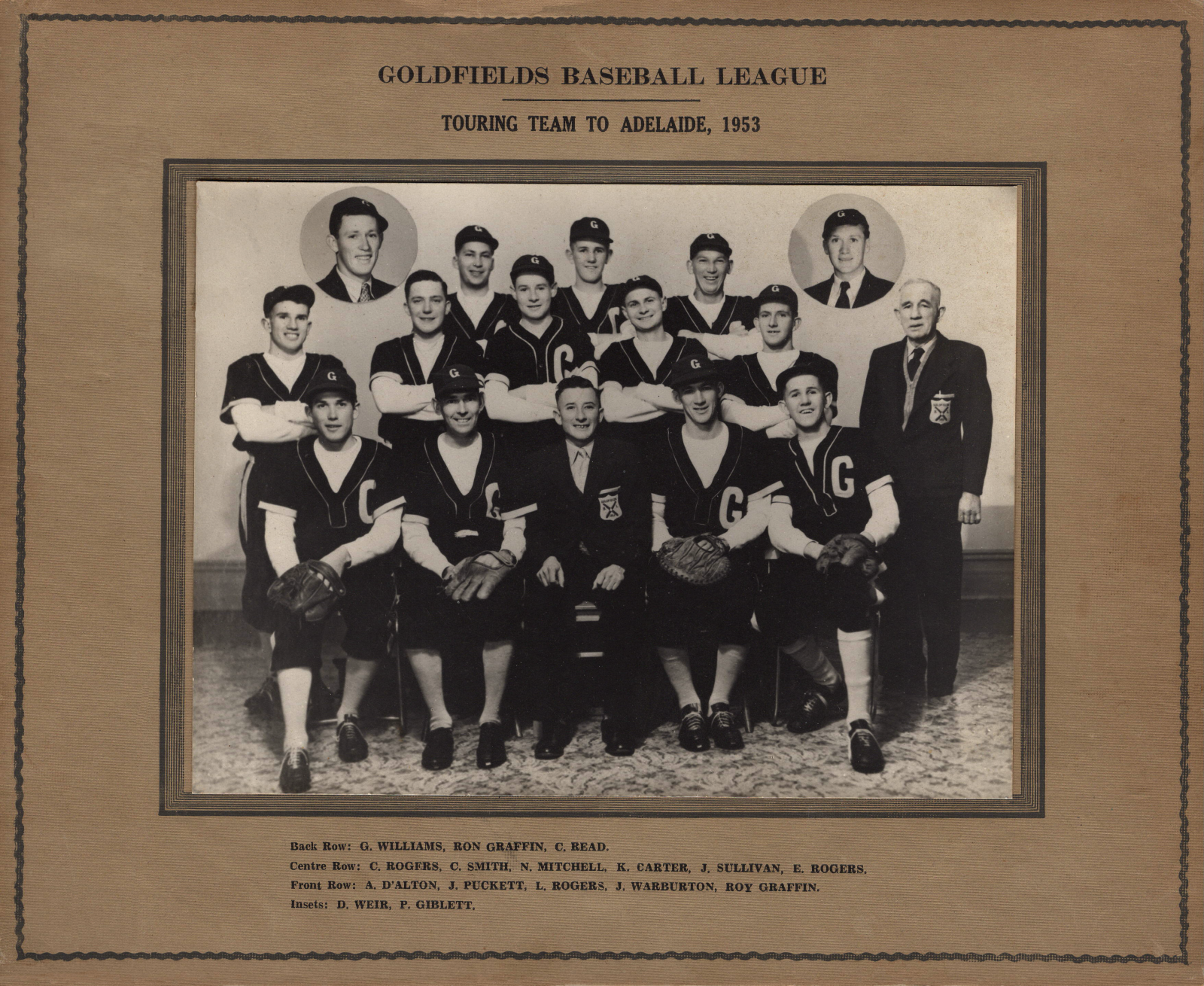
1953 Goldfields Team for the Coronation Carnival in Adelaide.
Players: Jim Puckett (Captain), Jack Warburton, Phil Giblett, Jim Sullivan, Allan D’Alton, Colin Smith, Kevin Carter, Cliff Read, G. Williams, Ron Graffin, Clive Rogers, Neil Mitchell, Roy Griffin, Don Weir and Lance Rogers (Manager).
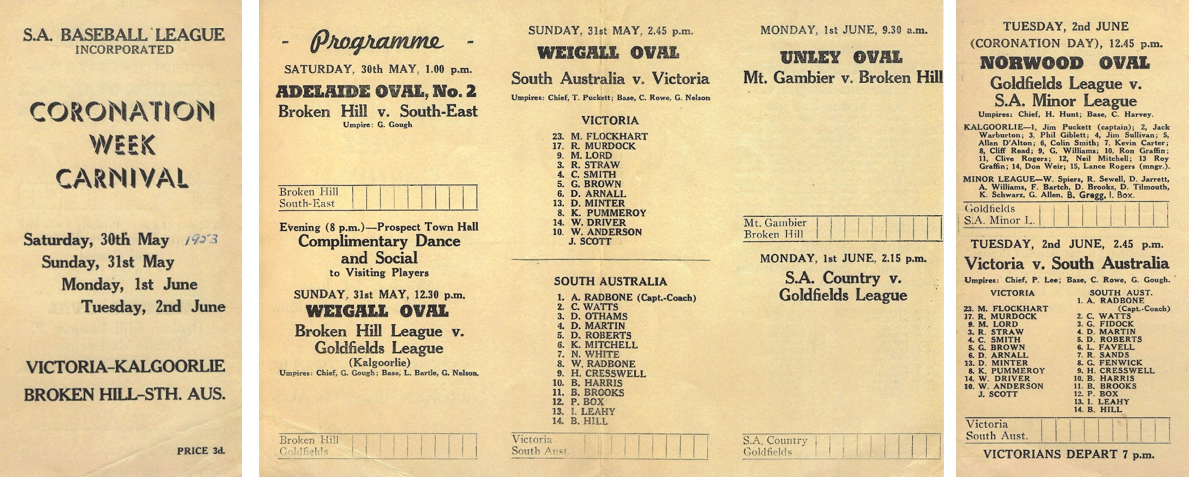
Photo and program courtesy of Colin Smith.
As baseball developed in the 1950s, so interest was galvanized to expand the sport in other country towns. Eventually a Country Week Carnival was established in 1956 with the first ever Country Week Carnival organised in Perth. Teams competed for the ‘Joe Thorn Trophy’ – the ‘grand old man of Goldfields baseball’. Joe was Vice-President of the Chamber of Mines of Western Australia in 1944–45 and he eventually passed away in Perth in 1975. It was fitting that the Country Carnival Week awarded the Joe Thorn Trophy to the winners in recognition of his services to baseball.
The result of the first competition for Country Associations in 1956 was Kalgoorlie (1), Collie (2), Bunbury (3) and Katanning (4). Baseball had only been played for two years in Bunbury and Katanning. Under the guidance of former South Perth ‘A’ grade player Gil Eddington (Katanning) and former State player Bruce Jeffries (Bunbury), these two towns performed well but were outplayed by the Goldfields team 17–1 and 24–3 respectively. In the final, Goldfields held off a strong Collie team winning 9–7. Jack Warburton won the trophy for the fairest and best player and he, together with Ian Thorburn and John Jessop, were invited to play in a State trial game.
The Goldfields later went on to win in 1957, 1959, 1960, 1961 and 1963. The 1958 title was won by Bunbury with Colin Trezona as pitcher – so Colin was a member of every winning team during at that time. In the game against his former team (Goldfields), Colin had 10 strike outs, 2 walks and 8 hits in a close game which Bunbury won 6–5.
At the same time, the West Australian Baseball League was adamant that the competition be exploited to the fullest. In the 1956 WABL Annual Report, Mr M. Scharf (Secretary) reported:
“There is unlimited enthusiasm and talent in these country centres and it is our responsibility to see it is not neglected.”
Meanwhile, baseball continued to flourish in Kalgoorlie with the Goldfields team dominating the Joe Thorn Trophy Country Carnival – winning the trophy ten times in twelve years. The 1957 team was star-studded with the victorious line-up featuring Colin Trezona, Dale Hughes, Ian Thorburn, Jack Warburton and Don Pettit. Getting into the starting line-up was a monumental task for some.
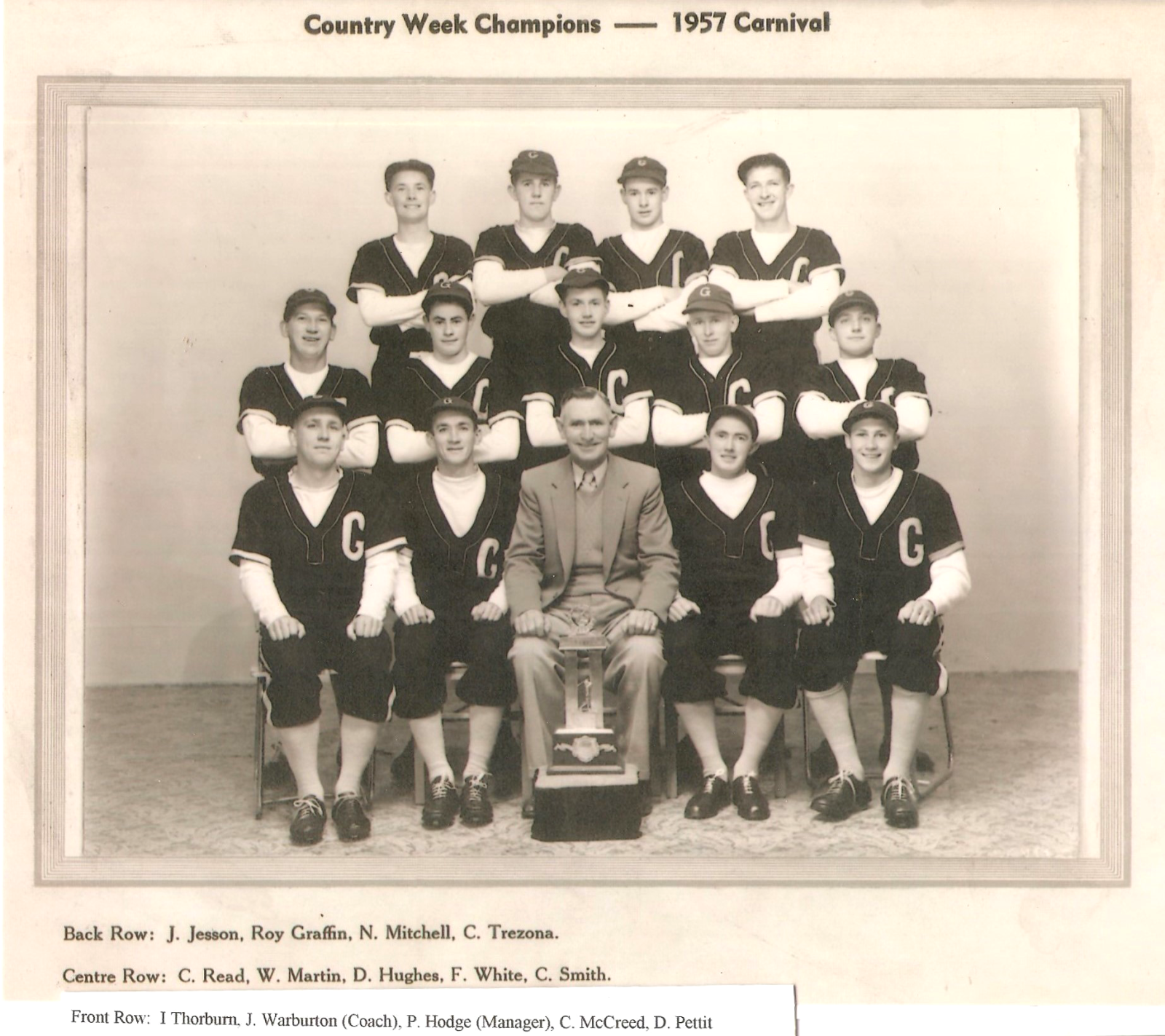
1957 Country Week Champions.
Photo courtesy of Colin Smith.
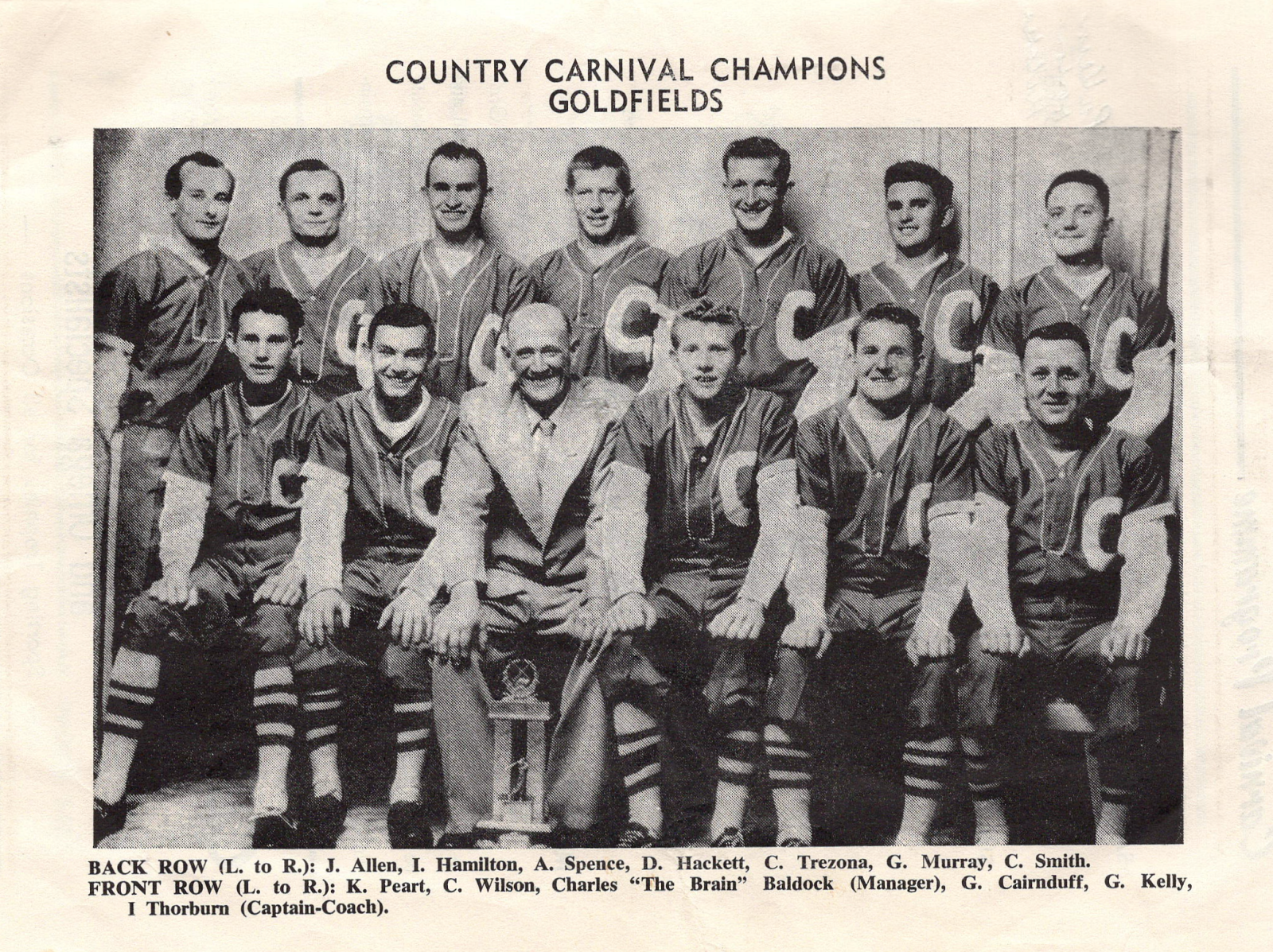
1961 Country Week Champions.
Photo courtesy of Colin Smith.
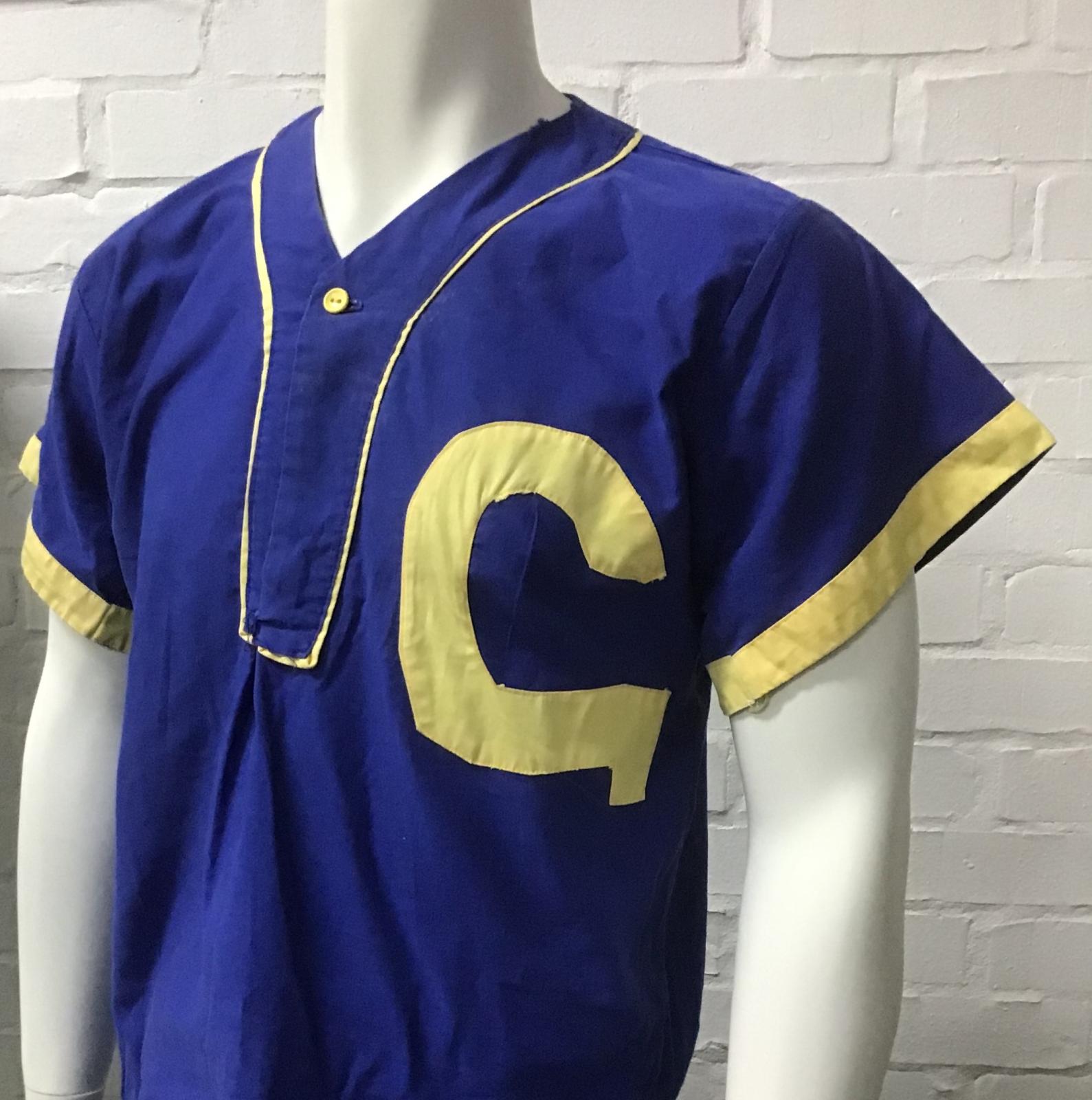
1961 Goldfields representative baseball team playing top.
Uniform courtesy of David Fraser.
In 1961, Goldfields, Bunbury, Armadale and Wagin-Narrogin competed in Perth, playing games at Ozone and Langley Park from Saturday 3rd June to Monday 5th June. Calvin Wilson, a member of that victorious 1961 team, records his memories:
“I was blessed to be part of an era and be able to play a small role and participate occasionally (still a junior, included in a couple of Country Weeks, playing on the Ozone Ground, getting a run at right field in the 9th, proud as punch I was) with such outstanding, multi-talented sportsmen, and even better blokes to boot. Great memories. Great ball players. Great men.”
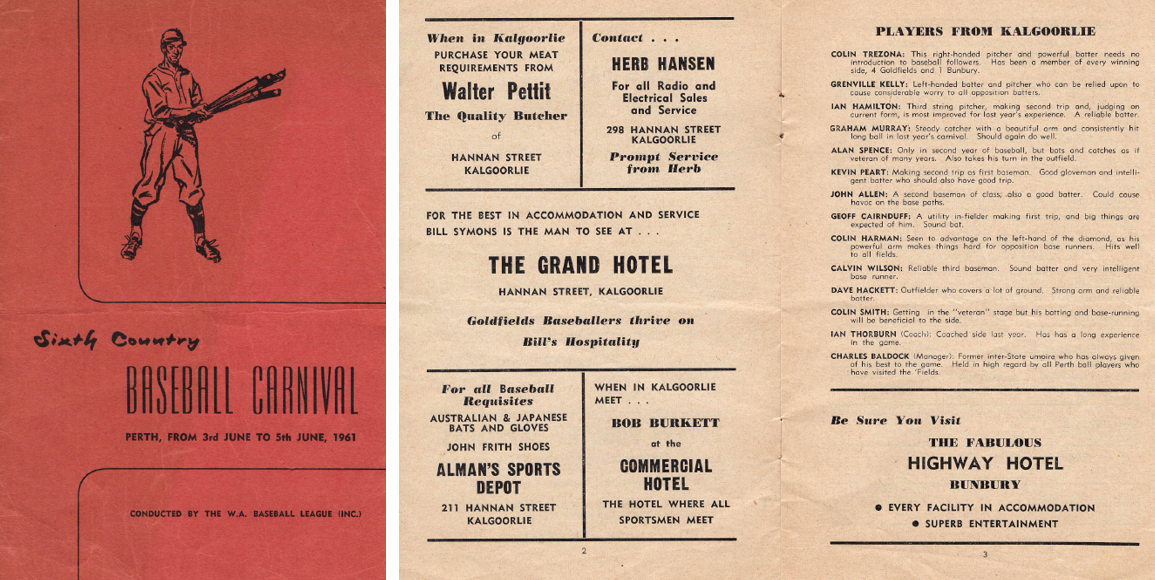
Program donated by Colin Smith.
To enhance the quality of the 1961 competition, and to present the opportunity to the public and visiting country teams, the West Australian Baseball League used the occasion to showcase the finest WA players with a Possibles v Probables game to select the 1961 Claxton Shield team to play in Adelaide. There were some formidable players in the line-ups.
|
PROBABLES N. Macey (Coach) |
POSSIBLES R. McFarlane (Coach) |
Junior baseball at the Carnival was not neglected either, with a State Colts team playing a Combined Country team. The State Colts team contained a player who later went on to become a great WA baseball player and represented Australia – Mel O’Hern.
|
STATE COLTS TEAM R. Cox (Wembley) |
In 1962, the Country Week Carnival saw teams from Kalgoorlie, South Suburban, Bunbury, Collie and Narrogin-Wagin participate, with Bunbury being the hosts.
|
Narrogin-Wagin Keith Russell |
Goldfields Colin Trezona |
Bunbury Colin Welsh |
Armadale-Medina C. Ried |
Collie Barry Annandale |
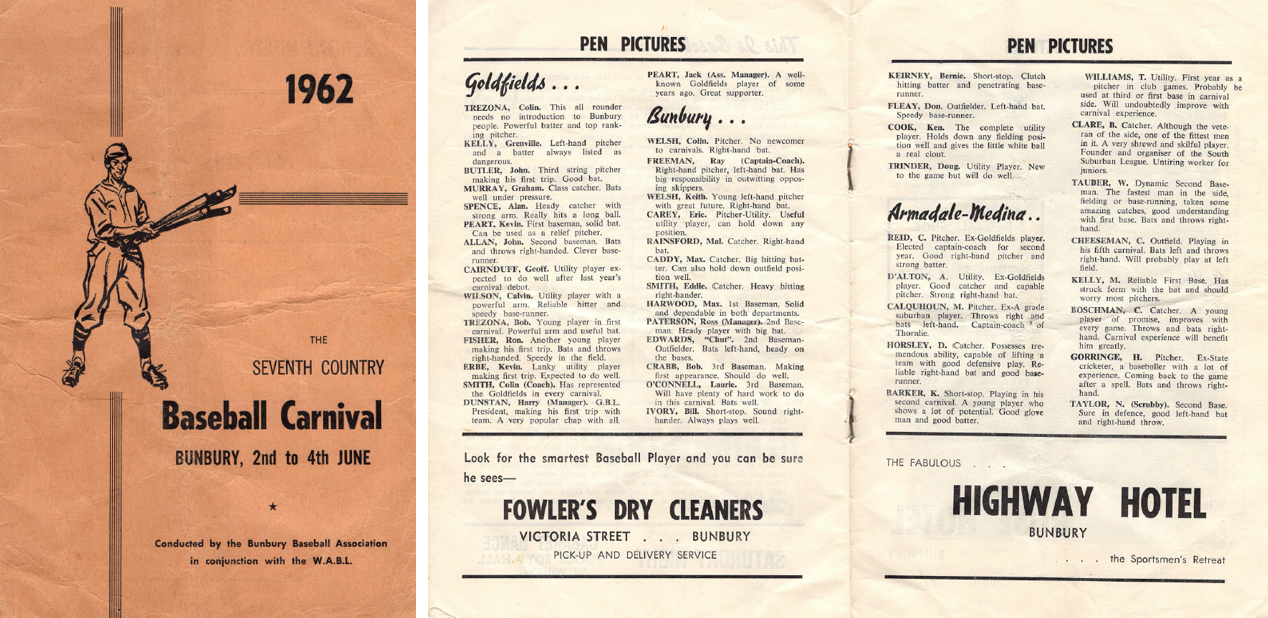
Program donated by Colin Smith.
At the same time, a combined country side beat a State team 1–0 in an errorless display of baseball.
The 1964 Carnival was hosted by the South Suburban League at the Medina Oval. Teams from the Great Southern and South Suburban Baseball Leagues, Bunbury and the Goldfields competed, with many of the players from 1962 again representing their zone. The Great Southern Baseball League comprised:
| K. Russell (pitcher) Narrogin E. Johnson (catcher) C. Brown (pitcher) Tigers/Katanning V. Bunter (catcher) Tigers/Katanning R. Smith (1st baseman) Tigers/Katanning J. Horn (catcher) Wagin D. McMullen (2nd baseman) B. Lanigan (2nd baseman) D. Wheeland (shortstop) G. Johnson (shortstop) Narrogin G. Dunne (3rd baseman) Narrogin R. Thorne (outfield) L. Hammill (shortstop) N. Aylmore (outfield) A. Reynolds (outfield) |
In 1965, a team of Americans from the radio base at the North West Cape entered the Country Baseball Carnival held in Perth from 1–3 June. Other teams to compete were Kalgoorlie, South Suburban (the defending champions) and Bunbury. The Goldfields team comprised Colin Trezona, Kevin Peart, Grenville Kelly, Calvin Wilson, E. Hardy, David Fraser, Ernie Shackleton, P. Dunstan, D. Hackett, I. Hamilton, C. Smith and R. Trezona.
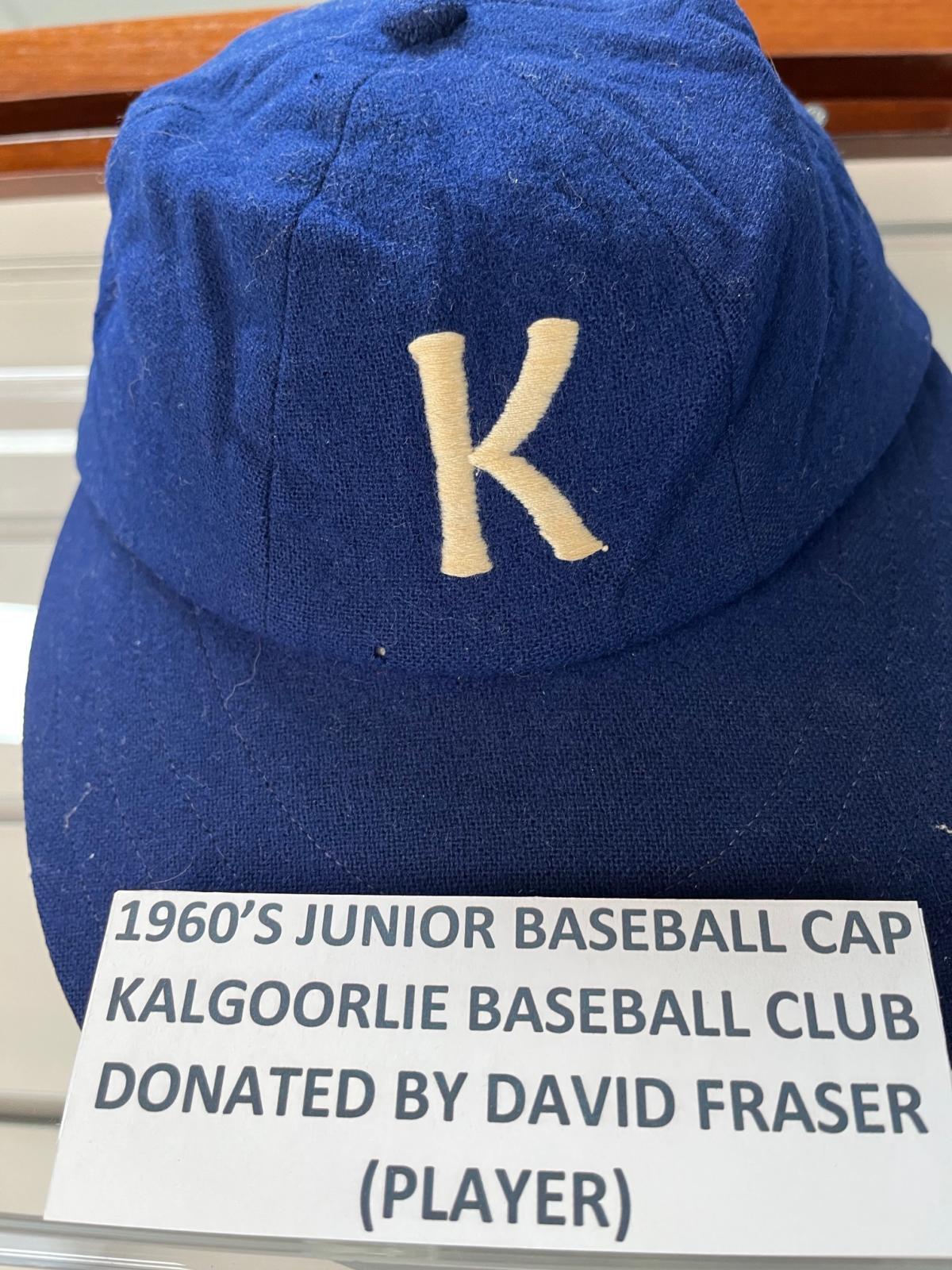
Kalgoorlie baseball cap c. 1960s.
Donated by Club Captain David Fraser.
In 1960, a young sporting talent emerged in the Goldfields junior ranks. Dale Hughes attended Kalgoorlie Central Primary School and later the Eastern Goldfields High School. He excelled in three sports – football, cricket and baseball.
As a junior he was attracted to baseball while cycling home one evening. He tried out the sport and was soon playing second base. When the team’s catcher was transferred to Perth, he was offered the role as he was also the wicketkeeper for the Kalgoorlie and State cricket teams.
He left the Goldfields at 19 to pursue his sporting career in Perth and was soon juggling his three sports of football, cricket and baseball. Frank Day, a prominent Claxton Shield baseballer, invited him to play with the Nedlands Baseball Club as a catcher and he was soon playing alongside great role models in Neville Pratt, Ray Cook and John Kelly. Dale later transferred to Wembley Baseball Club.
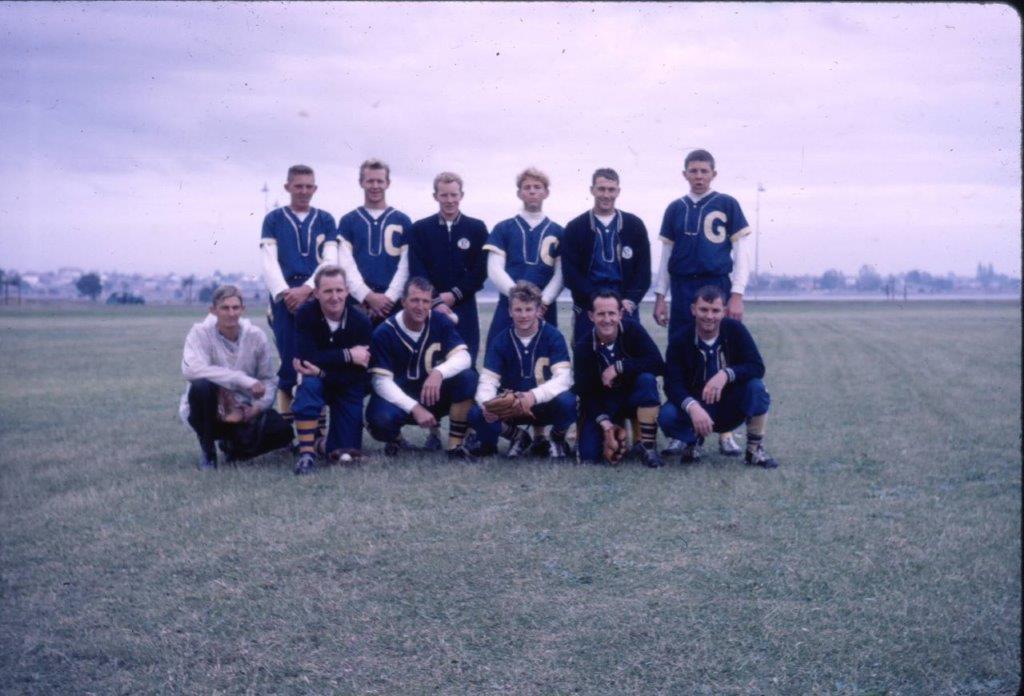
Goldfields Team c. 1962.
Back row (L-R): Jim Peart (Kevin Peart’s brother), Kerry Hosking, Geoff Cairnduff, Peter McCabe, Don Pettit, David Dunstan.
Front row (L-R): Barry Pascoe, Grenville Kelly, Colin Trezona, Ernie Shackelton, Bevan Kelly (Grenville Kelly’s brother),
Calvin Wilson.
Photo courtesy of Calvin Wilson.
A defining moment for baseball in Australia was when the 1969 Australian team was selected to play on foreign soil in an Asian Series in Manilla, Philippines for the very first time. Dale Hughes (catcher) was selected along with his Goldfields team mate Ray Cook. Ray was third baseman and was adjudged Australia’s most valuable player in the tournament. As Dale Hughes remarked:
“Two Kalgoorlie boys came home smelling of roses after they had helped Australia qualify for the future Asian Federation series for the very first time and put Australian baseball on the international scene.”
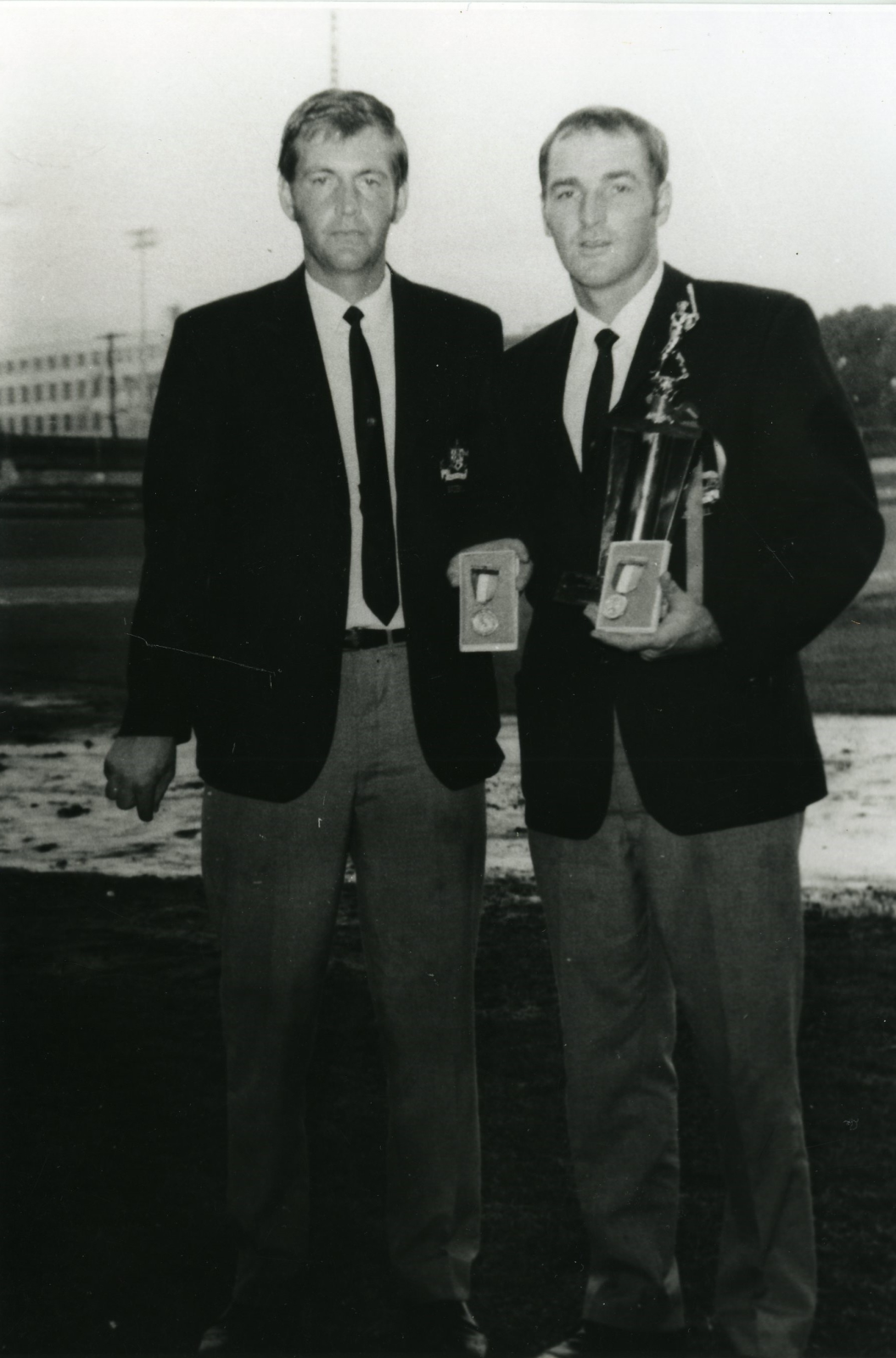
Dale Hughes (left) and Ray Cook.
Photo courtesy of Eastern Goldfields Historical Society.
Meanwhile, although the competition in Kalgoorlie was strong, players gradually began to move away from the town and suddenly, after 30 years, the sport began to wane as teams dropped out of the competition. Baseball disbanded in Kalgoorlie in the late 1960s due to a lack of interest, work commitments and the downturn in the mining industry.
By 1967, Goldfield’s baseball was defunct. The attempt to rejuvenate junior baseball as a strategy to replace the older players was also not as successful as anticipated.
At the same time, development of baseball competitions in other country areas thrived, with Newman, South Hedland, Dampier and Goldsworthy operating successfully.
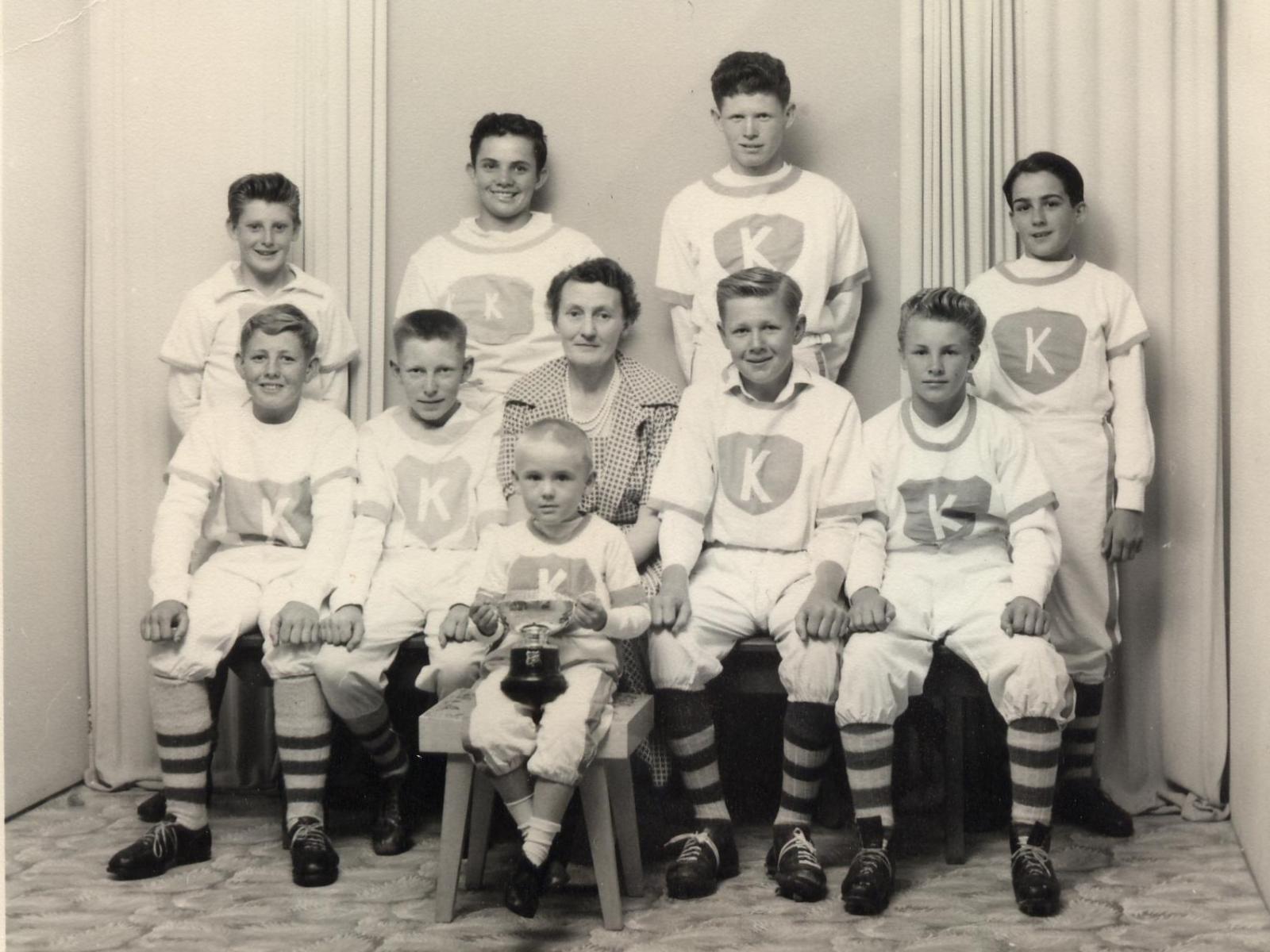
1963 Kalgoorlie Junior Baseball Team.
Back row (L-R): ???, Ernie McCreed, Ian Livingstone, Gary Pope.
Front row (L-R): Peter McCabe, Trevor Havenberg, Doreen Fraser, Kerry Hosking, Ernie Shackleton.
Mascot/Batboy holding trophy: Alan Mason.
Photo courtesy of David Fraser, Kalgoorlie Baseball Club Captain.
CHAPTER 5:
1970s – A rough diamond again
Baseball was reintroduced in Kalgoorlie in 1977, but the revival was short-lived as it folded again in 1984 at senior level. Barry Dickinson and Phil Reeve were instrumental in its initial reintroduction.
Neale Harvey, a local player and journalist, succinctly encapsulates the efforts to maintain baseball and to keep it alive on the sporting calendar and landscape in Kalgoorlie. He wrote:
“Goldfields Baseball League officials have struck out in their efforts to keep the sport alive in the region. For the second time in nine years, the sport has folded because of a lack of interest among players. The league’s winter season was by now meant to be in full swing, but treasurer Phil Henley this week confirmed any efforts to get the competition off the ground have been shelved.
"The setback marks the third time baseball has folded in Kalgoorlie-Boulder because of severe player shortages. Baseball enjoyed a very high profile in the Goldfields in the late 1960s, when it dominated the country championships and provided several State and Australian representatives, but folded late in the decade.”
Although baseball was in recession in the Goldfields, this did not deter players from making their mark at the State and National levels. Dale Hughes continued to make an impression through moving to Queensland as part of his employment opportunities in 1970 and was immediately appointed state manager of the Queensland team for the Claxton Shield series. In 1973, Japan toured Australia and he was then appointed Australian coach.
A new lease of life for baseball appeared in October 1978 as baseball made a comeback after an absence of 12 years. There was a resurgence of the Goldfields Baseball League with four teams established – Jets, Toyota Tigers, Pumas and Palace Blue Sox. Games were played at the D.R. Morrison Sporting Complex.
There was also a revival in the WA Country Baseball Carnival which had seen the Goldfields as the most prominent team for many years. They had been the trendsetters for well over a decade prior to the sport becoming defunct in the 1960s. Brian Harvey was appointed coach for the team to contest the North-West Championships in Geraldton over the Easter weekend and the team contained some Under-18 youngsters, including Greg Harvey, Pat Noonan and Bruce Guild.
Barry Dickinson and Phil Reeve were instrumental in the revival of baseball in the town at this time. Barry, son of the famous George Dickinson and having previously played for South Perth, recalls running an advertisement in the local 'Kalgoorlie Miner' to gauge interest in forming a new baseball competition. The advertisement informed interested persons to gather at Usher Park at the bottom of Hannan Street on a particular Saturday morning. Phil, being a radio announcer, was also able to promote the advertisement on air.
“The League was organised following the very positive response from local players. Four teams were formed from the many that came that Saturday morning or joined later when word got around about the formation of a new baseball league. Establishing a vibrant junior baseball competition was also not neglected.” – Barry Dickinson.
Other influencers behind the revival were:
Mr Brian Reeve – President
Mr Barry Scott – Vice President
Mr Ted Dorotich – New President
Mr David Fraser – Secretary
Mr Phil Reeve – Treasurer and Radio Support
Mr Brian (Butch) Harvey – Junior Vice President – Toyota Tigers Coach
With the formation of a league, the four teams’ competition was fierce for initial honours over 15 qualifying games. Most teams were also able to support a reserves and junior team.
- Palace Blue Sox – Colours White/Blue – sponsored by Palace Hotel – winners of two grand finals against Toyota Tigers.
Players: Barry Dickinson, Glen Weir, Steve Epps, Rod (Bomber) Fletcher, Jim Pearson, Eric Pearson, Peter Junkers, Matt Sheminant, Ted Dorotich (President). - Toyota Tigers – Colours White/Red – sponsored by Kalgoorlie Toyota.
Players: Brian (Butch) Harvey, Greg Harvey, Trevor Cruickshank, Don Cruickshank. - Pumas – Colours Black/White –
- Jets – renamed Tower Wolves – Colours Black/Orange – Kevin Peart (Coach).
Kambalda (Colours Maroon/Gold) also formed a team and entered the competition later on.
Toyota Tigers were the inaugural minor premiers in 1978, losing one sensational qualifying game to Jets. Down 21–0 in the first innings, the Tigers recovered to finally lose 22–21 but lost the grand final to Palace Blue Sox 18–11. From that game the League had its first tribunal hearing, with Tigers Coach Brian Harvey being ejected from the game.
Barry Dickinson noted that: “The League successfully conducted two Veterans v Rookies fixtures during the season. The criteria for these games were current league players versus the former league players of the 60s. The veterans included former national representative Colin Trezona, State representatives Grenville Kelly and Kevin Peart and State Junior representative Brian Bird and Goldfields greats such as Calvin Wilson, Geoff Cairnduff, Ernie Shackleton, Don Pettit and Alan Spence”.
The Veterans won the first game but lowered their colours in the second. An amazing 1000 spectators were overawed by the wizardry of the Veterans and the enthusiasm and determination of the Rookies.
The enthusiasm for the new League also inspired many former players to appear in the competition including Kevin Peart as coach of Jets.
The League winners for the 1979 season were:
• Fairest and Best: John O’Hare (Pumas)
• Golden Bat (Batting average): Don Cruickshank (Toyota Tigers)
• Rookie of the Year: Trevor Cruickshank (Toyota Tigers)
Teeball and junior baseball were also continually encouraged through a nucleus of teams in the local competition.
To demonstrate the strength of the Goldfields League, a combined Goldfields team hosted a game against a composite Australian team at the Sir Richard Moore Sports Centre in July 1979. The Kalgoorlie team were outplayed and lost 8–0, a not-unexpected result. However, the Australian team was star-studded with senior Australian and Australian Under-18 representatives. Don Kyle won the gold nugget as the MVP. To balance the game more evenly, Australian pitcher Ray Michell played for the Goldfields team. With so many renowned players and coaches in town, coaching clinics were also held to improve the skills of the locals.
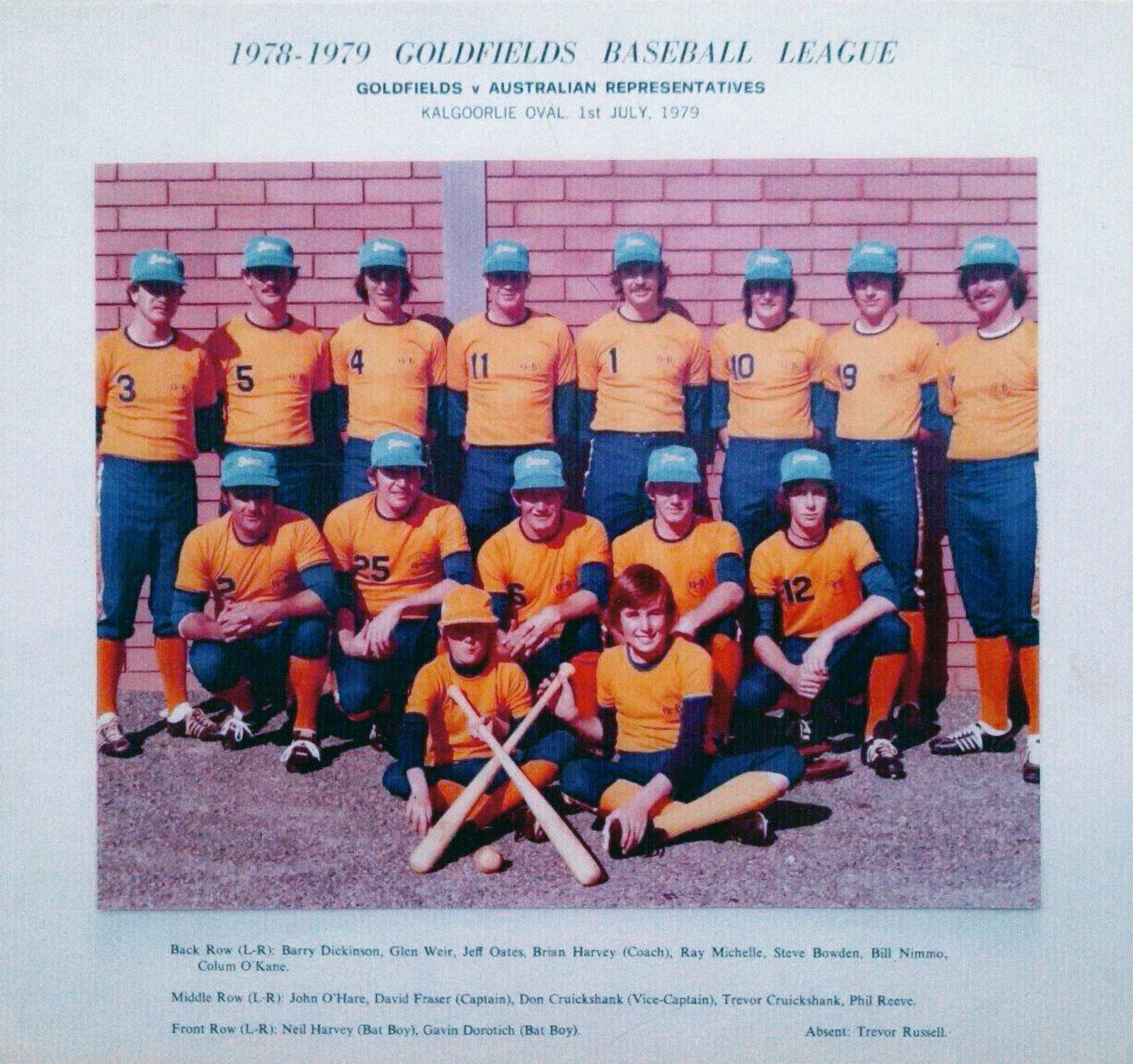
1978–1979 Goldfields Baseball League.
Goldfields v Australian Representatives – Kalgoorlie Oval,
1st July 1979.
Photo courtesy of David Fraser.
|
Goldfields Team Ray Michell (Australian Rep) – Guest Neale Harvey (Bat Boy) |
Australian Team Rod Byrne (Coach & player) Joe Hughes (Umpire)
|
While there was emphasis on developing players, the WABL Umpires' Association ensured that the recruitment of umpires was just as important. Through camps and seminars, the quality of umpiring in all country regions greatly improved and Perth umpires even travelled to country regions to umpire in grand final games.
One such umpire was Ken Smith, who had moved to Perth and later became involved in umpiring in Rockingham. Born in 1953, he retired in 2013 after 34 years behind the plate. The Kalgoorlie Miner reported his outstanding umpiring record of a remarkable 1957 games, including 89 Claxton Shield and National League games and an appearance at the 1987 Festival of Sport held in Perth between Australia, Japan, Korea and China. In a State League final of 22 innings between Melville and Morley, he called 580 pitches over almost 7 hours of play and estimates he made only two wrong calls!!
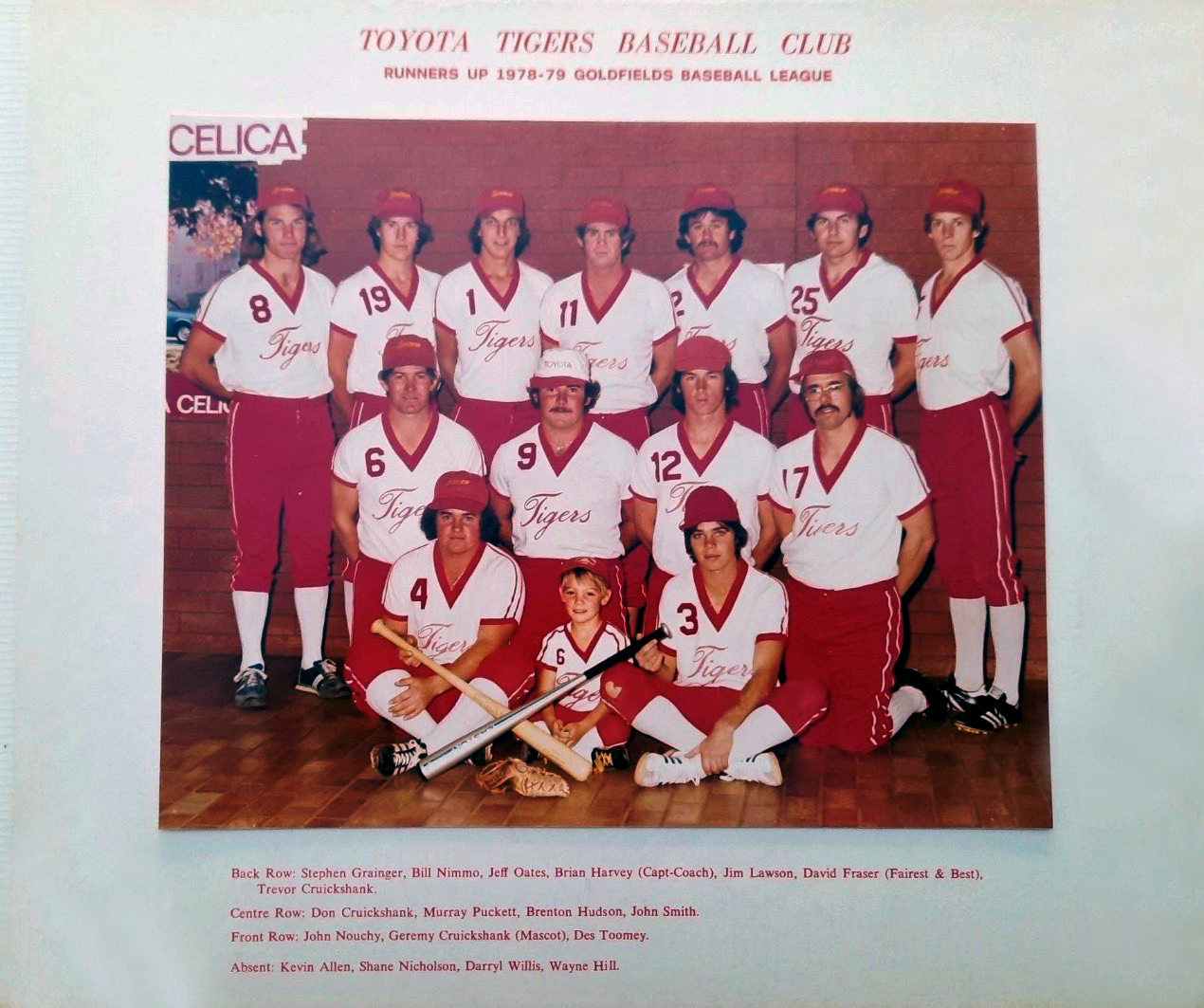
1978–79 Toyota Tigers, runners-up Goldfields Baseball league.
Photo courtesy of David Fraser.
CHAPTER 6:
1980s and 1990s – A diamond begins to surface again
The 1981–82 WABL Annual Report reported that baseball was mushrooming right through the State. WABL President Neville Pratt was instrumental in congratulating the success of affiliated Country Leagues, which had provided widespread opportunities for youngsters to play the sport and had produced some of Australia’s greatest individual sportsmen.
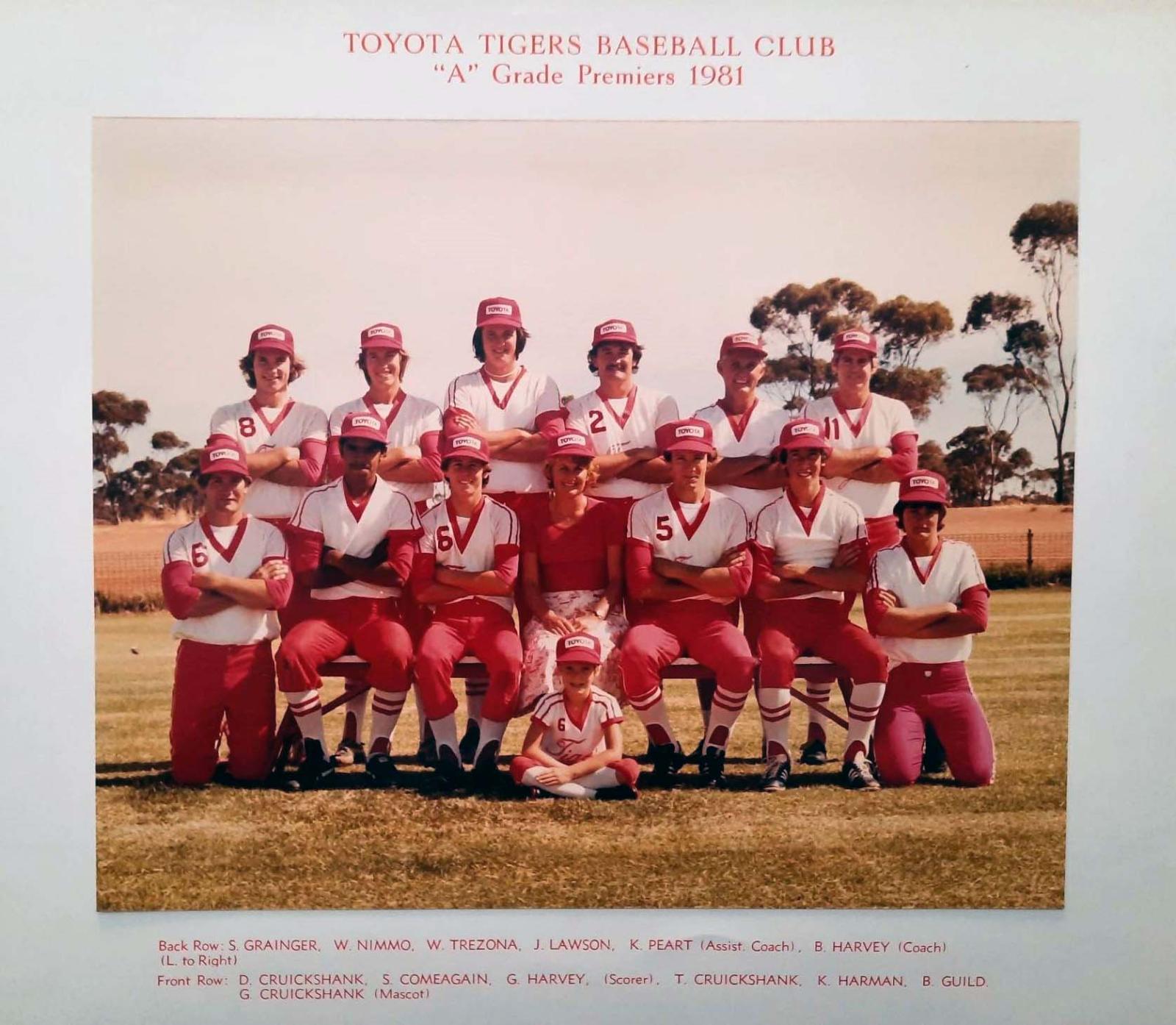
1981 Toyota Tigers Premier Team.
Photo courtesy of Brian Harvey.
The revival of baseball in Kalgoorlie started to unearth some depth in talent in the junior ranks but in order to develop their careers at a higher level, again they had to make sacrifices and constantly travel to Perth. Colin Guest, a State coach at that time, saw the potential in Neale Harvey (pitcher), his brother Greg (pitcher and catcher) and Robbie Payton. As 17-year-olds, they travelled to Perth on a weekly basis on the Indian Pacific train, which enabled them to take a sleeper, and then be billeted with the Thurley family.
Both Neale and Greg represented WA and Australia at Junior level. Neale pitched for Australia at the World Youth Series in Canada in 1986 when selection comprised of a five-day training camp. At that time there was “no formal development program in place, funding was not available, and complete strangers were thrown together”.
Although he played State league in Perth for Cockburn Braves, Neale retired at a relatively young age to concentrate on a cadet journalist position with the Kalgoorlie Miner; a role he still retains at the time of writing.
Greg was rewarded with not only representing WA in the Under-18 competition in Canberra and then Adelaide but also being selected to represent Australia in a trip to the USA. The team was based in Georgian Southern College for several weeks and exposed to the routine of training and playing regular games under the tutelage of Jack Stallings, a famous US coach.
There is no doubt that State coaches saw the great potential in Greg but in order to further his career at the senior level, he had to play regular State League baseball. This required travelling to Perth by car with his mate Wayne Trezona (son of Kalgoorlie icon Colin), to play for Wembley. He later transferred to Wanneroo but as Doug Mateljan was the catcher, Greg took to the short stop position because he had a ‘rocket arm’.
Greg played Claxton Shield in 1984, 1985,1986, 1987 and 1988 and was finally rewarded with winning the Golden Glove Award and selected to represent Australia at the 1988 Seoul Olympics. At that tournament he was named in the World All-Stars team.
Unfortunately, Greg’s career came to an end after a series of arm and knee issues which required long periods of rehabilitation after surgery. Mentally, physically and emotionally it was a very taxing period and after playing for Rockingham he decided it was time to quit the game and return to Western Mining in Kalgoorlie.
By 1986, the sport had once again become defunct. An attempt to relaunch the league in 1984 had also failed. The 1986 decision to shelve the competition was made after two registration days earlier in the year attracted only enough players for two teams.
The decline of baseball in Kalgoorlie was evident in 1985 when a Kalgoorlie team failed to participate in the NW Championships. Yet baseball continued to prosper in other country towns such as Port Hedland, Exmouth, Geraldton and West Pilbara. At the same time a National Country Championship was established in Canberra, with Port Hedland intending to participate. It would have been interesting to see how a Goldfields team would have fared in the national arena in the early years.
By 1985, it would appear that the Goldfields Baseball League was disbanded, although a Junior Goldfields Baseball League was formed on 27 November 1985. Little interest was being shown even at the Under-15 level. Brian Harvey, a stalwart of Kalgoorlie baseball, was elected President of the Junior League and he attempted to maintain interest in the Under-13 level by initiating ‘teeball’ and encouraging the broadening of the baseball base.
With the formation of a junior league, Kalgoorlie played host to Carine and Wanneroo Pee Wee baseball teams and the WA Junior Baseball League were requested to send coaches to assist in the development of the game. The 'Summer Cup' was introduced in the Christmas recess of 1985/6 and the competition was won by CBC Bluesox team who defeated Toyota Tigers by the odd run.
Baseball WA provided regular visits to the Goldfields through their Development Officer commitments.
Brian Harvey recalls that in the 1980s “a State Under-13 squad was brought to Kalgoorlie as a promotional and training clinic which was very beneficial for the game in Kalgoorlie and several local players were identified with potential in the sport. Don Thurley and Tony Brannigan, the State coach, were quite successful over the years with this endeavour. Several boys were invited to attend State training in Perth following the clinic”.
The State Under-18 squad was also brought to Kalgoorlie to play a Goldfields team with the game contested on Kalgoorlie Oval. The State team was coached by Colin Guest and Brad Kirk.
A live-in coaching camp was held in Kalgoorlie for junior players with 40 players and five coaches accommodated at the Eastern Goldfields Camp School (the old Goldfields Senior High School). The training sessions were held at the Cruikshank Sports Arena, and players endured a 0600-hours early morning exercise routine.
With this exposure to improved training, seven boys were invited to train in Perth with the State squad. Four of them represented WA Under-18s in Adelaide in 1982 and two (Greg Harvey was one of them) were later selected in the Australian squad on a USA tour.
As mentioned previously, Neale Harvey was also selected in 1986 to represent Australia in the Under-18 team in the World Youth Series in Windsor, Canada.
In March 1994 a rookie ball demonstration drew more than 100 youngsters to the D.R. Morrison Oval. The visit was in response to the Goldfields formally reviving the sport the previous year. Baseball WA Development Officer, Sean Jones’ visit was accompanied by Neville Pratt, who had grown up in Boulder and gone on to achieve great things in local and Australian baseball through playing and administration. Treasurer Phil Henley was pleased with the success of the visit and demonstration as a prelude to the launch of the junior competition later that year.
Meanwhile, Goldfields League Baseball was revived in 1997, and the 1998 final saw the inaugural ‘Tom’s Tyres Cup’ contested between the Blazers and the Phantoms. George Warrilow, a former Claxton Shield pitcher, assisted the Blazers to get over the line in a 7–6 thriller. Darren Guild, vice-president of Goldfields Diamond Sports, was buoyant with the running of the game locally, but was disappointed that the junior baseball competition had failed to develop to expectations. It was identified that unless junior baseball was developed, particularly through schools, “the game could fold in a couple of years”.
CHAPTER 7:
2000s – The sparkle of the diamond disappears
In August 2006, the Kalgoorlie Miner reported that junior baseball was to be officially relaunched after a long absence. There was a focus on resurrecting under-age teams at the Under-16 and Under-14 levels. There had been some success in 2005 to lay the foundation, with umpire Rod Hannigan instrumental in its development. Interest in teeball had grown and the Goldfields Oasis Playing Field was well equipped with club rooms, toilets, canteen and ground lighting.
Neale and Greg Harvey were instrumental in facilitating the coaching clinics with a view to providing structured training programs and a player flow-through to junior baseball.
To support the venture, Baseball WA organised an interstate clash between the South Australian Bite and Perth Heat, staged at Boulder’s Digger Daws Oval on November 10.
This was the first high-profile game of baseball to be staged in the Kalgoorlie region since the 1979 game between the Goldfields and the Australian (WA) side. The Heat managed to salvage the game with a come-from-behind 10–10 draw.
Three years later, the Heat returned for the clash again against South Australia in Boulder. Seen as a major growth area for Baseball WA, school visits and instructional sessions were also organised. Perth was out-hit in an eventual 12–4 loss. The game finished early as three light towers went down, which greatly affected visibility.
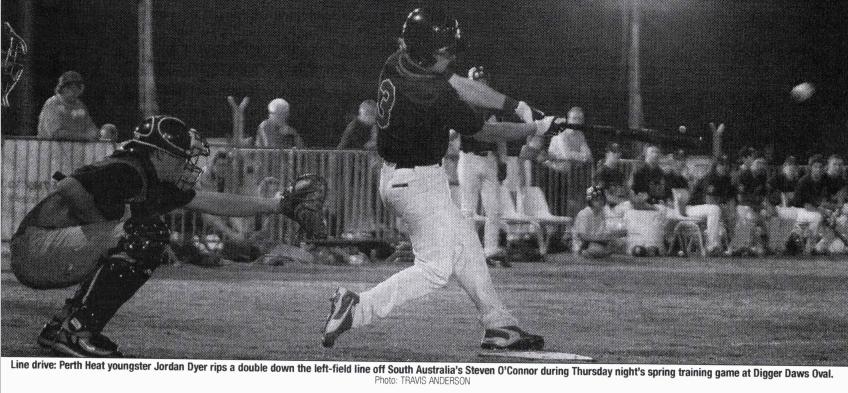
Perth Heat playing in Boulder.
Photo by Travis Anderson.
Unfortunately, in spite of huge efforts by Baseball WA, former players and local people, junior baseball eventually folded. In 2018 there was an attempt to resurrect junior baseball through the efforts of Tina Kippin, Robyn Fowler and Baseball WA.
Part of the problem lay in the reluctance of teeball to adapt their age groups and some of their rules to allow the introduction of a pitched ball. This effectively killed off the player flow to baseball. As a result, it was estimated that seven 13-years-and-under teams and the equivalent of 80 players were lost annually to junior baseball as a result of no second-tier feeder program. It was a frustrating situation trying to retain players and interest, and the situation has still not been satisfactorily rectified by all accounts.
However, the Goldfields can look back on its baseball history with pride as it produced such a great wealth of baseball gems from a deep pit that contributed heavily to the wealth of Western Australian and Australian successes. Hopefully, there is time for the diamond to re-emerge, be dusted off, shined up and sparkle once again.
APPENDICES
GOLDFIELDS BASEBALL INDUCTEES IN THE GOLDFIELDS SPORTING HALL OF FAME
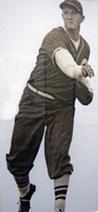
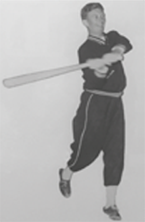
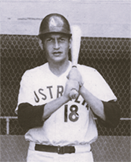
Photos courtesy of the 'Kalgoorlie Miner'.
Greg Harvey was inducted in 2006
Born in Kalgoorlie in 1964, Harvey was a talented baseballer from a young age. He played for Western Australia many times including the 1985 winning Claxton Shield team as a shortstop fieldsman. Two years later he was awarded the Golden Glove after being voted the best defensive player at the 1987 interstate Claxton Shield series. He subsequently represented Australia at the Seoul Olympics in 1988, and from that series he was named in the World All-stars team.
Colin Trezona was inducted in 2011
Born in Kalgoorlie in 1935, Colin Trezona was an exceptionally talented all-round sportsman. Twice an All-Australian baseball pitcher in 1965 and 1966, he also topped the batting averages at the Claxton Shield series in Sydney in 1965.
Neville Pratt was inducted in 2014
Born in Boulder in 1930, Pratt was introduced to baseball on the Goldfields, rising to become one of Western Australia’s and Australia’s finest players. He was also an outstanding Goldfields cricketer and sports administrator, being appointed President of the Australian Baseball Federation from 1987–1998 and voted Administrator of the Year by the International Baseball Federation.
Dale Hughes was inducted in 2014
Dale eventually cast aside cricket and football to concentrate on baseball and was rewarded by representing WA at the Claxton Shield in 1961 and later the All-Australian teams in 1963, 1965 and 1969. He represented WA in Claxton Shield over 10 years. He later became coach of Queensland in 1973 and coached Australia v Japan in the same year.
REFERENCES
Baseball WA, 2021, 'Oral history – Dale Hughes', Collections WA website (collectionswa.net.au).
Crutchett, Brian, Personal scrapbook of The West Australian newspaper articles, 1951/1952/1953/1954.
Dickinson, Barry, Notes, Apr. 7, 2023.
Fraser, David, Notes on Goldfields Baseball League, Jul. 1979.
Fraser, David, Notes, Feb. 6, 2023.
Goldfields Sporting Hall of Fame (www.goldfieldssportsstaroftheyear.com/hall-of-fame)
Harvey, Brian, Notes, May 15, 2023.
Harvey, N. 1982, 'Goldfields to Contest Baseball Series, Kalgoorlie Miner, Jan. 6.
Harvey, N. 1994, 'Baseball Star to give Goldfields Top Priority, Kalgoorlie Miner, Mar. 16.
Harvey, N. 1998, 'Blazers are Goldfields Baseball Champions', Kalgoorlie Miner, Aug.19.
Harvey, N. 2006, 'Green light for big clash', Kalgoorlie Miner, Jul. 27.
Harvey, N. 2006, 'Building on baseball revival', Kalgoorlie Miner, Aug. 4.
Harvey, N. 2006, 'Heat ready to fire, Kalgoorlie Miner, Nov. 9.
Harvey, N. 2006, 'Heat snatch a draw', Kalgoorlie Miner, Nov. 13.
Harvey, N. 2007, 'Baseball‘s Glory Days', Kalgoorlie Miner, May 23.
Harvey, N. 2008, 'Mystery Stumps Experts', Kalgoorlie Miner, Nov. 8.
Harvey, N. 2009, 'Heat, SA ready to clash', Kalgoorlie Miner, Sept. 23.
Harvey, N. 2009, 'Baseball Deeds Well Chronicled', Kalgoorlie Miner, Oct. 10.
Harvey, N. 2009, 'Players will feel the Heat', Kalgoorlie Miner, Oct. 22.
Harvey, N. 2009, 'The Heat is on', Kalgoorlie Miner, Oct. 24.
Harvey, N. 2010, 'Sports star had spades of skill', Kalgoorlie Miner, Feb. 20.
Harvey, N. 2010, 'Taking time out for a well-earned daydream', Kalgoorlie Miner, Aug. 14.
Harvey, N. 2011, 'Pocket dynamo led way for WA baseball', Kalgoorlie Miner, Oct. 22.
Harvey, N. 2015, 'Smith at Home Plate', Kalgoorlie Miner, May 22.
Harvey, N. (date ?) 'One Name Needed for Baseball Photo', Kalgoorlie Miner.
Harvey, N. 2016, 'All-rounder cements place among elites', Kalgoorlie Miner, Nov. 12.
Harvey, N. 2018, 'Committee of two focus on juniors', Kalgoorlie Miner, Jul. 16.
Harvey, N. 2018, 'Loss of a Stalwart Mourned', Kalgoorlie Miner, Oct. 23.
Interview with Greg Harvey, 4 May, 2023
Kalgoorlie Miner, 'Baseball: Glances at the Past' By "Shortstop", Jul. 17, 1947.
Kalgoorlie Miner, May 18, 1968.
Kalgoorlie Miner, Aug. 23, 1978.
Kalgoorlie Miner, Dec. 9, 1978.
Kalgoorlie Miner, Jan. 31, 1979.
Kalgoorlie Miner, May 30, 1979.
Kalgoorlie Miner, Jun. 21, 1979.
Kalgoorlie Miner, Jun. 28, 1979.
Kalgoorlie Miner, Jul. 3, 1979.
Kalgoorlie Miner, May 18, 1993.
Kennedy, P. 2016, 'Dale Hughes honoured in Kalgoorlie', Kalgoorlie Miner, Dec. 9.
Smith, Colin 2023, 'My association with Jim Puckett”. Personal notes, Apr. 28.
The West Australian, Jun. 22, 1954.
West Australian Baseball League Annual Report 1956–1957, p3.
West Australian Baseball League Annual Report 1975–1976.
West Australian Baseball League Annual Report 1981–1982, p3.
West Australian Baseball League Annual Report 1984–1985.
West Australian Baseball League Annual Report 1985–1986.
Wilson, Calvin, Notes, Apr. 28, 2023.
The Western Mail 'Baseball on the Goldfields', Aug. 27, 1936.
Trove Research by Brian Harvey:
• Kalgoorlie Miner, May 8, 1950.
• Kalgoorlie Miner, Jun. 10, 1950.
• Kalgoorlie Miner, Jun. 13, 1950.
• Kalgoorlie Miner, Jun. 17, 1950.
• Kalgoorlie Miner, Jun. 19, 1950.
• Kalgoorlie Miner, Jun. 24, 1950.
• Kalgoorlie Miner, Jun. 26, 1950.
• Kalgoorlie Miner, Jun. 30, 1950.
• Kalgoorlie Miner, Jul. 8, 1950.
• Kalgoorlie Miner, Jul. 11, 1950.
• Kalgoorlie Miner, Jul. 14, 1950.
• Kalgoorlie Miner, Jul. 17, 1950.
• Kalgoorlie Miner, Jul. 21, 1950.
• Kalgoorlie Miner, Jul. 26, 1950.
• Kalgoorlie Miner, Jul. 28, 1950.
• Kalgoorlie Miner, Aug. 3, 1950.
• Kalgoorlie Miner, Aug. 4, 1950.
• Kalgoorlie Miner, Aug. 7, 1950.
Trove Research by David Fraser:
• Sun, Nov. 7, 1909.
• Kalgoorlie Miner, Dec. 1, 1909.
• The Western Mail, Aug. 27, 1936.
• Kalgoorlie Miner, Aug. 31, 1936.
• The Western Argus, Sept. 1, 1936.
• The Goldfields Observer, Apr. 4, 1937.
• New Call & Bailey’s Weekly, Apr. 15, 1937.
• Kalgoorlie Miner, Jun. 25, 1937.
• Kalgoorlie Miner, Jul. 10 1937.
• Kalgoorlie Miner, Aug. 3 1937.
• Kalgoorlie Miner, Aug. 18 1937.
• Kalgoorlie Miner, Jun. 25, 1938.
• The Western Argus, Jul. 13, 1938.
• Kalgoorlie Miner, Jul. 22, 1938.
• Kalgoorlie Miner, Sept. 10, 1938.
• Kalgoorlie Miner, May 4, 1940
• The West Australian, Sept.24, 1946
• Kalgoorlie Miner, Dec. 1, 1946
• Kalgoorlie Miner, Jul. 17, 1947
• Kalgoorlie Miner, Oct. 4, 1947
• Kalgoorlie Miner, May 24, 1948
• Kalgoorlie Miner, 1949.
• The West Australian, 1949.
• Kalgoorlie Miner, 1949 Grand Final