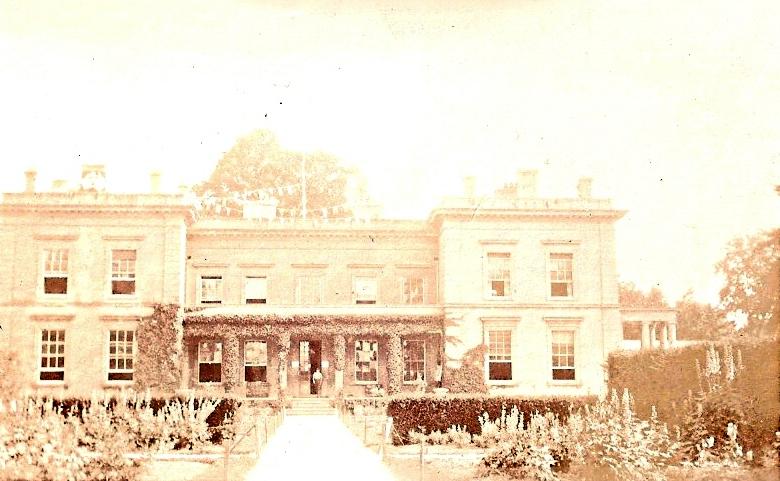
Interwar, England Sutton Veny, YMCA "Greenhill House", 51 Battalion, 1919
1919Green House, YMCA at Sutton Veney
Proximity to Warminster and Salisbury Plain ensured that Sutton Veny and the surrounding villages in the upper Wylye Valley area, was an ideal location to barrack troops in order for them to train prior to deploying to northern France.
Sutton Veny consisted of ten individual camps including a hospital adjacent to the most northerly of the camps. The main camps were in Sutton Veny and Codford; One of those camps was known as Sand Hill camp near Longbridge Deverill, built in 1914 to accommodate infantry units, and taken over by the Australians in October 1917 to be the Overseas Training Brigade's base which had relocated from Perham Downs. Earlier, in December 1916 the No 1 Australian Command Depot moved to Sutton Veny where it remained until 1919. After the Armistice, No 1 Australian General Hospital was transferred to Sutton Veny where it remained until the end of 1919.
At the time Greenhill House was situated in the midst of the largest Australian Imperial Force training and convalescent depots in Great Britain. This mansion, consisting over 50 rooms and with spacious lawns and grounds offered ideal possibilities for rest and recuperation for war weary troops.
In late 1918 and 1919 Spanish Influenza was particularly virulent and many Australian died. The names of 142 Australians and 2 Sisters are recorded in the Australian Chapel in St John's Church, and they are interred in the grave yard.
In 1919 the AIF formed an agricultural training depot at Sutton Veny to prepare and train soldiers for returning to civilian life. At the end of 1919, Australian troops had all left for home, and the huts were demolished and the camp railway lifted
Details
Details
AMWA41333
The YMCA was founded in 1844 during the Industrial Revolution in England, a time of great despair and poverty. George Williams, a drapery merchant, decided that something had to be done. He gathered together a few friends to form a society that met regularly to support each other and gain renewed strength in body, mind and spirit. The group called itself the Young Men's Christian Association (YMCA).
The official opening of the YMCA association in Western Australia, based in the Eastern Goldfields was in 1902. Perth soon followed suit with its first association official formed in 1908, after receiving a donation of land on Murray Street in the city. Throughout its history YMCA Perth has held a focus on working with young people through activities such as sports, camps, arts, leadership programs and services such youth work and youth hostels. From 1914-1918, YMCA Perth provided services in a peacetime military camp and for armed services in Australia and war fronts. During the depression YMCA Perth helped in the sustenance of workers, held classes for unemployed young people and provided an employment bureau. From 1940-1945, YMCA Perth staff and volunteers help servicemen and women in war, and from 1946-1961 continue to proved service to peacetime armed services and trainees.
Open in Google Maps
Nearest geotagged records:
Australian Army Museum of Western Australia
Australian Army Museum of Western Australia
More items like this


Other items from Australian Army Museum of Western Australia
-
Interwar, England London Wandsworth, 51 Battalion, 1919
-
Interwar, England Kent, 51 Battalion, 1919
-
World War 1, England Kent, 51 Battalion, 1919
-
Interwar, England Hurdcott, 51 Battalion, 1919
-
World War 1, Europe Dinant, German Cemetery, 1919
-
Interwar, Europe, 51 Battalion, 1918
-
World War 1, Australia, Duntroon, 51 Battalion, 1917
-
Interwar, Europe, DORSCH, MAGAREY, Australian Army Nursing Service, 1919
-
Interwar, Europe, TSS Indarra, 51 Battalion, 1919
-
Interwar, Europe, 51 Battalion, 1919
-
World War 1, Europe, German officer, 1919

-
Interwar, Europe Denant, 51 Battalion, 1919